
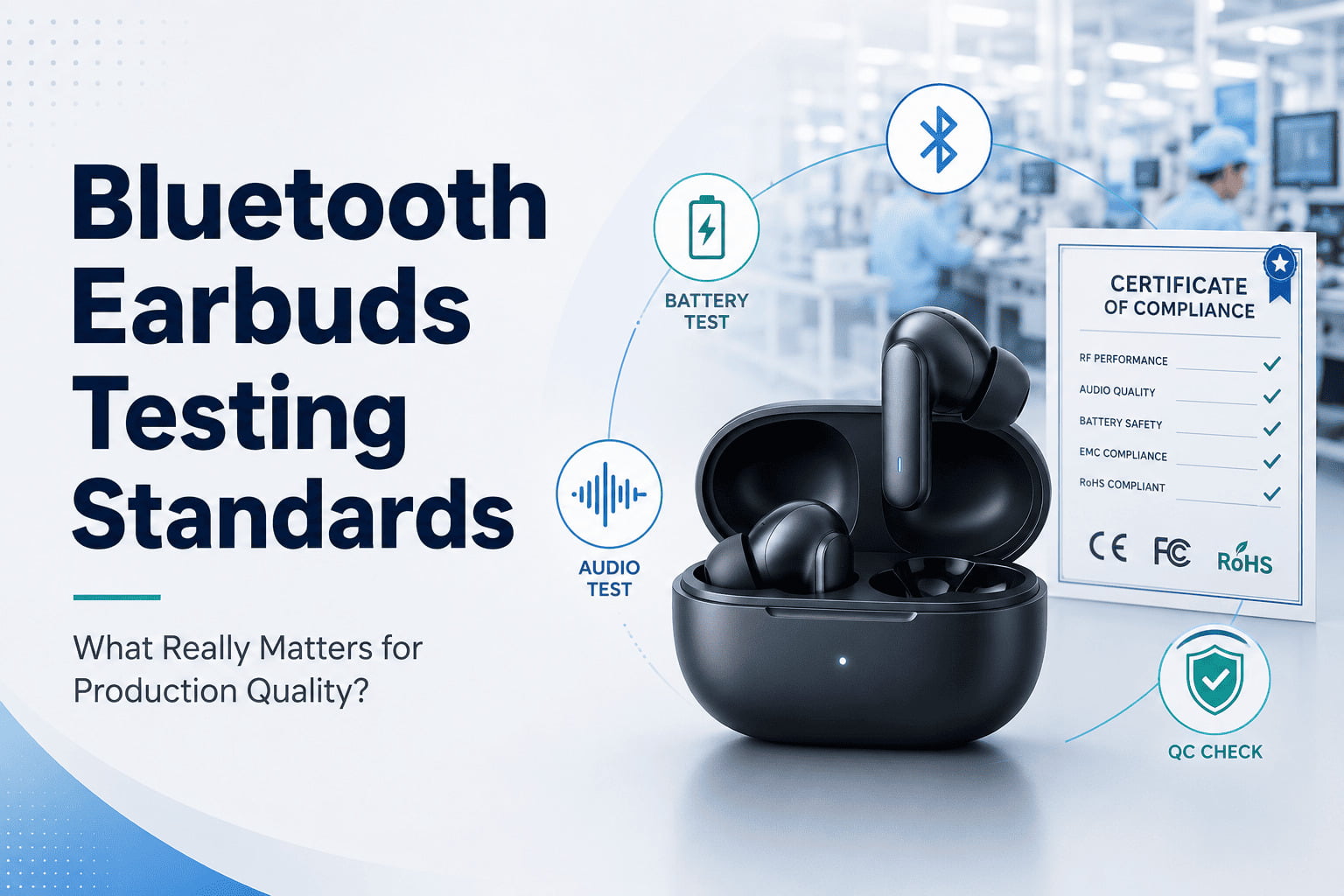
What Do Bluetooth Earbuds Testing Standards Really Tell You?
Worried your next batch of Bluetooth earbuds won't match the perfect sample? Many B2B buyers like you face the frustrating gap between initial samples and inconsistent mass production. This often comes down to misunderstandings about factory quality control.
Bluetooth earbuds testing standards, beyond basic certifications, are designed to confirm a supplier's ability to consistently reproduce sample quality in mass production and effectively control defects before products ever leave the factory floor, ensuring stability and reliability for your brand.
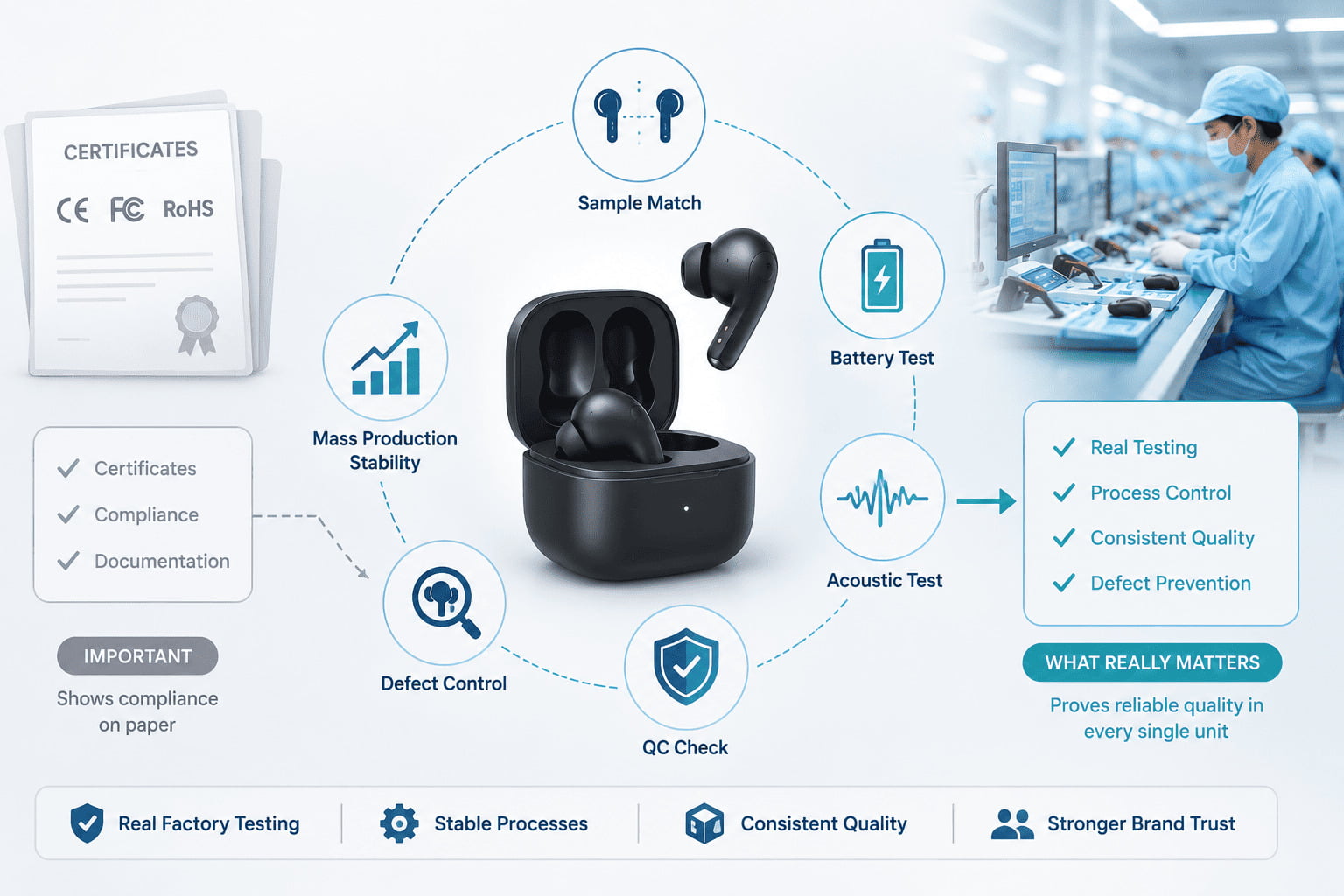
When you're sourcing Bluetooth earbuds, knowing the real story behind "testing standards" is crucial. It’s not just about ticking boxes for certificates; it’s about understanding the hands-on quality control that ensures every single unit meets your expectations. Let me show you what we focus on inside our factory.
Are Certificates Enough to Guarantee Production Quality?
You've landed a great sample, and the factory has all the right certifications. But then the bulk order arrives, and suddenly, performance issues pop up. This disconnect frustrates many buyers, leading to higher after-sales costs and damaged brand reputation.
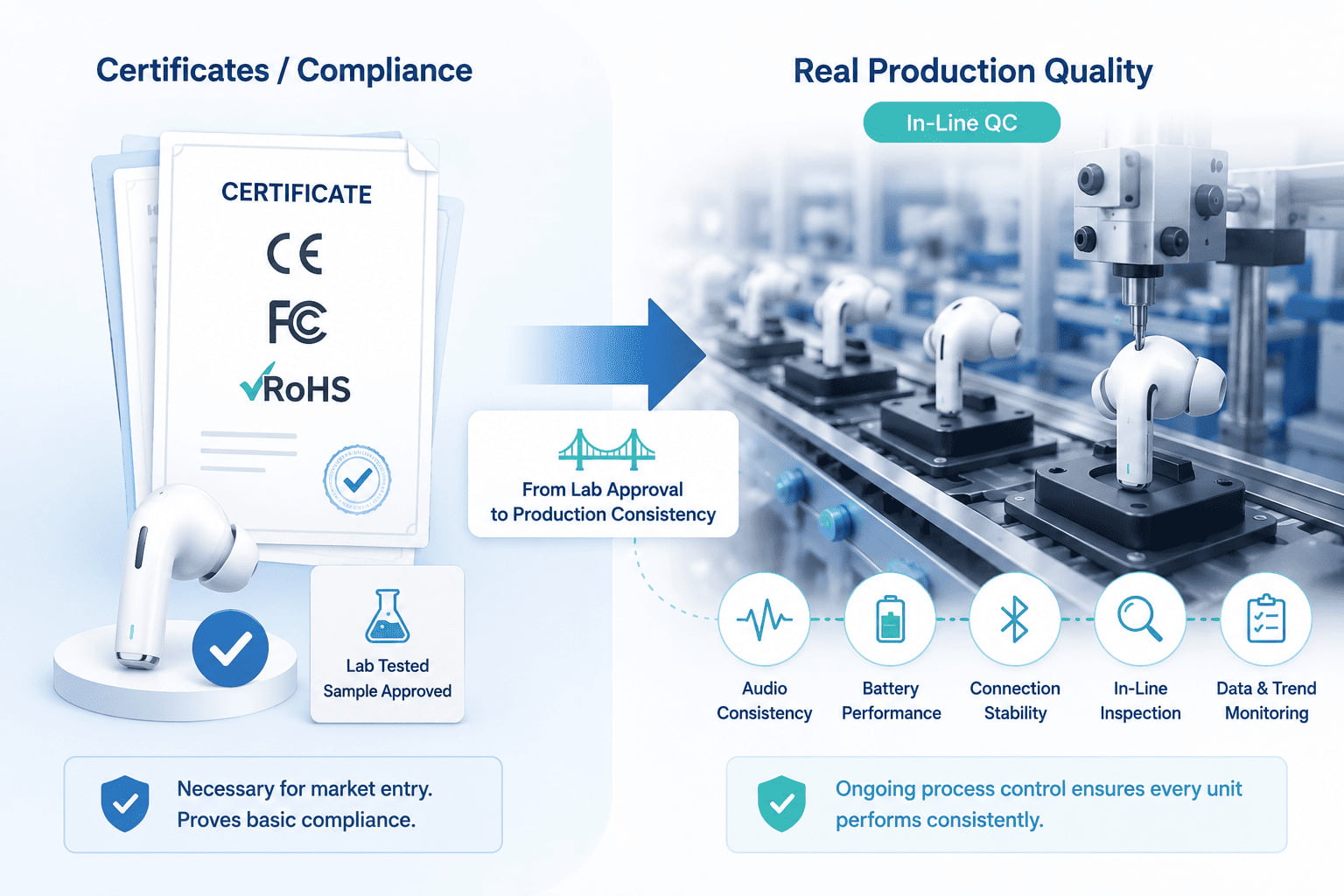
Certificates like CE, FCC, and RoHS confirm basic compliance for market entry, but they do not inherently guarantee consistent performance, audio stability, connection reliability, or battery life across every single batch of your mass-produced Bluetooth earbuds.
Why Compliance Documents Don't Tell the Whole Story
From my experience on the factory floor, I see buyers often equate a stack of certificates with assured product quality. While these documents are absolutely necessary for legal market access – proving things like electromagnetic compatibility (EMC)1 or hazardous substance restrictions – they represent a baseline, not a guarantee of consistent excellence in mass production. For instance, a CE certification means a product meets essential European health, safety, and environmental protection requirements2. FCC approval indicates that its electromagnetic interference is within limits for the US market3. RoHS compliance restricts specific hazardous materials4. These are vital tests, usually performed on initial samples in a certified lab. However, they don't monitor the day-to-day variations that can occur on a busy production line. A single approved sample doesn't predict how 100,000 units will perform. We know that small changes in component batches, assembly line calibration, or even ambient factory conditions can subtly affect performance5. This is why our internal production quality control (PQC) goes far beyond what certifications cover. We focus on the ongoing, dynamic checks to ensure what you experienced with the sample is replicated for every single earbud in your order.
The Gap Between Lab and Line
Certifications are like a driver's license – they prove you can drive safely under specific conditions. But they don't predict if you'll hit traffic every day or how you'll handle a flat tire. In the same way, laboratory testing for certifications is often done in controlled environments, using carefully selected samples. What happens when the production line is running at full speed, with different batches of components, and multiple operators? That's where the real challenge lies. For us, this means implementing rigorous in-line checks that continuously verify audio consistency, connection stability, and battery performance, aspects that a static certificate can't provide. We understand that buyers need confidence that every earbud will deliver the same clear sound, strong connection, and reliable charge. That level of assurance comes from comprehensive, continuous testing during the manufacturing process itself, not just a one-time lab approval.
Is a Flawless Sample Always a Promise of Mass Production Consistency?
You've received and approved the golden sample, a perfect representation of your desired product. But then the first bulk shipment arrives, and suddenly, you're hearing complaints about inconsistent pairing, weak audio, or unexpected charging issues. This common problem often leaves buyers wondering what went wrong.
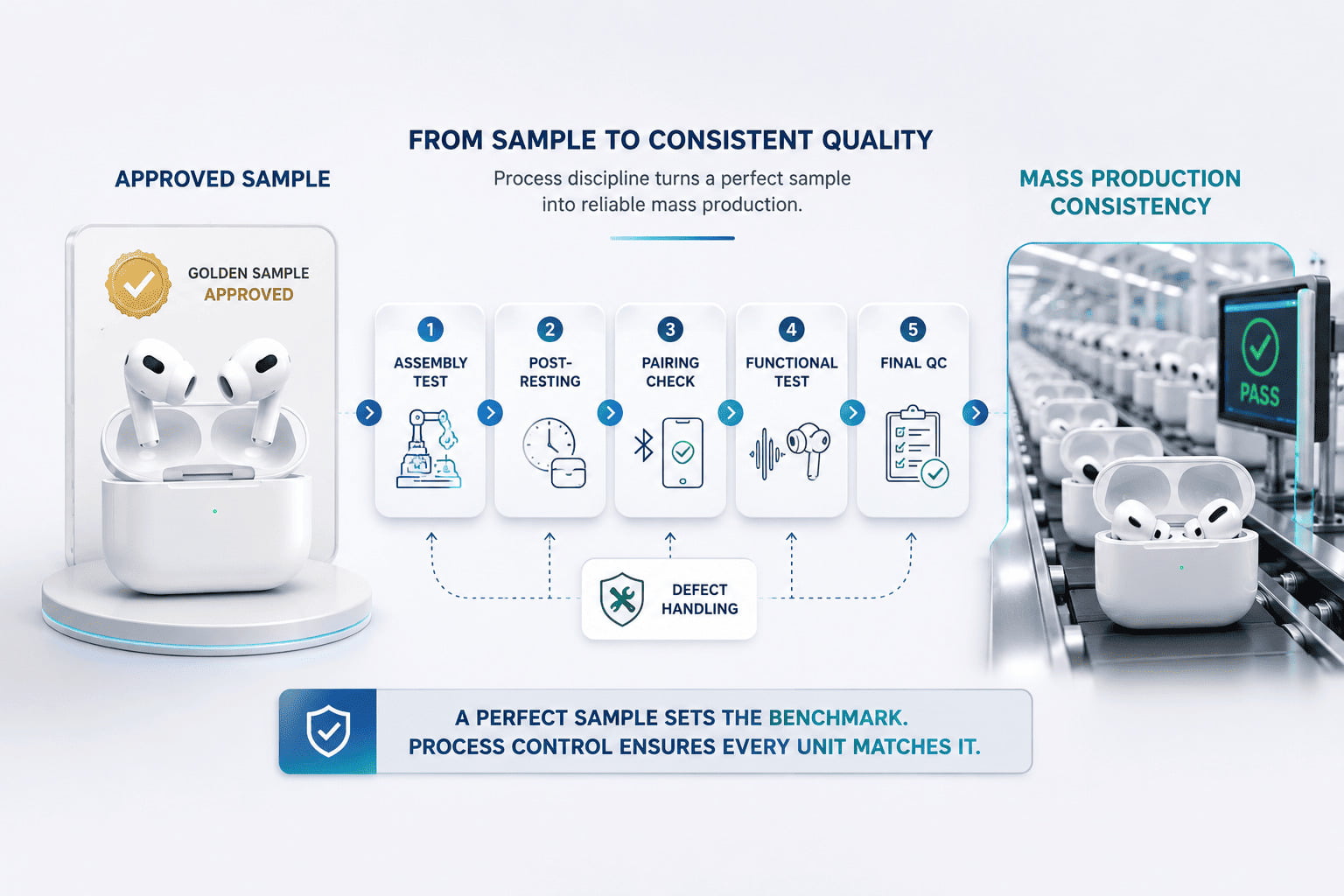
A good sample is a critical starting point, but it does not automatically guarantee mass production consistency; buyers must inquire about a factory's detailed in-process testing during assembly, post-resting, pre-shipment, and their defect management protocol to ensure bulk orders match the approved sample quality.
The Illusion of Sample Perfection
As a manufacturer, I often see the relief and excitement when a buyer approves a sample. And I get it – that sample is the culmination of design, engineering, and initial quality checks. But what many don't realize is that producing a few perfect samples is a very different challenge from manufacturing hundreds of thousands of units with the exact same level of quality. The sample is often assembled with extra care, sometimes even by senior technicians, using components that are meticulously selected. Mass production, by its nature, involves more variables: multiple operators, different shifts, larger component batches, and faster assembly speeds. This is why we always emphasize that while a sample sets the benchmark, the true measure of a factory’s capability lies in its ability to replicate that benchmark consistently at scale. We constantly monitor these variables to prevent any drift from the approved sample’s performance. For us, the sample is not the end of the quality journey, but the beginning of our mass production quality verification process.
What to Ask Beyond Sample Approval
When a buyer approves a sample, their next critical question should not just be "When can you ship?" but rather, "How do you ensure every unit in mass production will match this sample?" Buyers need to dig into the factory’s quality assurance methodology. I always advise asking specific questions: What tests are performed during assembly at each critical stage? Is there a designated resting period for units after assembly to allow glues to cure and structures to stabilize before final testing? What comprehensive functional tests are conducted before shipment? And crucially, how are defects identified, recorded, and fixed when they inevitably occur on the line? Understanding these process-level details will give you far greater insight into a factory's true quality control capability than just seeing an approved sample. For us, these questions are welcome because they allow us to demonstrate our robust, multi-stage testing protocols.
What Are the Concrete Factory Checkpoints That Ensure Quality?
The term "quality control" can feel abstract. You want tangible proof that your Bluetooth earbuds are being built right, not just vague assurances. As an experienced factory insider, I can tell you exactly where our focus lies on the production line, ensuring every unit meets its mark.
Effective factory quality control for Bluetooth earbuds involves concrete, multi-stage checkpoints, including mandatory battery charging checks before shell closure, meticulous appearance inspections, automated pairing failure repairs, a crucial 24-hour resting period6, thorough shielded-room functional testing, and final charging before shipment.
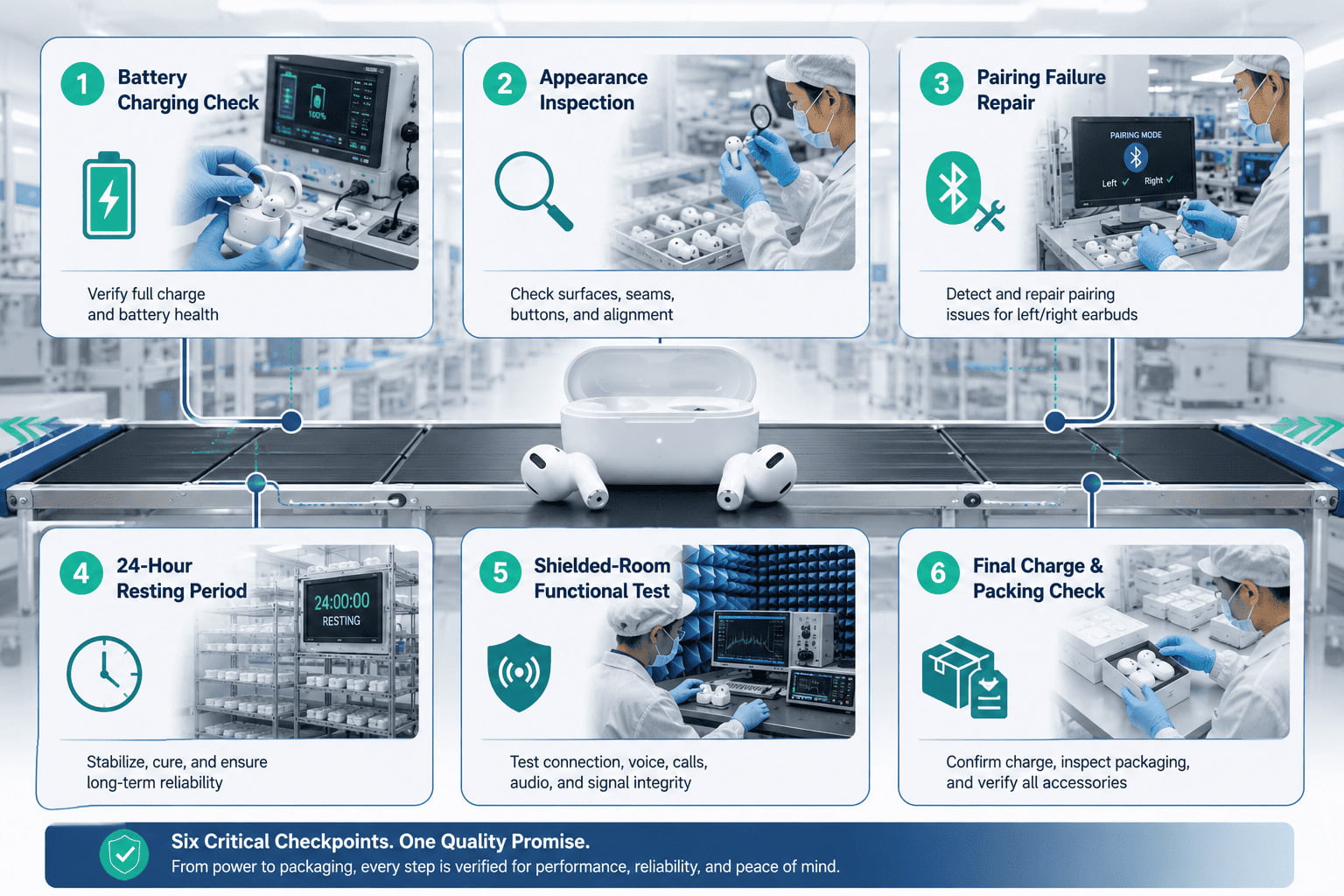
Crucial Steps on the Production Line
In our factory, quality control is woven into every stage of production, not just an end-of-line check. It starts even before the earbud shells are sealed.
Initial Battery and Component Verification
One of the very first critical steps is a battery charging check before closing the shell. We connect the raw battery cell to a charger and verify it’s taking a charge correctly. This small but vital check prevents major rework later. If a battery isn't charging then, it's caught immediately. Similarly, before assembly, our team performs initial inspections on key components like drivers, microphones, and chipsets. We visually check for any damage and use automated systems to confirm basic functionality where possible. This proactive approach saves significant time and resources downstream.
Post-Assembly Appearance and Basic Functionality
Once the shells are closed, an immediate appearance inspection is mandatory. This includes checking for scratches, gaps, uneven seams, and proper button alignment. A good-looking product suggests a good assembly process. Simultaneously, we perform initial power-on tests and basic connectivity checks.
Addressing Pairing Failures On-the-Spot
A common issue that frustrates users is pairing problems. On our line, we have a dedicated station to repair pairing failures for left/right earbuds. If an earbud fails to pair correctly, it's immediately routed to a technician who uses specialized tools to reset and re-pair the units, ensuring they function as a stereo pair. This quick intervention prevents defective pairs from moving further down the line.
The Critical 24-Hour Resting Period
After initial assembly and basic checks, all units undergo a 24-hour resting period. This might seem like downtime, but it's crucial. It allows any glues or adhesives used in the assembly to fully cure and stabilize. It also lets the internal structures settle, which can impact acoustic performance and durability over time. Any latent defects or stress-related issues often reveal themselves during this resting phase. We believe this step is vital for long-term product stability and reliability.
Advanced Functional Testing in Shielded Rooms
The next major stage is shielded-room testing for connection, voice, and call functions7. In these specially designed rooms, we eliminate external electromagnetic interference. This allows us to rigorously test Bluetooth connectivity stability, range, audio quality during playback, and crucial call functions (microphone performance, echo cancellation8). We check latency, multi-device pairing capabilities, and overall signal integrity9. This environment ensures accurate and reliable testing results, reflecting real-world performance without interference.
Final Charge and Packaging Checks
Finally, before packaging and shipment, each earbud undergoes a pre-shipment charging cycle. This confirms the charging case and earbuds are fully functional and ready for immediate use upon arrival. It also serves as a final power-on test. We also perform a comprehensive audit of packaging, accessories, and user manuals to ensure everything is correct and present. These concrete, measurable steps are what truly define our quality control.
Is a "High Pass Rate" Always Realistic, and What Happens to Defects?
Suppliers often boast about a "high pass rate," sometimes even claiming 100% defect-free production. While impressive on paper, this often leads to unrealistic expectations. What happens when a factory, as all do, inevitably encounters defects? Understanding this is key to assessing a supplier's true quality commitment.
No reputable factory can truthfully promise 100% zero defects in mass production; the more credible indicator of quality is a supplier's transparent process for detecting, isolating, repairing, documenting, and preventing defects from reaching customers, ensuring overall product reliability.
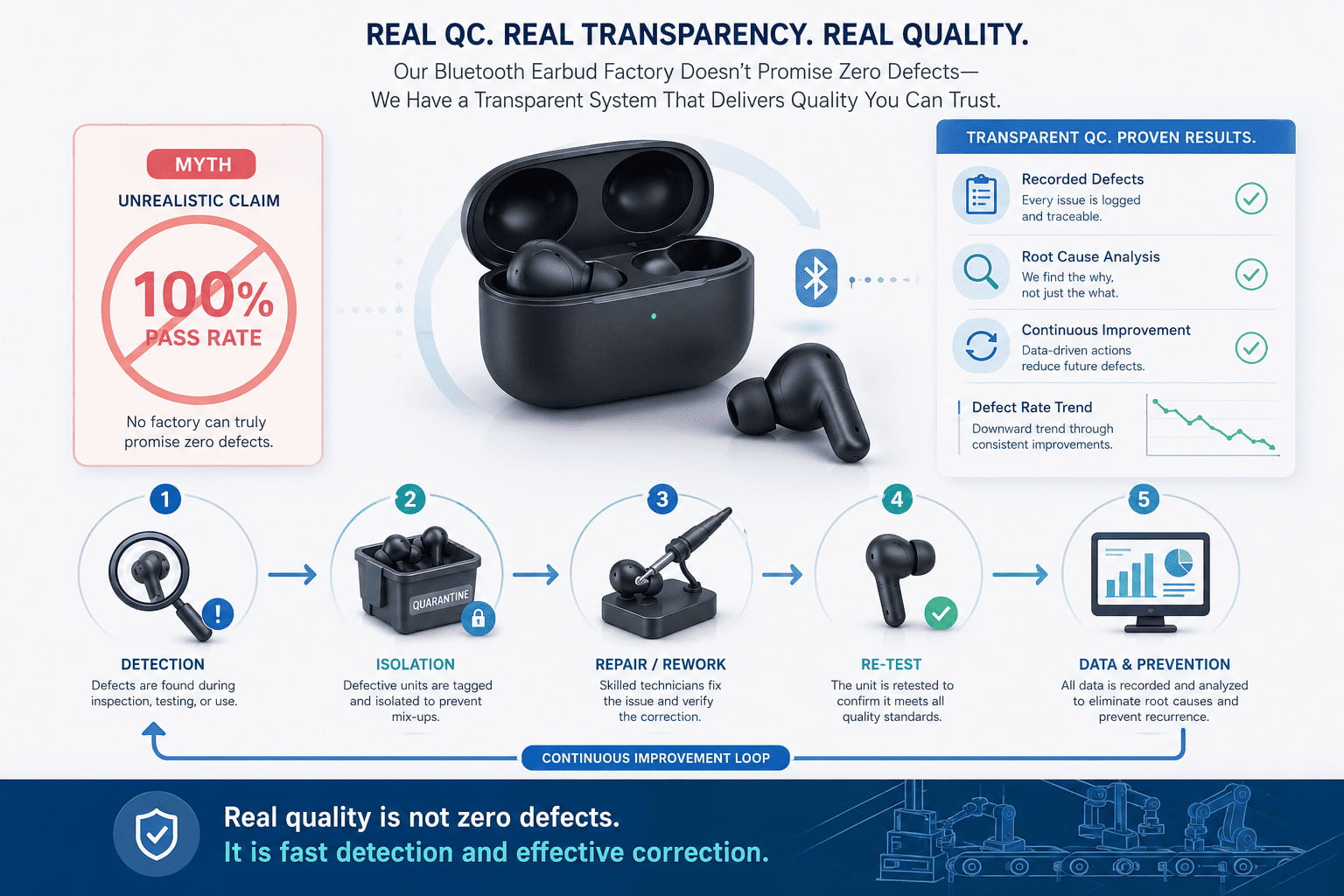
The Myth of 100% Defect-Free Production
From my years of experience in manufacturing, I can tell you that promising 100% defect-free mass production is simply not realistic10. Even with the most advanced automation and stringent processes, human error, component variations, and unforeseen issues can lead to defects. It's a universal truth in manufacturing. Any factory that claims zero defects is either not testing rigorously enough or is being disingenuous. The real strength of a quality system isn't in preventing every single defect (which is impossible), but in having an ironclad system to find those defects, fix them, and prevent them from ever reaching your customers. Our focus is on continuous improvement and robust detection11, rather than an unachievable perfect score. We've found that transparency about defect rates, coupled with effective countermeasures, builds far more trust with our buyers than empty promises. It shows we understand the realities of production.
How We Handle Defects: Detection, Repair, and Prevention
Our approach to defects is systematic and transparent. When a defect is found at any stage – during component inspection, assembly, resting, or final testing – it triggers a specific workflow:
Detection and Isolation
Defective units are immediately identified, marked, and isolated from the main production flow. We use clear tagging systems and dedicated holding areas to prevent any mix-ups. Each defect is recorded with details about where and when it was found.
Repair and Rework
Units are then sent to a repair station staffed by skilled technicians. Here, the specific issue is diagnosed and rectified. For example, a non-pairing earbud might need a firmware reset12, or a loose connection might require re-soldering. Once repaired, the unit doesn't just go back into the main stream; it goes through a full re-test cycle from the point of defect detection onward, sometimes even repeating all prior tests, to ensure the repair was successful and didn't introduce new issues.
Recording and Analysis
Every single defect and its resolution is meticulously recorded in our quality management system. This data is crucial. We analyze defect trends by production batch, component supplier, and even operator. This allows us to pinpoint recurring problems.
Prevention and Process Improvement
The most important part of our defect management is prevention. Based on our analysis, we implement corrective actions. If a particular component batch shows a higher defect rate, we work with the supplier or switch to a new one. If an assembly step consistently causes issues, we refine the process or retrain staff. This continuous feedback loop ensures that future production runs have fewer defects. We also provide buyers with regular reports, showing our defect rates and the actions we've taken. This transparency is critical for building confidence in our ability to deliver consistently high-quality products.
Conclusion
True Bluetooth earbuds testing goes beyond certificates, proving a factory's consistent mass production and defect control. It's about diligent factory checkpoints, transparent defect management, and a commitment to ensuring every unit matches your approved sample, reducing your sourcing risks.
"Electromagnetic compatibility", https://en.wikipedia.org/wiki/Electromagnetic_compatibility. The International Electrotechnical Commission defines electromagnetic compatibility as the ability of equipment to function satisfactorily in its electromagnetic environment without introducing intolerable electromagnetic disturbances to other equipment in that environment. Evidence role: definition; source type: institution. Supports: the definition and scope of electromagnetic compatibility in electronics. ↩
"CE marking - Wikipedia", https://en.wikipedia.org/wiki/CE_marking. CE marking indicates conformity with EU health, safety, and environmental protection legislation applicable to products sold within the European Economic Area, as defined by European Commission directives. Evidence role: definition; source type: government. Supports: the scope and essential requirements covered by CE certification in the European Union. ↩
"Radio Frequency Safety | Federal Communications Commission", https://www.fcc.gov/general/radio-frequency-safety-0. The Federal Communications Commission requires electronic devices to meet electromagnetic interference limits under Part 15 regulations to prevent harmful interference with radio communications. Evidence role: definition; source type: government. Supports: the electromagnetic interference standards enforced by FCC for electronic devices. ↩
"European Union Reduction of Hazardous Substances RoHS and ...", https://www.waru.edu/artifact/european-union-reduction-hazardous-substances-rohs-and-waste-electrical-and-electronic. The EU RoHS Directive restricts the use of ten hazardous materials including lead, mercury, cadmium, and certain brominated flame retardants in electrical and electronic equipment. Evidence role: definition; source type: government. Supports: the specific hazardous materials restricted under RoHS directives. ↩
"Understanding and Controlling Sources of Process Variation", https://www.bioprocessintl.com/bioanalytical-methods/understanding-and-controlling-sources-of-process-variation-risks-to-achieving-product-critical-quality-attributes. Manufacturing research demonstrates that component lot-to-lot variations, equipment calibration drift, and environmental factors such as temperature and humidity can introduce measurable performance variations in electronic assemblies. Evidence role: mechanism; source type: research. Supports: how process variations in manufacturing environments affect product consistency. Scope note: This supports the general principle of manufacturing variability rather than specific effects on Bluetooth earbuds. ↩
"[PDF] Workmanship Standard for Polymeric Application on Electronic ...", https://nepp.nasa.gov/files/27618/NSTD87391B.pdf. Materials engineering literature indicates that many industrial adhesives used in electronics assembly require 12-24 hours for complete curing, and assembled structures benefit from rest periods to allow stress relaxation and dimensional stabilization. Evidence role: mechanism; source type: research. Supports: the time required for adhesive curing and stress relaxation in assembled electronics. Scope note: This supports general adhesive curing principles rather than specific requirements for Bluetooth earbud assembly. ↩
"Wireless Coexistence and EMC of Bluetooth and 802.11b Devices ...", https://pmc.ncbi.nlm.nih.gov/articles/PMC3201214/. Electromagnetic compatibility testing standards specify that shielded enclosures or anechoic chambers provide controlled environments by attenuating external radio frequency interference, enabling repeatable measurements of wireless device performance characteristics. Evidence role: mechanism; source type: education. Supports: how shielded testing environments enable accurate wireless performance measurement. ↩
"Noise-cancelling headphones - Wikipedia", https://en.wikipedia.org/wiki/Noise-cancelling_headphones. Audio engineering literature describes acoustic echo cancellation as a signal processing technique that identifies and removes echo signals caused by acoustic coupling between speaker and microphone, commonly implemented in Bluetooth headsets through digital signal processing algorithms. Evidence role: mechanism; source type: education. Supports: how echo cancellation functions in wireless audio devices. ↩
"Let's talk about the audio latency on Bluetooth headphones - Reddit", https://www.reddit.com/r/headphones/comments/ugrsea/lets_talk_about_the_audio_latency_on_bluetooth/. Bluetooth Special Interest Group specifications define measurable performance parameters for audio devices including latency (typically 100-200ms for standard Bluetooth audio), multi-point connection capabilities, and signal quality metrics such as packet loss and bit error rates. Evidence role: definition; source type: institution. Supports: the technical parameters that define Bluetooth audio device performance. ↩
"Six Sigma - Wikipedia", https://en.wikipedia.org/wiki/Six_Sigma. Quality management research indicates that even Six Sigma processes, representing world-class quality control, target 3.4 defects per million opportunities rather than absolute zero defects, acknowledging that some level of variation is inherent in all manufacturing systems. Evidence role: expert_consensus; source type: research. Supports: the realistic defect rates achievable in manufacturing. ↩
"Applying the PDCA Cycle to Reduce the Defects in ... - Academia.edu", https://www.academia.edu/76737081/Applying_the_PDCA_Cycle_to_Reduce_the_Defects_in_the_Manufacturing_Industry_A_Case_Study. Continuous improvement methodologies such as Kaizen and the Plan-Do-Check-Act cycle emphasize iterative refinement of processes through systematic detection, analysis, and prevention of defects, rather than assuming defect-free production is achievable. Evidence role: general_support; source type: encyclopedia. Supports: the principles of continuous improvement in quality management. ↩
"My Android Won't Connect To Bluetooth. Here's The Fix! - YouTube",
. Technical documentation for Bluetooth devices indicates that firmware resets clear stored pairing data and restore default configuration parameters, often resolving connectivity issues caused by corrupted pairing tables or configuration conflicts. Evidence role: mechanism; source type: education. Supports: how firmware resets address Bluetooth connectivity problems. Scope note: This describes the general mechanism rather than providing specific success rates for this repair method. ↩