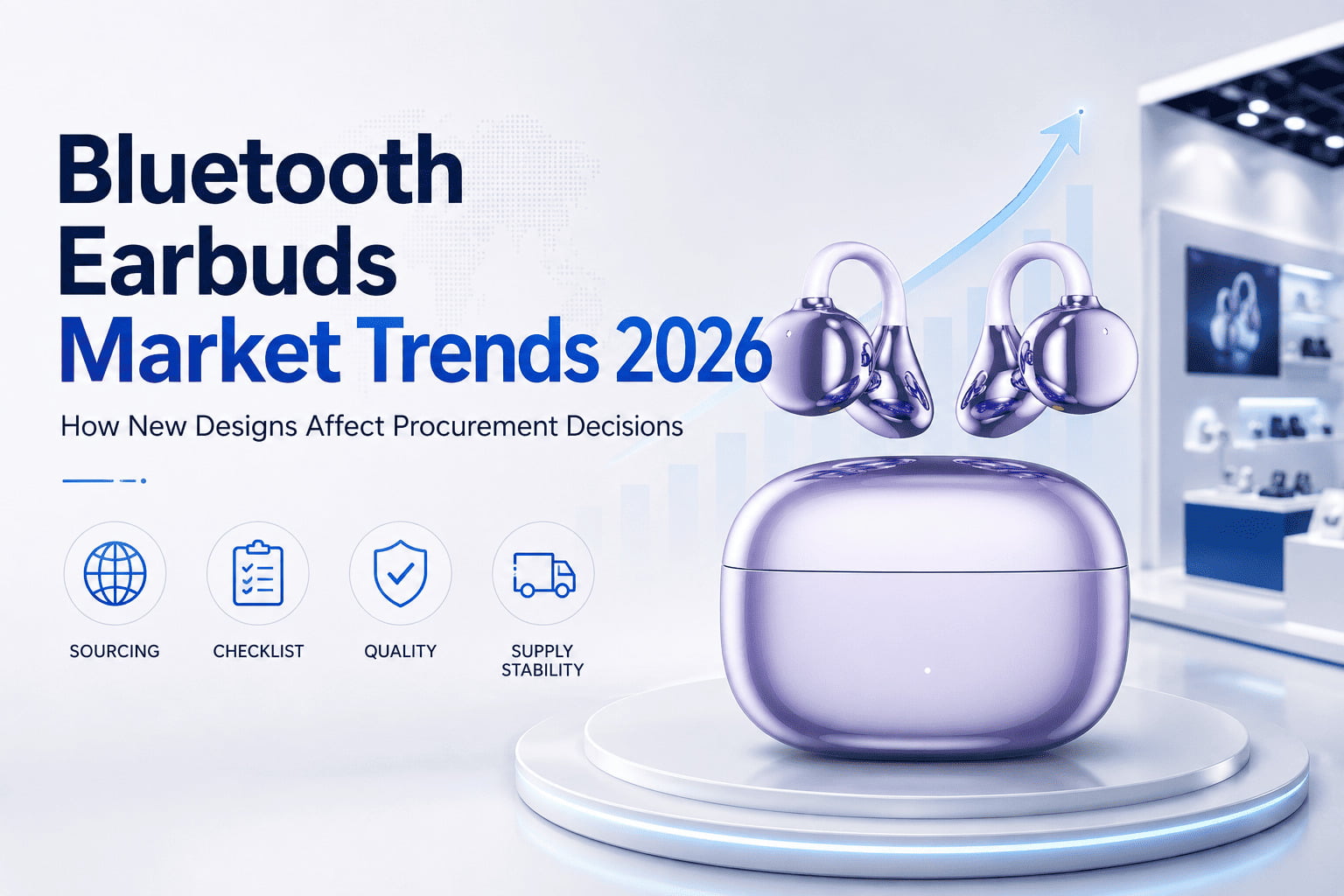
What Are the Real Bluetooth Earbuds Market Trends for 2026, and How Do They Affect Your Procurement Decisions?
Are you feeling overwhelmed by the endless new Bluetooth earbud designs1 at trade shows? Many procurement managers chase the latest trends, only to face unexpected risks and costs later.
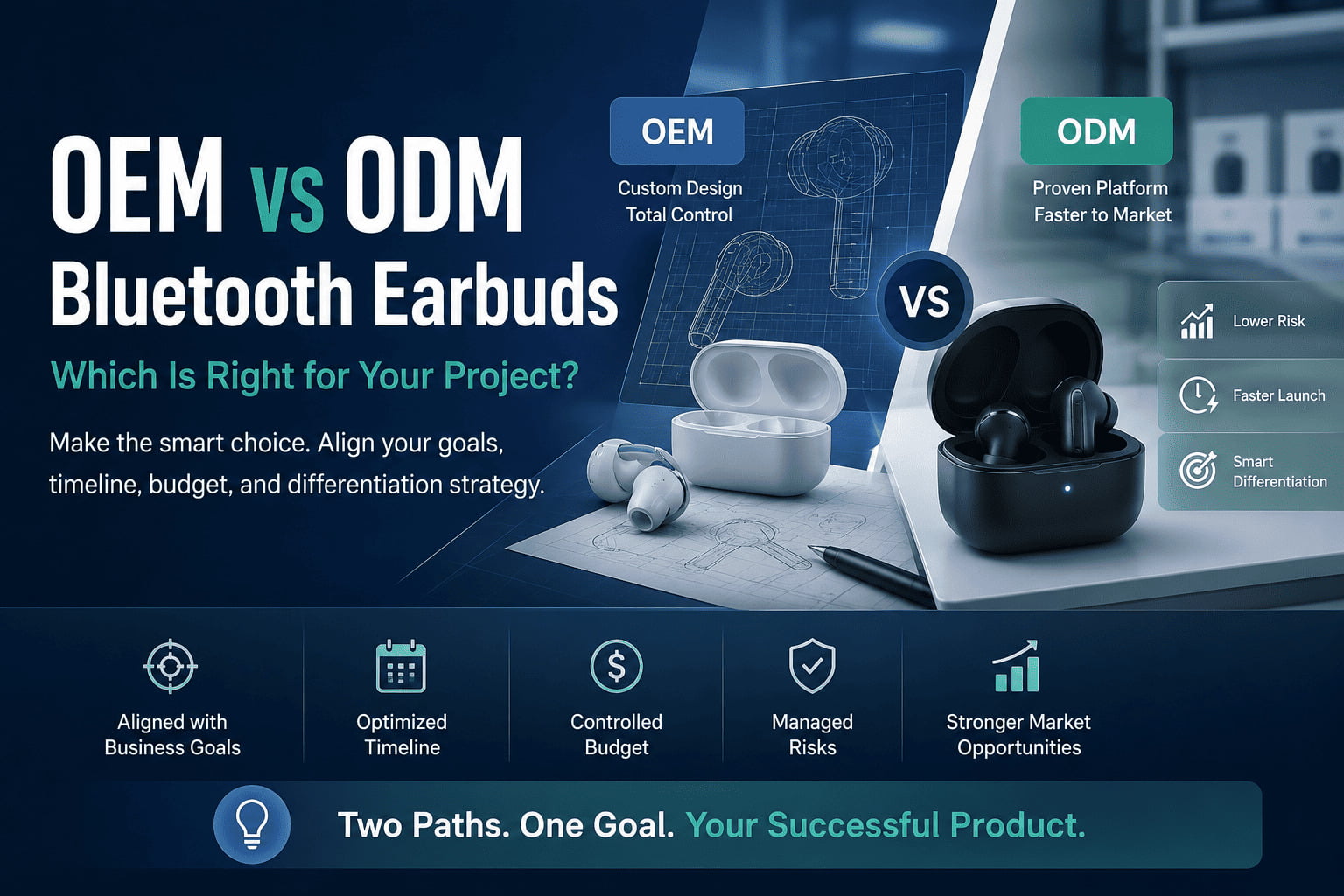
The real Bluetooth earbud market trends for 2026 are not about technology features; they are about managing procurement risk. Successful sourcing means understanding the difference between a flashy concept and a product ready for stable, cost-effective mass production.
As someone deeply involved in Bluetooth earphone manufacturing, I see firsthand how challenging it is to navigate the fast-paced market. It's easy to get caught up in the excitement of new designs, but my role is to help buyers like you understand the underlying truths behind what appears to be a "trend."
Are the New Bluetooth Earbud Designs You Saw at the Trade Show Ready for Mass Production?
Do you get excited by the innovative designs displayed at industry events? Many buyers are drawn to these cutting-edge concepts, but this excitement can sometimes lead to overlooking critical production realities.
New Bluetooth earbud designs seen at trade shows are often concept displays, not validated products ready for mass production. The true trend lies in structural innovations that have successfully passed factory quality control at scale and proven reliable in retail environments.
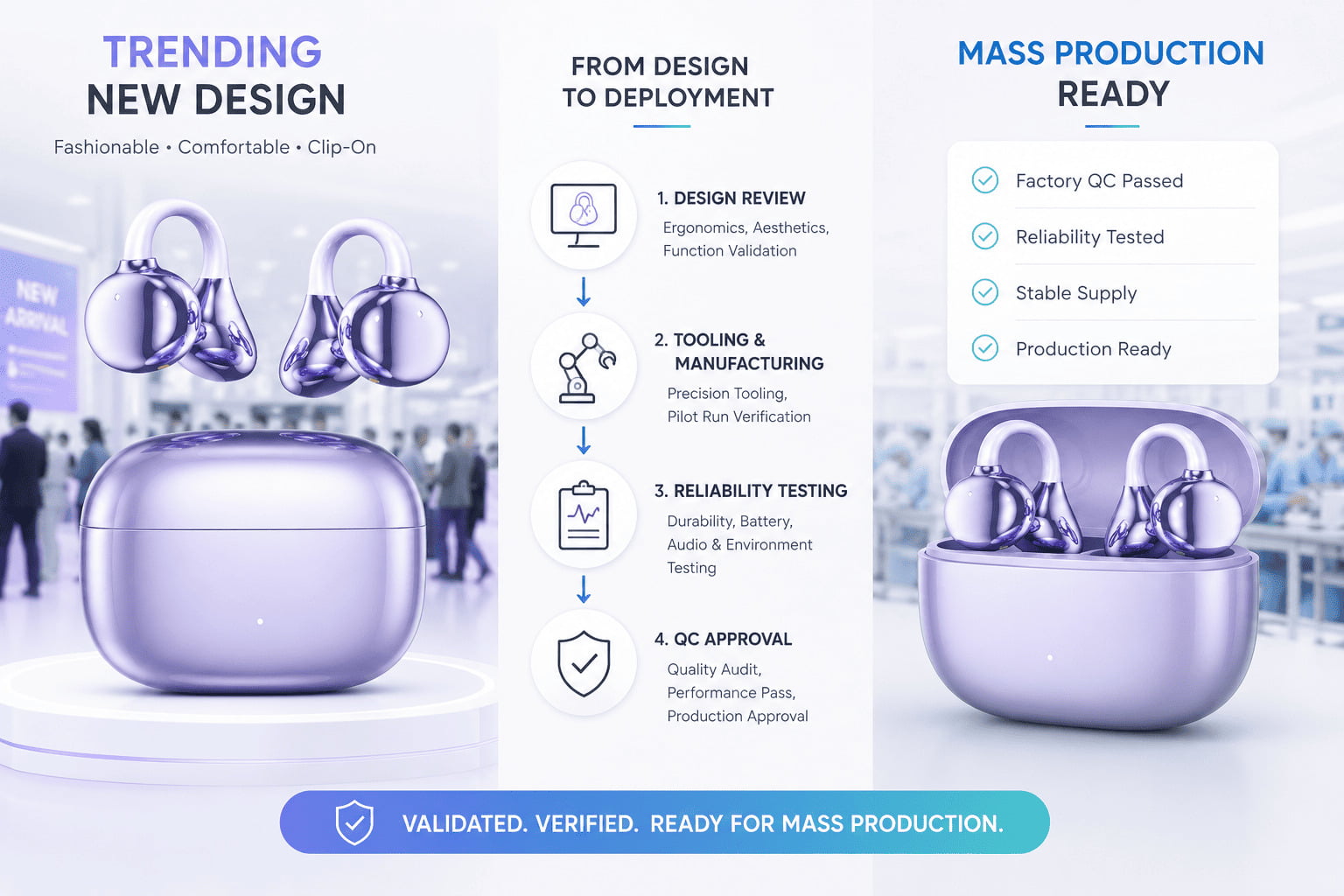
At the April 2026 Hong Kong Global Sources Fair2, I noticed many buyers were captivated by the new ear-clip earphone designs3. These looked fresh and stylish. However, what most buyers confuse is the difference between a trade show concept and a product that has undergone rigorous factory validation. A concept display shows what is possible, but not what is necessarily proven for large-scale production. The real trend, from a factory perspective, is not merely that "ear-clip earphones exist." Instead, it is "which structural innovations have actually passed factory QC at scale and survived real-world retail feedback?" This means the design must be manufacturable consistently, pass all necessary quality tests, and hold up under consumer use without excessive returns. For us, a "trend" is something that can be reliably produced and sold, not just a flashy prototype. Focusing only on the initial aesthetic can lead to significant headaches down the line if the design has not been properly vetted for mass production. It is crucial to look beyond the initial visual appeal and understand the entire lifecycle of a product from design to consumer feedback.
Understanding Design Validation Stages
- Concept Design: An initial idea or prototype, often handmade or 3D printed4.
- Factory-Validated Design: A design tested for manufacturability, durability, and consistent performance.
| Feature | Concept Design (Trade Show) | Factory-Validated Design (Real Trend) |
|---|---|---|
| Development Stage | Idea, prototype, early sample | Production-ready, tested, refined |
| Risk Level | High (untested for mass production) | Low (proven manufacturability) |
| QC Status | Minimal or no production QC | Passed rigorous factory QC at scale |
| Market Feedback | None (purely theoretical) | Positive retail feedback, repeat orders |
| Buyer Outcome | Potential delays, cost overruns, defects | Predictable supply, consistent quality |
Does Chasing Complex Bluetooth Earbud Designs Lead to Higher Costs and Risks?
Are you always seeking the most intricate and innovative Bluetooth earbud designs? While they may seem attractive, pursuing overly complex structural designs can introduce significant hidden costs and operational risks for your business.
Yes, chasing complex structural designs for Bluetooth earbuds often leads to higher defect rates5, increased after-sales costs, and greater supply chain instability6. Simpler, more proven designs may appear less innovative but consistently deliver more stable supply chains and lower overall risks for procurement managers.
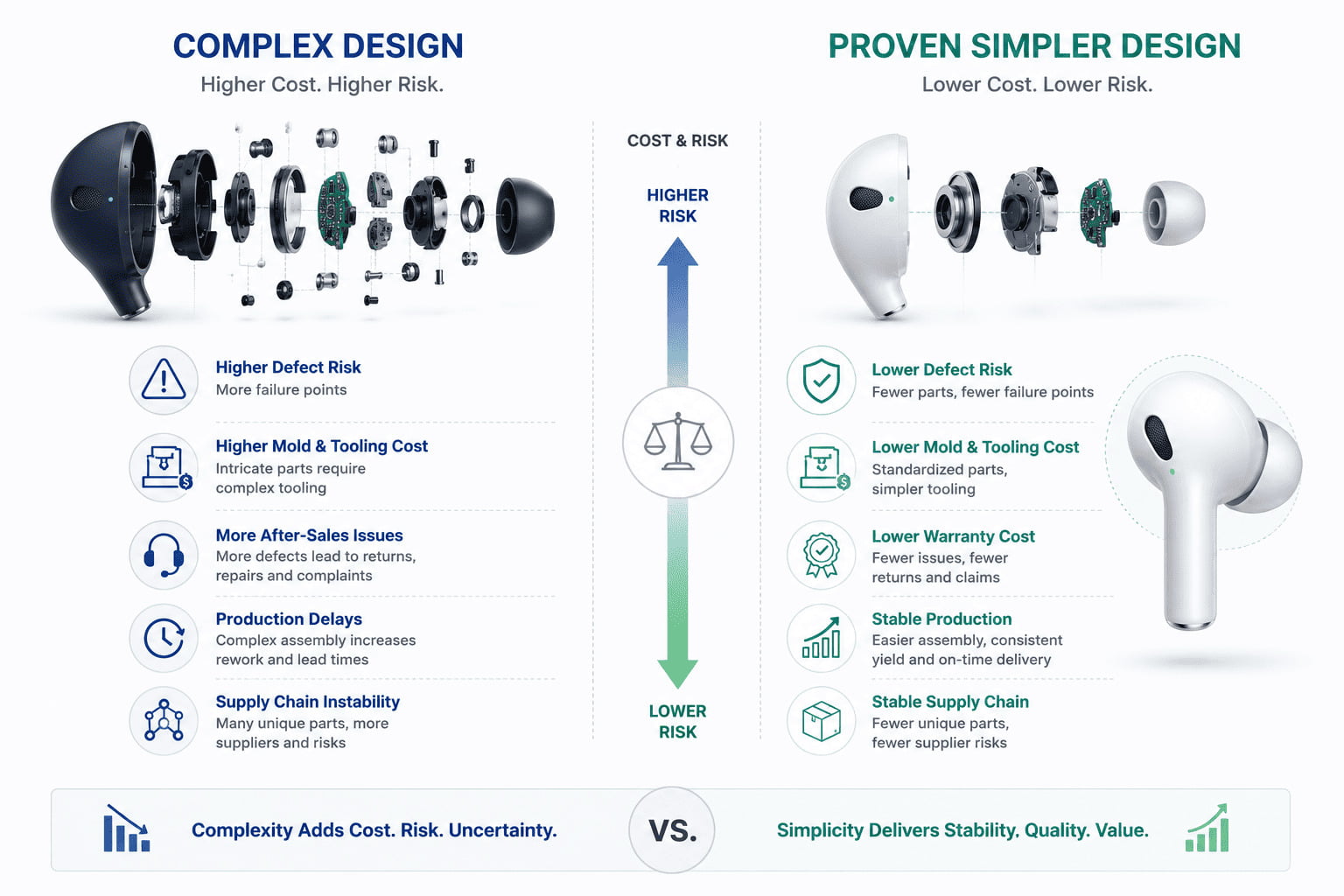
The factory has observed that intricate designs often lead to higher defect rates. Every additional moving part, every complex curve, or every unique material integration introduces more points where things can go wrong during assembly. This directly translates to more units failing quality control checks7 and a higher percentage of defective products reaching the market. When this happens, after-sales costs shoot up. Returns, replacements, and customer service inquiries about faulty products erode your profit margins and damage your brand reputation. From my discussions with medium-scale distributors, many report that custom designs without sufficient market validation often lead to significant inventory risk. They invest heavily in a unique design, only to find that its complexity causes production delays, inconsistent quality, or that the market does not accept the novelty as expected. This leaves them with unsold inventory, tying up capital and requiring costly write-offs. A simpler, more robust design, while perhaps less flashy, ensures a smoother production process, fewer defects, and a more predictable supply chain. This stability is often more valuable than a perceived design edge, especially for businesses focused on consistent supply and customer satisfaction.
Impact of Design Complexity on Procurement
- Manufacturing Efficiency: Simpler designs are easier and faster to produce consistently.
- Quality Control: Fewer failure points mean higher first-pass yield rates8.
- After-Sales Support: Reduced defects lead to lower warranty claims9 and customer complaints.
| Aspect | Complex Structural Design | Simpler Structural Design |
|---|---|---|
| Defect Rates | Higher (more failure points) | Lower (fewer failure points) |
| After-Sales Costs | Increased (returns, repairs, support) | Decreased (fewer issues) |
| Supply Chain Stability | Less predictable (production hurdles) | More stable (smooth manufacturing) |
| Inventory Risk | High (unproven market acceptance) | Lower (validated market demand) |
| Mold Costs | Higher (more intricate tooling) | Lower (standardized tooling) |
What Hidden Costs Do Buyers Face When Designing Their Own Bluetooth Earbud Products?
Are you considering designing your own unique Bluetooth earbud products to stand out? While customization seems appealing, many buyers overlook several hidden costs that can impact their budget and market entry.
When buyers choose to design their own Bluetooth earbud products, they often face three significant hidden costs: extensive mold development time10 that delays market entry, iteration risk due to untested designs, and increased factory communication overhead because of non-standard specifications.
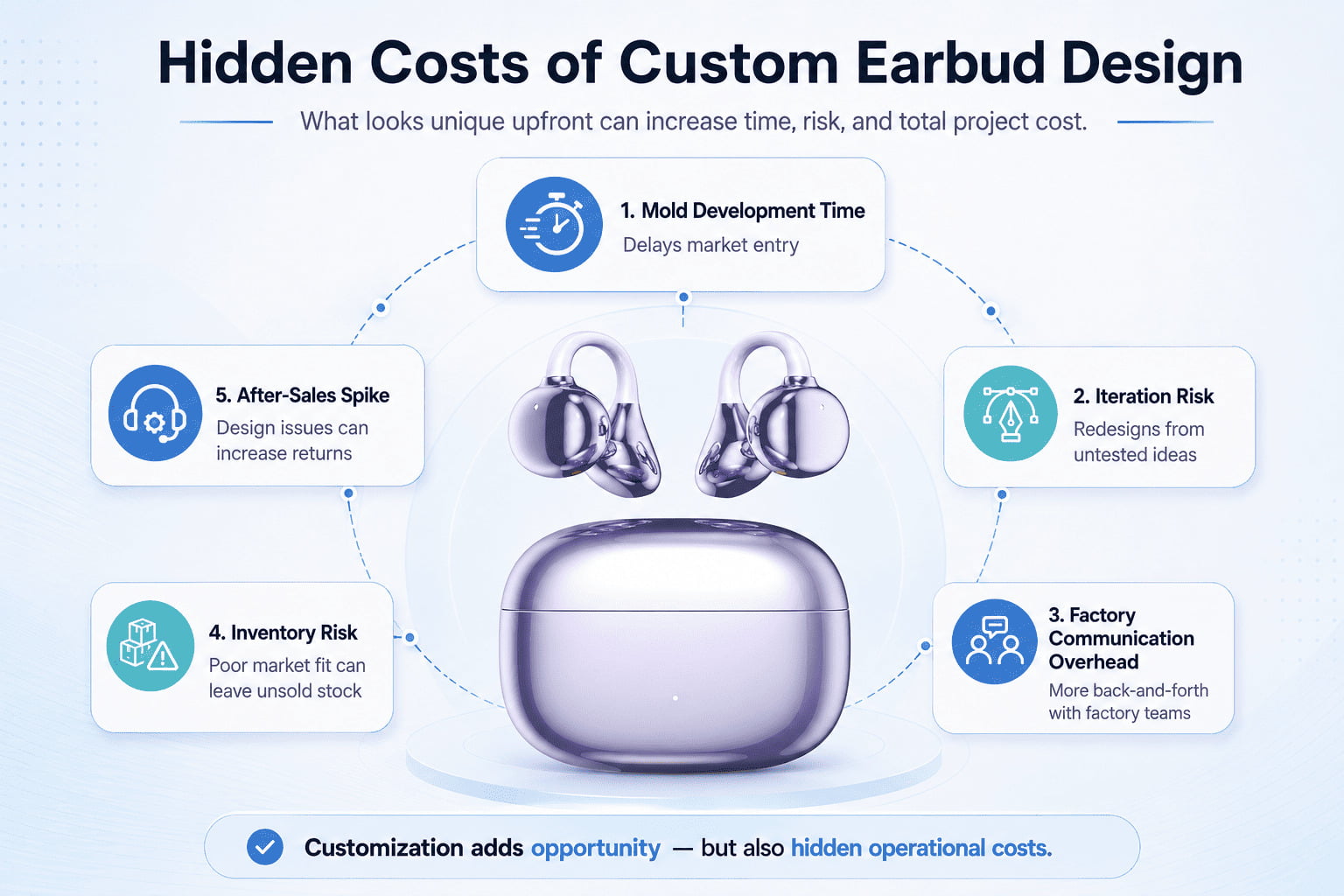
In my experience, many buyers underestimate the time and resources needed for custom mold development. What they see as a quick design tweak can actually mean weeks or even months of tool fabrication and refinement. This mold development time directly translates into delays for market entry. If your product is late, you might miss key selling seasons or lose your competitive edge. There is also significant iteration risk. An untested design, no matter how good it looks on paper, might not perform well in real-world production or, crucially, might not resonate with consumers. This can lead to costly redesigns or, worse, products that simply do not sell, resulting in inventory write-offs11. The third hidden cost is factory communication overhead. When you bring non-standard specifications, it requires more detailed discussions, more frequent checks, and more back-and-forth between your team and the factory. This non-standard approach increases production variability, leading to potential errors and further delays. It consumes valuable time for both parties and can easily lead to misunderstandings, all of which add to the overall project cost and timeline. These factors are often not included in the initial cost estimates but become very real during the production process.
Types of Hidden Costs in Custom Design
- Time-Related Costs: Delays in product launch, missed market opportunities.
- Quality and Market Risk: Unforeseen defects, poor market acceptance.
- Operational Overheads: Increased communication and management efforts.
| Hidden Cost Type | Impact on Project | Example Scenario |
|---|---|---|
| Mold Development Time | Delays market entry, missed sales windows | A new earbud shape requires 3 months for mold creation. |
| Iteration Risk | Untested designs may not sell, requiring redesigns | Earbud fit causes discomfort; requires mold revision. |
| Factory Communication Overhead | Non-standard specs increase production variability | Constant back-and-forth on minor design changes. |
| Inventory Risk | Unsold stock due to poor market acceptance | A unique charging case design finds no consumer demand. |
| After-Sales Spike | Unforeseen design flaws cause high return rates | Complex button mechanism breaks easily after purchase. |
How Do You Balance Cutting-Edge Bluetooth Earbud Design with Safe Procurement Choices?
Are you torn between chasing the latest, most innovative Bluetooth earbud designs and making safe, reliable procurement decisions? Finding the right balance is crucial for sustainable business growth, but it requires a careful assessment of your specific business context.
Balancing cutting-edge Bluetooth earbud design with safe procurement choices depends on your business's risk tolerance12, order volume, and capacity to absorb unsold inventory. It is not solely about a design's technical feasibility but about aligning the design choice with your strategic and financial capabilities.
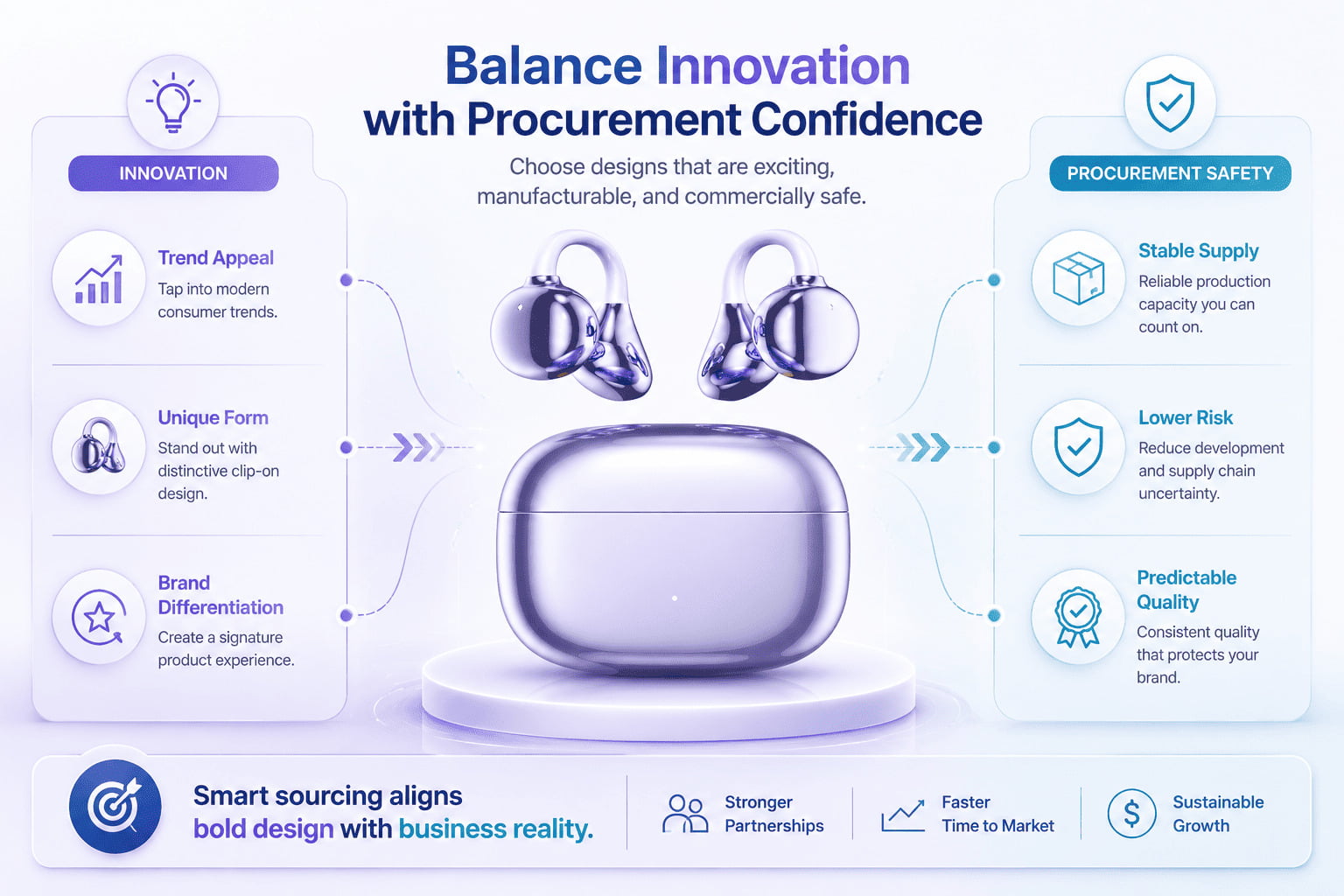
Buyers I meet at trade shows often focus only on the technical feasibility of a cutting-edge design. They ask, "Can you make this?" instead of "Should I make this?" The "safest choice" for your procurement strategy is not a universal truth. It truly depends on your specific business model and current situation. For instance, if you are a large brand with significant marketing budgets and a high-volume demand, you might have the capacity to absorb the higher mold costs and potential risks of a truly unique design. You can leverage your brand power to validate the design in the market. However, if you are a medium-scale distributor with limited capital and a lower risk tolerance, opting for a proven structural design, perhaps with custom branding or a unique color, might be a much safer and more profitable path. This choice minimizes inventory risk and ensures a more stable supply. The ability to absorb unsold inventory is a critical factor here. A groundbreaking design might fail to capture market interest, leaving you with stock. Your risk tolerance, how much capital you can afford to tie up, and your annual procurement volume should dictate how far you lean into innovation versus proven structures. It is about making a strategic decision, not just a technical one.
Strategic Considerations for Design Choices
- Risk Assessment: Evaluate potential financial and operational risks.
- Market Validation: Assess existing demand for similar designs or conduct focused surveys.
- Inventory Management: Plan for potential unsold stock and its financial implications.
| Factor | High Risk Tolerance (Large Brands) | Low Risk Tolerance (Medium Distributors) |
|---|---|---|
| Order Volume | Very High (can absorb R&D and inventory) | Medium (needs predictable sales) |
| Capacity for Unsold Inventory | High (can manage slower sales or write-offs) | Low (cannot afford significant unsold stock) |
| Design Choice | Cutting-edge, unique structural innovations | Proven structures with cosmetic customization |
| Procurement Strategy | Pioneer new trends, willing to invest in R&D | Focus on reliability, cost-effectiveness, stable supply |
| Market Entry Speed | Willing to wait for complex mold development | Prefers faster market entry with established designs |
Conclusion
Understanding Bluetooth earbud market trends for 2026 means assessing procurement risks, not just design aesthetics. Prioritize proven structures over unvalidated concepts to ensure stable supply and avoid hidden costs, aligning choices with your business's risk tolerance.
"List of Bluetooth profiles - Wikipedia", https://en.wikipedia.org/wiki/List_of_Bluetooth_profiles. Bluetooth earbuds are wireless audio devices that use Bluetooth technology for audio transmission, typically featuring in-ear designs, rechargeable batteries, and charging cases, with true wireless stereo (TWS) variants operating independently without connecting cables. Evidence role: definition; source type: encyclopedia. Supports: Establishes Bluetooth earbuds as a wireless audio device category. ↩
"Global Sources Consumer Electronics - LUMI.cn", https://www.lumi.cn/en/tradeshowdetail/global-sources-consumer-electronics_zh2024008. Global Sources hosts multiple electronics trade shows annually in Hong Kong, typically including spring and autumn editions focused on consumer electronics and mobile accessories. Evidence role: case_reference; source type: institution. Supports: Confirms the existence and typical timing of Global Sources Fair events in Hong Kong. Scope note: Cannot verify specific April 2026 event details or ear-clip earphone prevalence at future shows ↩
"Clip-On Earbuds Guide | Open-Ear Audio Explained", https://shokz.com/blogs/news/clip-on-earbuds. Ear-clip or ear-hook earphones feature a structural design that hooks over or clips onto the outer ear rather than inserting into the ear canal, offering an alternative wearing style that some users find more comfortable for extended use or physical activity. Evidence role: definition; source type: other. Supports: Describes ear-clip earphones as a design variant. Scope note: Design terminology and categorization may vary across manufacturers and markets ↩
"Additive manufacturing, explained | MIT Sloan", https://mitsloan.mit.edu/ideas-made-to-matter/additive-manufacturing-explained. 3D printing enables rapid prototyping by creating physical models directly from digital designs without tooling, allowing designers to quickly iterate concepts and evaluate form and fit, though prototypes typically differ in material properties and surface finish from mass-produced parts. Evidence role: general_support; source type: education. Supports: Explains 3D printing's role in prototype development. Scope note: 3D printed prototypes may not accurately represent final production part performance or manufacturability ↩
"The role of variation, error, and complexity in manufacturing defects", https://digital.library.unt.edu/ark:/67531/metadc1314726/. Manufacturing research demonstrates that increased product complexity correlates with higher defect rates due to additional failure points, tighter tolerances, and more complex assembly processes requiring greater precision. Evidence role: mechanism; source type: research. Supports: Establishes the relationship between design complexity and manufacturing defect rates. Scope note: General manufacturing principle; specific defect rate increases vary by industry and product category ↩
"[PDF] MANAGING SUPPLY CHAIN COMPLEXITY: AN INDUSTRY ...", https://business.lehigh.edu/sites/default/files/2020-03/Managing_Complexity_WHITE_PAPER.pdf. Supply chain research demonstrates that product complexity increases supply chain vulnerability through greater component variety, more specialized suppliers, longer lead times, and reduced flexibility to respond to disruptions or demand changes. Evidence role: mechanism; source type: research. Supports: Connects product complexity to supply chain challenges. Scope note: Supply chain stability depends on multiple factors beyond product design, including supplier relationships and inventory strategies ↩
"Quality Control in Manufacturing: Overview and Best Practices", https://www.6sigma.us/manufacturing/quality-control-in-manufacturing/. Quality control in manufacturing involves systematic inspection and testing procedures to ensure products meet specified requirements, typically including incoming material inspection, in-process checks, and final product testing against defined acceptance criteria. Evidence role: general_support; source type: institution. Supports: Describes quality control as a systematic manufacturing process. Scope note: Specific QC procedures vary by industry, product type, and regulatory requirements ↩
"[PDF] Does product design really determine 80% of manufacturing cost?", https://dspace.mit.edu/bitstreams/d12b51db-f707-4022-8fc5-c4d87028a0c0/download. First-pass yield (FPY) measures the percentage of manufactured units that meet quality specifications without requiring rework or repair, serving as a key indicator of manufacturing process efficiency and design manufacturability. Evidence role: definition; source type: encyclopedia. Supports: Defines first-pass yield as a manufacturing quality metric. ↩
"Impact of warranty and green level of the product with nonlinear ...", https://pmc.ncbi.nlm.nih.gov/articles/PMC11088665/. Manufacturing quality research indicates that product defects directly increase warranty costs through replacement parts, labor, logistics, and administrative expenses, with studies showing warranty costs can represent 2-10% of revenue for consumer electronics depending on defect rates. Evidence role: mechanism; source type: research. Supports: Establishes the economic relationship between product defects and warranty expenses. Scope note: Specific warranty cost impacts vary by product category, warranty terms, and defect severity ↩
"A Comprehensive Guide To Consumer Electronic Injection Molding", https://firstmold.com/tips/consumer-electronic-injection-molding/. Injection mold development for consumer electronics typically requires 4-12 weeks depending on complexity, including design, fabrication, testing, and refinement phases, with complex geometries requiring longer development cycles. Evidence role: general_support; source type: education. Supports: Provides context for typical mold development timelines in manufacturing. Scope note: Timeframes vary significantly based on part complexity, tooling technology, and manufacturer capabilities ↩
"Inventory Write-Offs: A How-To Guide with Example Entry | NetSuite", https://www.netsuite.com/portal/resource/articles/inventory-management/inventory-write-off.shtml. Inventory write-offs occur when businesses reduce the recorded value of unsold inventory to reflect market value or obsolescence, recognizing the loss as an expense that directly impacts profitability, typically required when inventory cannot be sold at or above its carrying cost. Evidence role: definition; source type: education. Supports: Explains inventory write-offs as an accounting practice. ↩
"Enterprise Risk Management Framework", https://ogc.yale.edu/erm/resources/enterprise-risk-management-framework. Risk tolerance represents the degree of variability in outcomes that an organization is willing to accept in pursuit of objectives, influenced by financial capacity, strategic goals, and stakeholder expectations, serving as a key parameter in decision-making frameworks. Evidence role: definition; source type: education. Supports: Defines risk tolerance in a business context. ↩