Frustrated by inconsistent Bluetooth earbud quality or unpredictable delivery times? Many buyers struggle to understand why some projects go smoothly while others face delays. This is often because the production process is more complex than it appears.
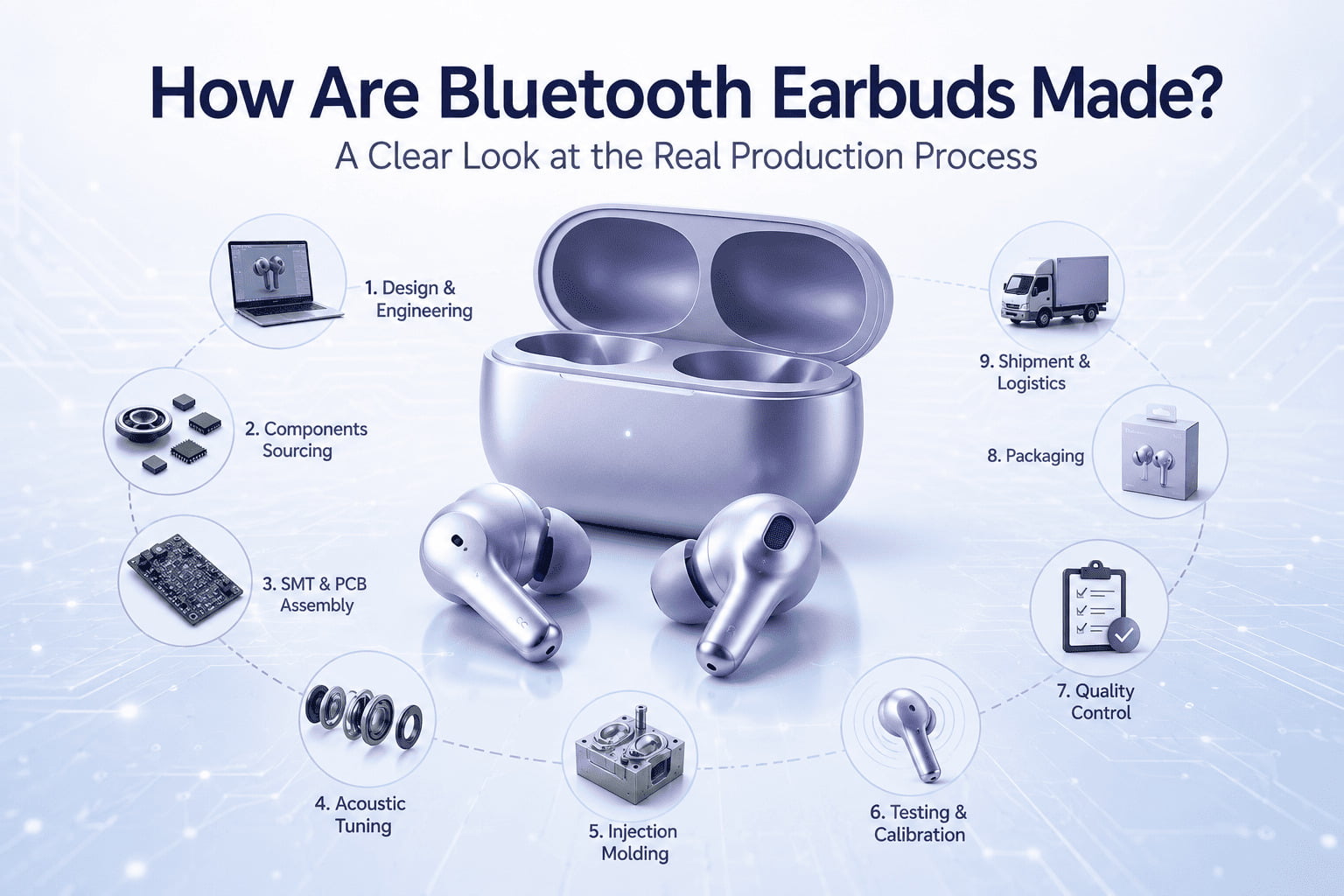
Bluetooth earbud production is a detailed process that varies greatly depending on the earbud type and customization needed. It involves stages like material inspection, SMT assembly1, acoustic tuning2, and rigorous quality checks. Understanding these steps helps manage expectations and secure reliable supply.
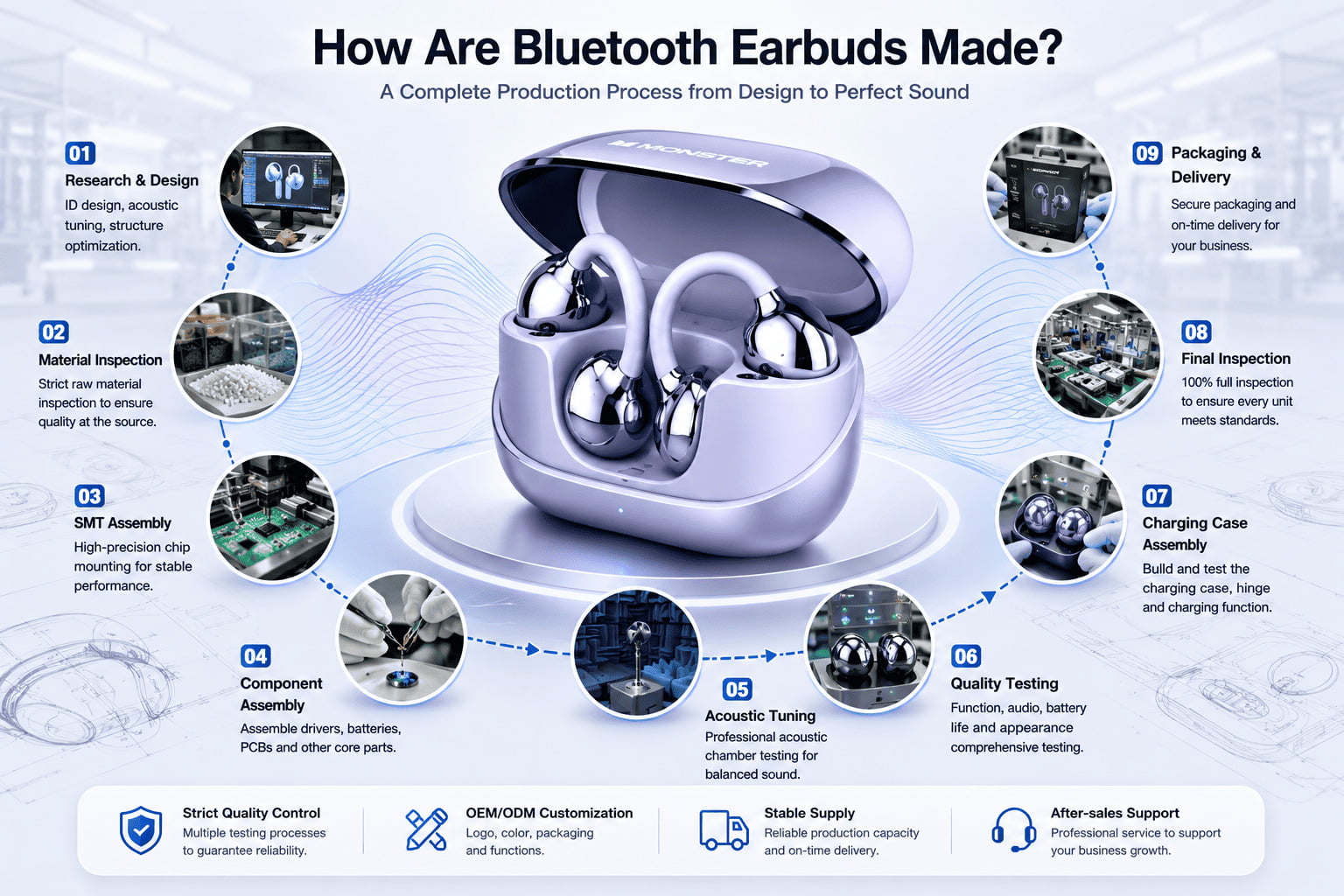
I have seen many B2B clients ask about the journey from design to a finished product. They want to know what truly goes into making a Bluetooth earbud. This journey is not a single path. It changes based on what kind of earbud we make. Let me share with you how this works. I want to explain why this process is not always the same. This will help you understand what to expect. You will learn what makes a good earbud production reliable.
How Do Different Earbud Designs Change the Manufacturing Steps?
Are you wondering why producing TWS earbuds seems so different from neckband models? Many people think all earbuds are made the same way. But their unique structures demand very different manufacturing sequences and tooling investments.
Different earbud designs, like TWS, neckband, or sports models, require specific manufacturing steps and distinct tooling. For example, TWS earbuds need injection molding for charging cases3 and precise hinge assembly, steps not found in neckband or sports earbud production.
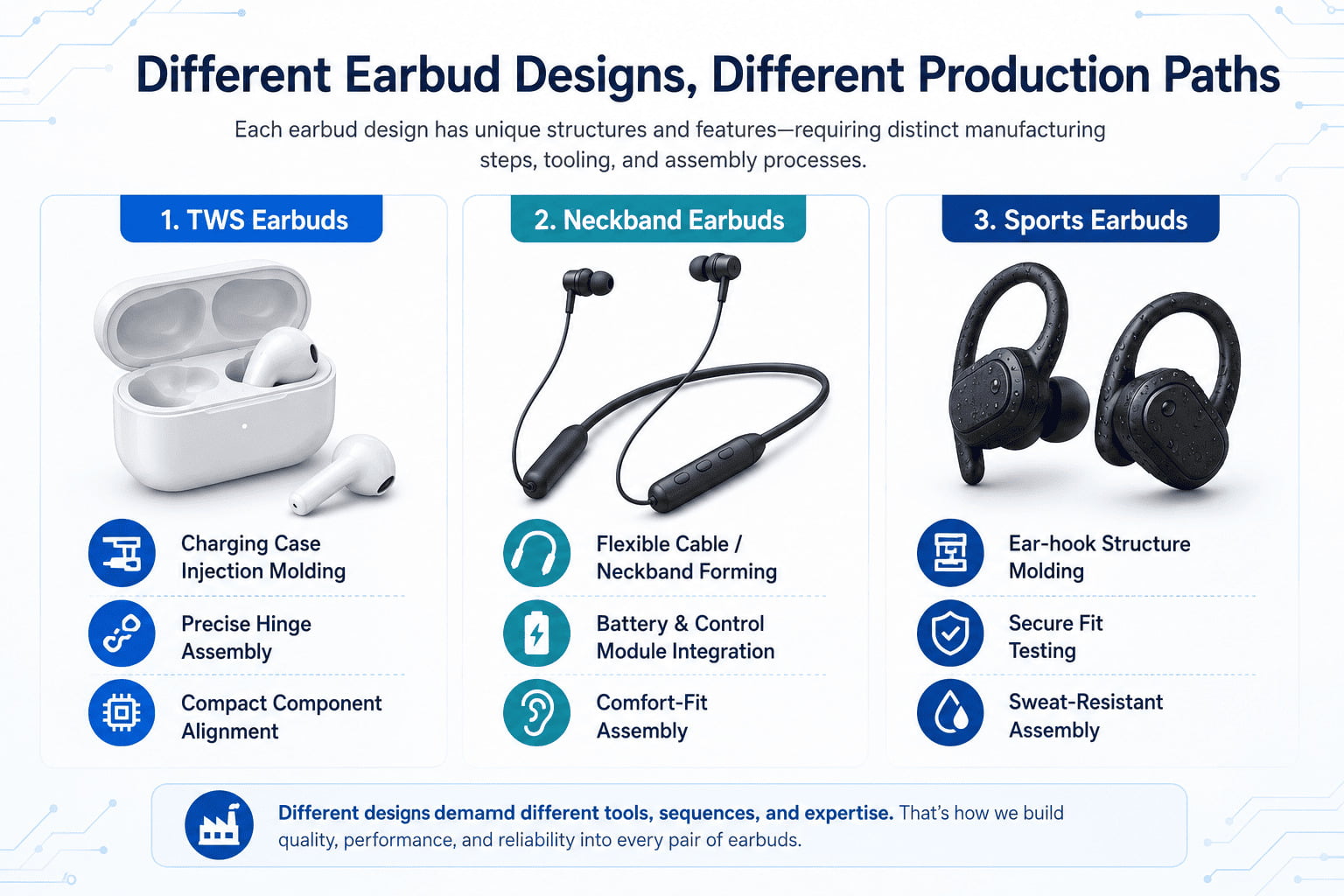
I understand why it is important to know about these differences. It directly affects production timelines and costs. When we talk about earbud production, we are not talking about one single assembly line for everything. For instance, the small, true wireless stereo (TWS) earbuds4 involve many more intricate steps due to their compact size and separate charging case. Based on our factory’s workflow diagrams, making a TWS earbud means we must precisely align tiny components. This includes the main earbud units, the battery inside, and the charging case itself. The charging case needs its own injection molding. It also needs a separate battery assembly. And it needs hinge testing for the lid. These are steps that neckband models simply do not require. Neckband earbuds, on the other hand, have a flexible band connecting the earpieces. This simplifies some assembly steps. It might mean a different kind of cable management. It also requires different housing for the main control unit, often in the neckband itself. Sports models focus on durability and sweat resistance. This often means different materials and extra sealing processes. Our production records show that each type demands specific expertise and machinery. This affects how long it takes to set up production and how much it costs.
TWS Earbuds: Unique Steps
TWS earbuds, due to their independent nature and charging case, have a distinct set of production steps. They require highly precise manufacturing. We start with the main earbud housing, often made through injection molding. Then, we assemble the tiny printed circuit board (PCB)5 with the Bluetooth chip6. We also put in the driver and the small battery. This requires fine motor skills and automated machines for accuracy. The charging case is another complex item. It needs its own injection molded parts. It has its own battery and charging circuit. Connecting the earbud units to the charging case, including the charging pins and the lid hinge, adds more stages. We test the charging function and the magnetic hold of the earbuds inside the case. This entire process is very detailed. It means specialized jigs and fixtures.
Neckband Earbuds: Streamlined Assembly
Neckband earbuds offer a different production approach. The main components, including the battery and control board, are often housed in the neckband itself. This design allows for a larger battery. It also allows for more straightforward circuit placement compared to TWS earbuds. The earpieces are connected by wires running through the neckband. This eliminates the need for a separate charging case. Instead, we focus on the flexibility and durability of the neckband material. We also make sure the wires are securely routed. The assembly process for these is more about integrating the earpieces with the band. We check the strength of the cable connections. We also check the comfort of the band.
Sports Earbuds: Durability Focus
Sports earbuds, whether TWS or neckband, require an extra focus on resilience. This means we select materials that can withstand sweat and impact. Production steps include advanced sealing processes. We use special glues and gaskets to achieve IPX ratings for water resistance7. This adds complexity to the assembly. It also adds to the testing phase. We often conduct specific tests for sweat exposure and drop resistance. This ensures the earbuds can survive harsh environments. This extra layer of protection means more steps and more rigorous checks during production.
| Earbud Type | Key Production Differences | Impact on Timeline/Cost |
|---|---|---|
| TWS | Charging case injection molding, hinge assembly, dual battery integration | Higher initial tooling cost, longer assembly time |
| Neckband | Neckband molding, integrated control unit, simpler earpiece connections | Lower tooling cost, potentially faster assembly |
| Sports | Waterproof sealing, durable materials, special environmental tests | Increased material cost, added testing stages |
Where Do OEM/ODM Customizations Fit Into Production?
Are you unsure when to introduce your specific branding or acoustic preferences? Many clients only think about customization at the very end of a project. But integrating OEM/ODM customization is not a last-minute detail. It needs to happen at specific points in the production timeline.
OEM/ODM customizations are integrated into specific production stages, not just at the end. Initial design approvals happen before mold creation. Acoustic tuning takes place during pilot runs. Branding and packaging are handled after final quality control. Each customization adds its own lead time and can change costs.
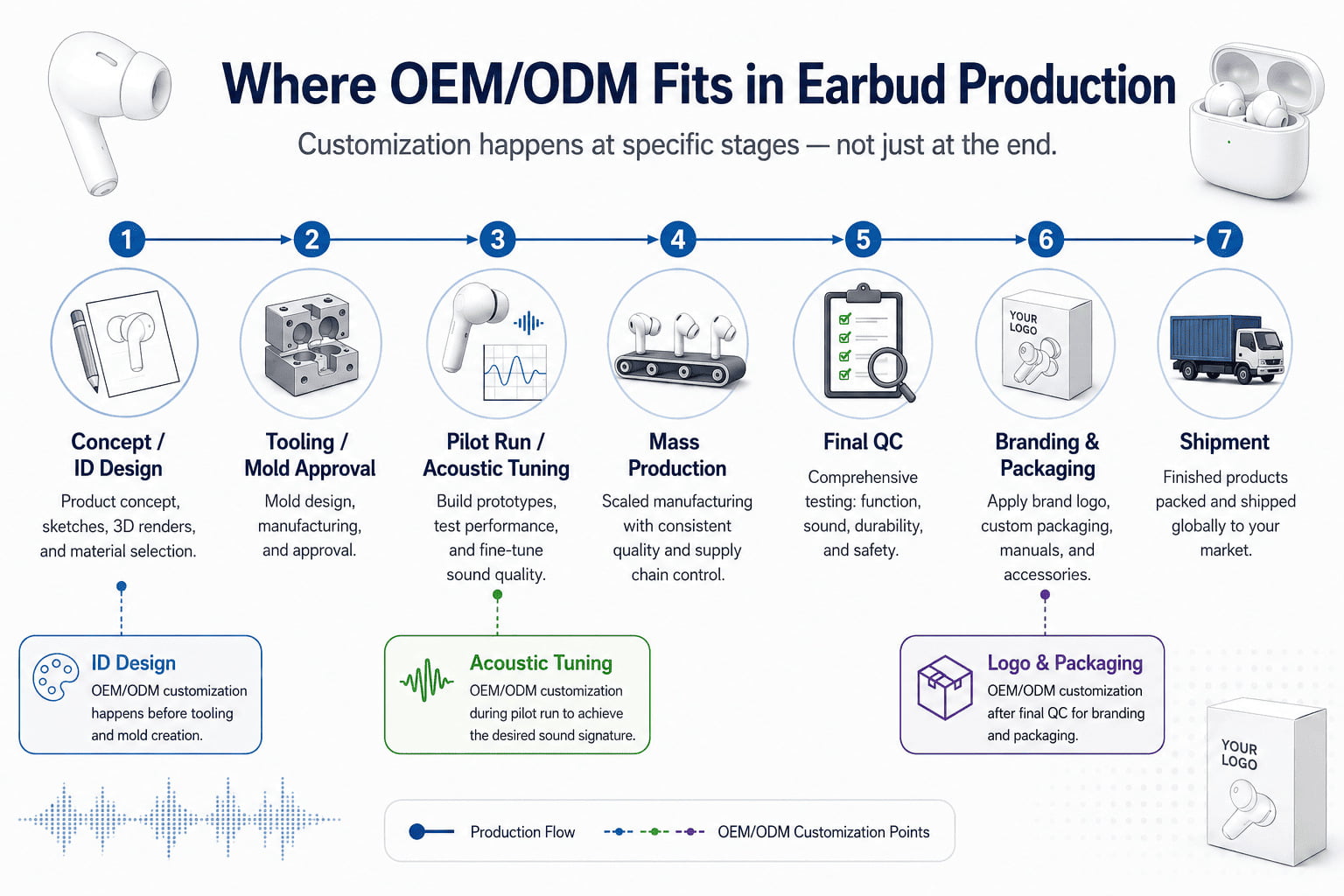
I have seen that timing is everything for successful customization. Our factory’s process shows that early communication about customization needs helps avoid costly delays. For instance, if you want a unique industrial design (ID) for your earbud housing, this must be approved before we even think about opening a mold. If we start mold making and then you change the ID, we might have to restart, which adds huge costs and time. After initial prototypes are built, acoustic tuning is a critical OEM/ODM step. This is where we adjust the sound profile to your exact specifications. This happens during pilot runs, not at the very beginning or end. We test different drivers and fine-tune the audio output. This ensures your brand’s signature sound. Finally, branding elements, like your logo on the earbuds or the specific design of your packaging, come after the core product passes functional quality checks. These steps add variable lead times. They also affect the overall cost structure. It is important for buyers to understand these integration points. This prevents surprises later on. It also helps manage expectations for delivery.
Initial Design Integration
The journey for custom Bluetooth earbuds begins with the initial design. This is where the product concept takes shape. If a client needs a custom industrial design (ID), our engineers work closely with them. This involves detailed sketches, 3D renders, and material selection. This stage must conclude with a final design approval. This happens before any mold opening. Any changes after mold approval can cause significant delays and added costs. Based on our B2B customer communication history, design finalization early on is key. This ensures a smooth transition to tooling development.
Acoustic Tuning: The Sound Signature
After the physical structure is defined and early prototypes are available, we move to acoustic tuning. This is a highly specialized part of ODM customization. It is where we adjust the sound performance to meet specific client requirements. This could mean enhancing bass for a powerful sound. It could also mean optimizing clarity for vocal tracks. This process involves testing different speaker drivers. It also involves modifying the internal acoustic chambers. Our engineers perform these adjustments during the pilot run phase. We use specialized audio testing equipment. This ensures that the final product delivers the desired sound quality. I have seen clients provide reference samples or detailed sound profiles. This guides our acoustic engineers. This back-and-forth process ensures the unique sound signature is achieved.
Branding and Packaging: Final Touches
The final stages of customization involve branding and packaging. Once the earbuds have passed all functional and quality tests, we apply your brand’s logo. This can be done through pad printing, laser engraving, or other methods. The packaging design is also critical. It includes custom box structures, graphics, and user manuals. Our factory’s production records show that these branding elements are prepared in parallel with the main production. However, they are only assembled and applied after the final quality control of the earbud units themselves. This ensures that the finished products, complete with your brand identity, are ready for shipment.
| Customization Type | Integration Stage | Impact on Production |
|---|---|---|
| ID Design | Pre-tooling approval | Affects mold cost and time |
| Acoustic Tuning | Pilot run | Requires specialized testing and adjustments |
| Branding/Packaging | Post-final QC assembly | Adds lead time for materials and printing |
Why Is Quality Assurance More Than Just a Final Check?
Do you ever wonder if a single final check is enough to guarantee product quality? Many believe quality control happens only at the end. But quality assurance is not a single gate. It is a series of distributed checkpoints throughout the entire production process.
Quality assurance in earbud manufacturing is a multi-stage process, not just a final check. It includes Incoming Material Inspection (IQC), In-Process Quality Control (IPQC) during SMT and assembly, and Final Quality Control (FQC) with ISO 2859 sampling8. Skipping any stage significantly increases the risk of defective products reaching the customer.
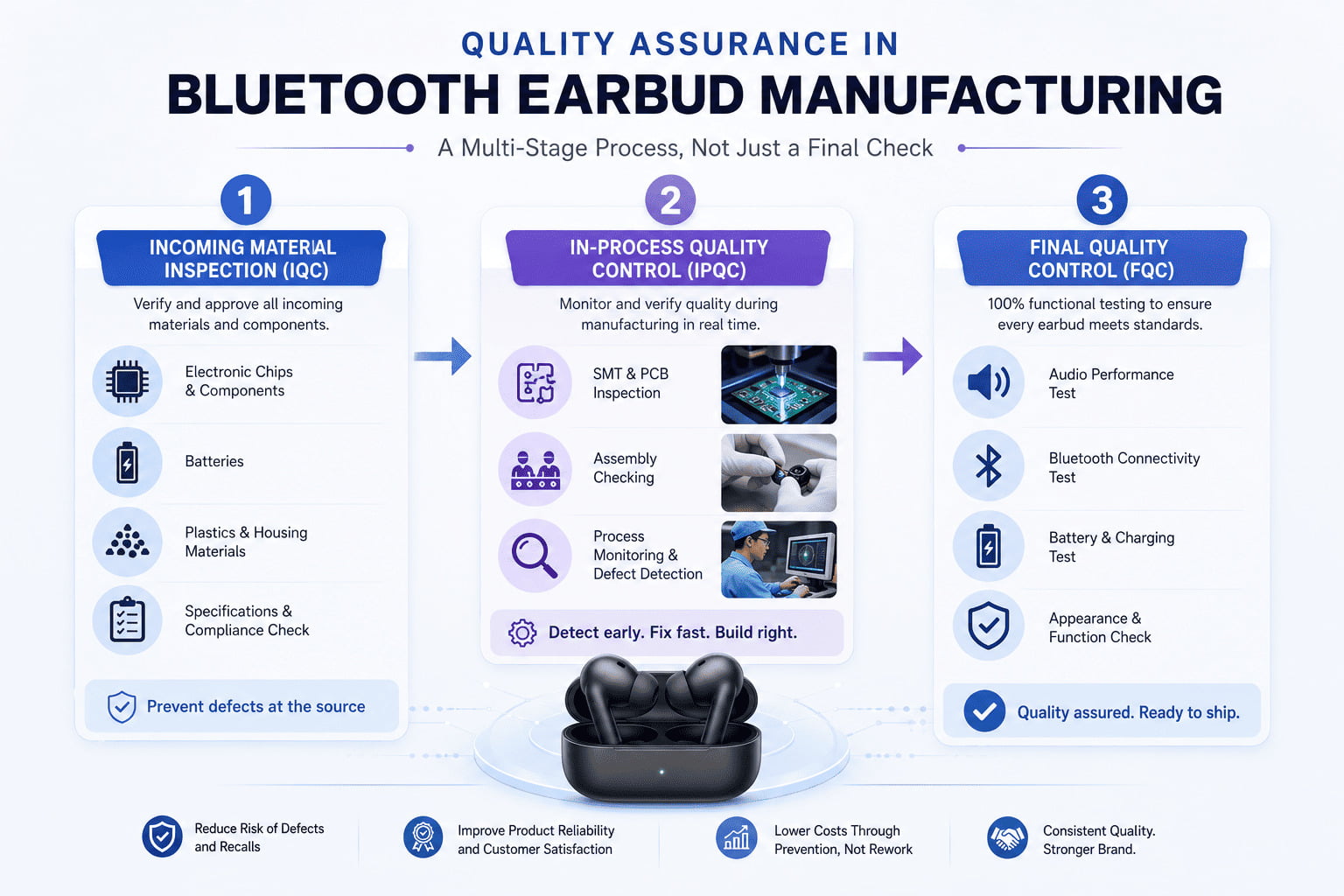
I understand that procurement managers need to be sure about product reliability. Our factory’s QC protocol clearly shows that robust quality control is built into every step. It starts even before production begins. It does not wait until the earbuds are fully assembled. Based on the factory's IQC protocol, all incoming materials, like Bluetooth chipsets, batteries, and plastics, undergo strict inspection. We check them for compliance with standards like RoHS and REACH9. This prevents faulty components from ever entering the production line. Then, during the manufacturing process, we have In-Process Quality Control (IPQC). This involves checks during SMT (Surface Mount Technology) assembly for PCBs. It also includes checks during the earbud housing assembly. This catches issues early. It avoids wasting resources on defective units. Finally, after assembly, we conduct Final Quality Control (FQC). This includes 100% functional testing for every earbud. We check audio performance, battery life, and Bluetooth connectivity. We also use ISO 2859 sampling for overall batch quality. Every B2B customer question about quality assurance is met with this detailed, multi-stage approach. This ensures consistent product quality and reduces defect rates.
Incoming Material Inspection (IQC)
The first line of defense for quality is Incoming Material Inspection, or IQC. Before any material enters our production line, our QC team rigorously checks it. This applies to every component, from tiny electronic chips to plastic granules for injection molding. We verify material specifications against purchase orders. We also check for any physical damage or defects. For electronic parts, we conduct electrical tests. We ensure compliance with environmental standards like RoHS. I have seen that catching a bad batch of batteries or faulty PCBs at this stage saves immense time and cost. If these issues are not found here, they lead to problems much later in production.
In-Process Quality Control (IPQC)
During the actual manufacturing, In-Process Quality Control (IPQC) is continuously active. As components are assembled, our QC inspectors perform checks at various critical points. For example, after the SMT process, we inspect the PCB for correct component placement and soldering quality. During the earbud assembly, we check for proper driver installation. We also check for secure wiring. We check for correct housing assembly. This is not a random check. It is a systematic process. It is integrated into each workstation. It catches defects as they happen. This prevents further assembly of a faulty unit. It ensures that only good quality partially finished products move to the next stage.
Final Quality Control (FQC)
The final stage is Final Quality Control (FQC). This is where the fully assembled earbuds undergo a comprehensive series of tests. Every single earbud goes through a 100% functional test. We check Bluetooth pairing stability. We test audio output across different frequencies. We measure battery life. We verify button functions. We also check the charging case functionality for TWS models. Beyond individual unit testing, we also perform batch sampling according to ISO 2859 standards. This ensures overall batch quality. This rigorous final check confirms that every earbud leaving our factory meets the specified performance and quality criteria.
| QC Stage | Purpose | What is Checked | Risk if Skipped |
|---|---|---|---|
| IQC | Prevent faulty raw materials | Component specs, material compliance | Wasted production, major recalls |
| IPQC | Catch defects during assembly | Soldering, component placement, assembly | High defect rate, rework, production delays |
| FQC | Verify final product performance | Full functionality, audio, battery | Customer complaints, brand damage |
What Really Limits Production Capacity and Affects Delivery?
Are you wondering why a factory with high daily output still struggles with sudden rush orders? Many buyers equate capacity solely with the number of units produced per day. But production capacity is constrained by more than just daily output. It is about line setup time and component availability.
Production capacity is limited not only by daily output but also by line setup time, component availability, and existing production schedules. Rush orders without buffer time often lead to increased costs, higher risks of errors, and potential delays for other projects. This is because reconfiguring lines and sourcing components takes time.
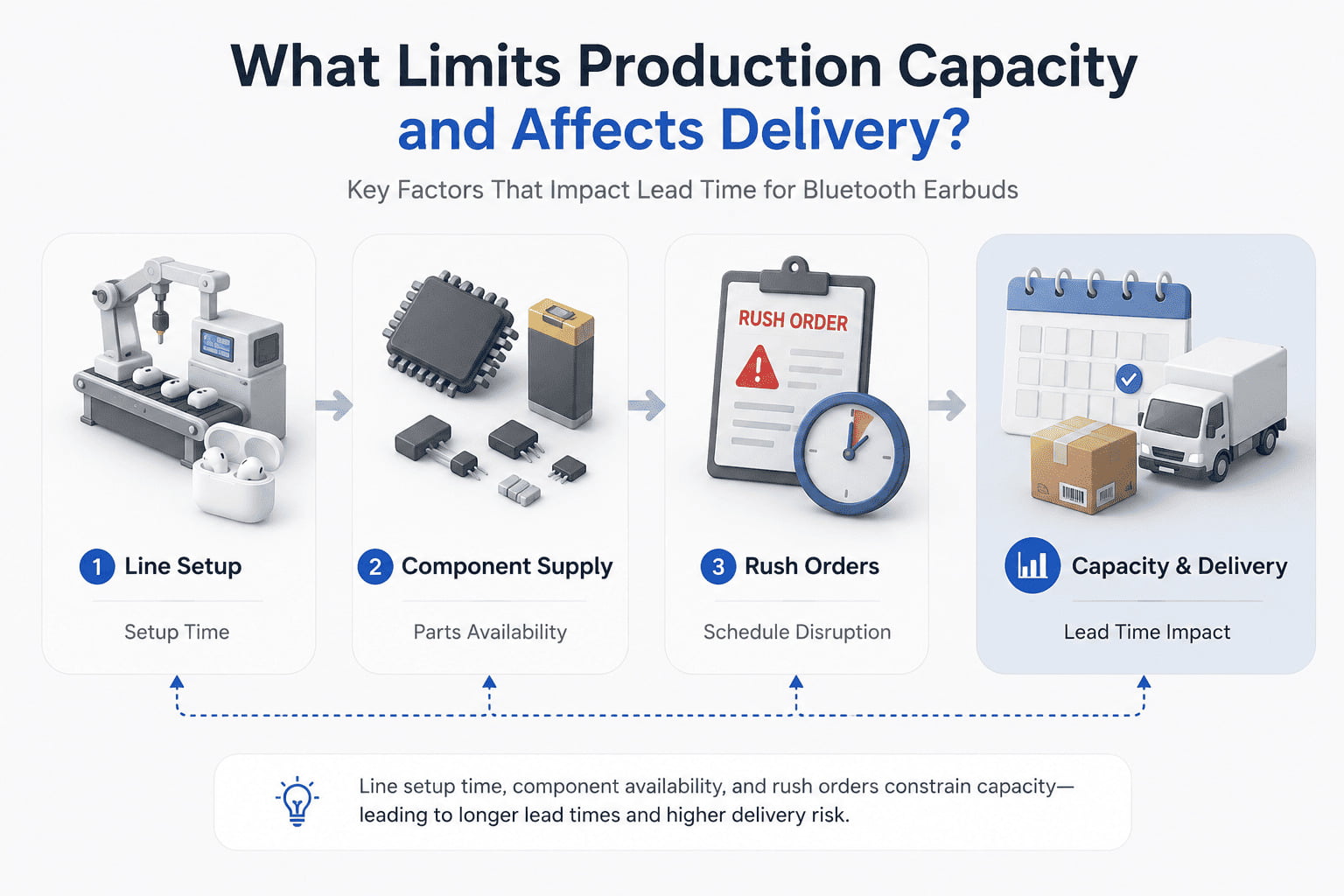
I have seen many B2B customers wonder why an urgent request takes longer or costs more. It is because production capacity is a complex equation. It is not just about the number of machines we have. Our factory has 13 production lines10 and can make over 1 million units a year11. However, setting up a production line for a new model or a significantly different customization takes time. We call this line setup time. It involves calibrating machines, installing specific jigs, and training staff for new assembly processes. Based on our factory’s production records, this setup can take days. This reduces the actual production time available. Another big factor is component availability. Even with a large factory, we rely on a supply chain for chips, batteries, and other parts. Disruptions or sudden high demand for specific components can severely limit how many earbuds we can build. This affects our ability to process rush orders without buffer time. Understanding these constraints helps manage expectations. It also helps clients understand why buffer time is important. It reduces risk and ensures more predictable delivery.
Line Setup and Reconfiguration
Each type of earbud or significant customization requires a specific production line setup. This is not a simple flip of a switch. It involves reconfiguring assembly stations. It also means installing specialized tools and test fixtures. Our engineers must recalibrate automated equipment. The production staff needs training on new assembly sequences or quality checks. For a TWS model, this might mean setting up charging case assembly. For a sports model, it might mean integrating specialized sealing stations. This process takes time away from actual production. I understand that rushing this setup can lead to mistakes. It can also lead to lower quality. This is why we schedule line changes carefully.
Component Supply Chain
The availability of key components is a major bottleneck for production capacity. Bluetooth chipsets, lithium-ion batteries12, and even specific acoustic drivers are often sourced from specialized suppliers. We manage a robust supply chain to ensure a steady flow of materials. However, global market changes, supplier issues, or unexpected demand spikes can cause shortages. Our factory constantly monitors component inventories. We also work closely with suppliers. This helps predict and mitigate potential delays. If a client needs a specific, less common chipset, the lead time for that component alone can dictate the entire project timeline.
The Impact of Rush Orders
When a client requests a rush order, it creates significant challenges. Our production lines are typically scheduled weeks or months in advance. A rush order often means disrupting an existing schedule. It might mean pulling staff from other projects. It might also mean paying overtime. More importantly, it reduces the buffer time for quality checks and unexpected issues. This increases the risk of errors and defects. I have seen that rush orders without proper buffer time often lead to higher costs for expedited shipping of components. They also lead to potentially compromised quality due to shortened testing cycles. Clear communication and realistic timelines are vital to avoid these issues.
| Limiting Factor | Impact on Production Capacity | Buyer Decision Implication |
|---|---|---|
| Line Setup Time | Reduces effective production days | Early design finalization for efficiency |
| Component Supply | Potential shortages, longer lead times | Provide demand forecasts, choose common components |
| Rush Orders | Disrupts schedules, increases risk | Plan with buffer time, accept higher costs |
Conclusion
The production of Bluetooth earbuds is a complex, multi-stage process with variations based on product type and customization. Understanding steps like material inspection, SMT, acoustic tuning, and continuous quality checks is crucial. This helps manage timelines and ensures supply reliability.
"Surface Mount Process", https://www.surfacemountprocess.com/. Surface Mount Technology (SMT) is an established electronics assembly method where components are placed directly onto PCB surfaces, widely used in compact consumer electronics manufacturing including audio devices. Evidence role: definition; source type: encyclopedia. Supports: Surface Mount Technology (SMT) is a standard method for assembling electronic circuits where components are mounted directly onto the surface of printed circuit boards. ↩
"Anechoic chamber - Wikipedia", https://en.wikipedia.org/wiki/Anechoic_chamber. Acoustic tuning in audio devices involves modifying driver parameters, acoustic chambers, and electronic equalization to achieve specific frequency response characteristics and sound signatures. Evidence role: mechanism; source type: education. Supports: Acoustic tuning involves adjusting physical and electronic parameters to modify frequency response and sound characteristics in audio devices. Scope note: This describes general acoustic tuning principles; specific implementation methods vary by manufacturer and product design. ↩
"Injection moulding - Wikipedia", https://en.wikipedia.org/wiki/Injection_moulding. Injection molding is a standard thermoplastic manufacturing process where molten plastic is injected into precision molds, commonly used for producing durable housings in consumer electronics. Evidence role: mechanism; source type: encyclopedia. Supports: Injection molding is a manufacturing process for producing plastic parts by injecting molten material into molds. ↩
"TWS - Wikipedia", https://en.wikipedia.org/wiki/TWS. True Wireless Stereo (TWS) technology enables completely independent left and right earbud operation without cables, with each unit containing its own battery, Bluetooth receiver, and audio driver. Evidence role: definition; source type: encyclopedia. Supports: True Wireless Stereo (TWS) refers to wireless earbuds where left and right units operate independently without any physical connection. ↩
"Printed circuit board - Wikipedia", https://en.wikipedia.org/wiki/Printed_circuit_board. Printed circuit boards (PCBs) are laminated boards with etched conductive copper pathways that provide mechanical support and electrical connections for electronic components, fundamental to modern electronics assembly. Evidence role: definition; source type: encyclopedia. Supports: A printed circuit board (PCB) is a board that mechanically supports and electrically connects electronic components using conductive pathways. ↩
"List of Bluetooth protocols - Wikipedia", https://en.wikipedia.org/wiki/List_of_Bluetooth_protocols. Bluetooth is an IEEE 802.15.1 standardized wireless protocol developed by the Bluetooth Special Interest Group, enabling short-range radio frequency communication for audio and data transmission in consumer electronics. Evidence role: mechanism; source type: institution. Supports: Bluetooth is a standardized wireless technology protocol for short-range data transmission between devices. ↩
"IP code - Wikipedia", https://en.wikipedia.org/wiki/IP_code. The IPX rating system, defined in IEC 60529, provides standardized classifications for protection against water ingress, with higher numbers indicating greater water resistance in electronic devices. Evidence role: definition; source type: institution. Supports: IPX ratings are part of the IEC 60529 international standard that classifies degrees of protection against water ingress. ↩
"[PDF] ISO 2859-1 - UNT Chemistry", https://chemistry.unt.edu/~tgolden/courses/iso2859-1.pdf. ISO 2859 establishes statistical sampling procedures for lot-by-lot inspection, providing standardized methods for determining batch acceptance based on sample defect rates in manufacturing quality control. Evidence role: definition; source type: institution. Supports: ISO 2859 is an international standard that provides procedures for acceptance sampling by attributes for batch inspection. ↩
"EU REACH - International Trade Administration", https://www.trade.gov/eu-reach. RoHS and REACH are European Union regulatory frameworks that restrict hazardous substances and chemicals in manufactured products, widely adopted as compliance standards in global electronics supply chains. Evidence role: definition; source type: government. Supports: RoHS (Restriction of Hazardous Substances) and REACH (Registration, Evaluation, Authorization and Restriction of Chemicals) are European regulations governing hazardous materials in products. ↩
"Production line design and system analysis for new ... - DSpace@MIT", https://dspace.mit.edu/handle/1721.1/85788. Electronics contract manufacturers typically operate multiple parallel production lines to enable simultaneous manufacturing of different product variants and to provide production flexibility and redundancy. Evidence role: general_support; source type: other. Supports: Multi-line production configurations are standard in medium to large-scale electronics manufacturing facilities. Scope note: This describes general industry practice but does not verify the specific 13-line configuration claimed for this facility. ↩
"Industrial Production and Capacity Utilization - Federal Reserve Board", https://www.federalreserve.gov/releases/g17/current/default.htm. Contract electronics manufacturers serving the consumer audio market commonly operate facilities with multi-million unit annual capacities, scaled to meet global demand for wireless audio devices. Evidence role: general_support; source type: other. Supports: Large-scale consumer electronics manufacturing facilities typically operate with annual capacities in the millions of units. Scope note: This provides industry context but does not verify the specific 1 million unit capacity claim for this particular facility. ↩
"Lithium-Ion Battery - Clean Energy Institute - University of Washington", https://www.cei.washington.edu/research/energy-storage/lithium-ion-battery/. Lithium-ion batteries offer high energy density and rechargeable capacity, making them the dominant power source for compact portable electronics including wireless audio devices. Evidence role: mechanism; source type: encyclopedia. Supports: Lithium-ion batteries are widely used in portable electronics due to their high energy density and rechargeability. ↩