
Why Does the Internal Structure of Bluetooth Earbuds Matter for Quality?
You’ve seen earbud specs with "same chip," yet sound quality varies wildly. This inconsistency isn't random; it's a direct result of hidden structural choices inside.
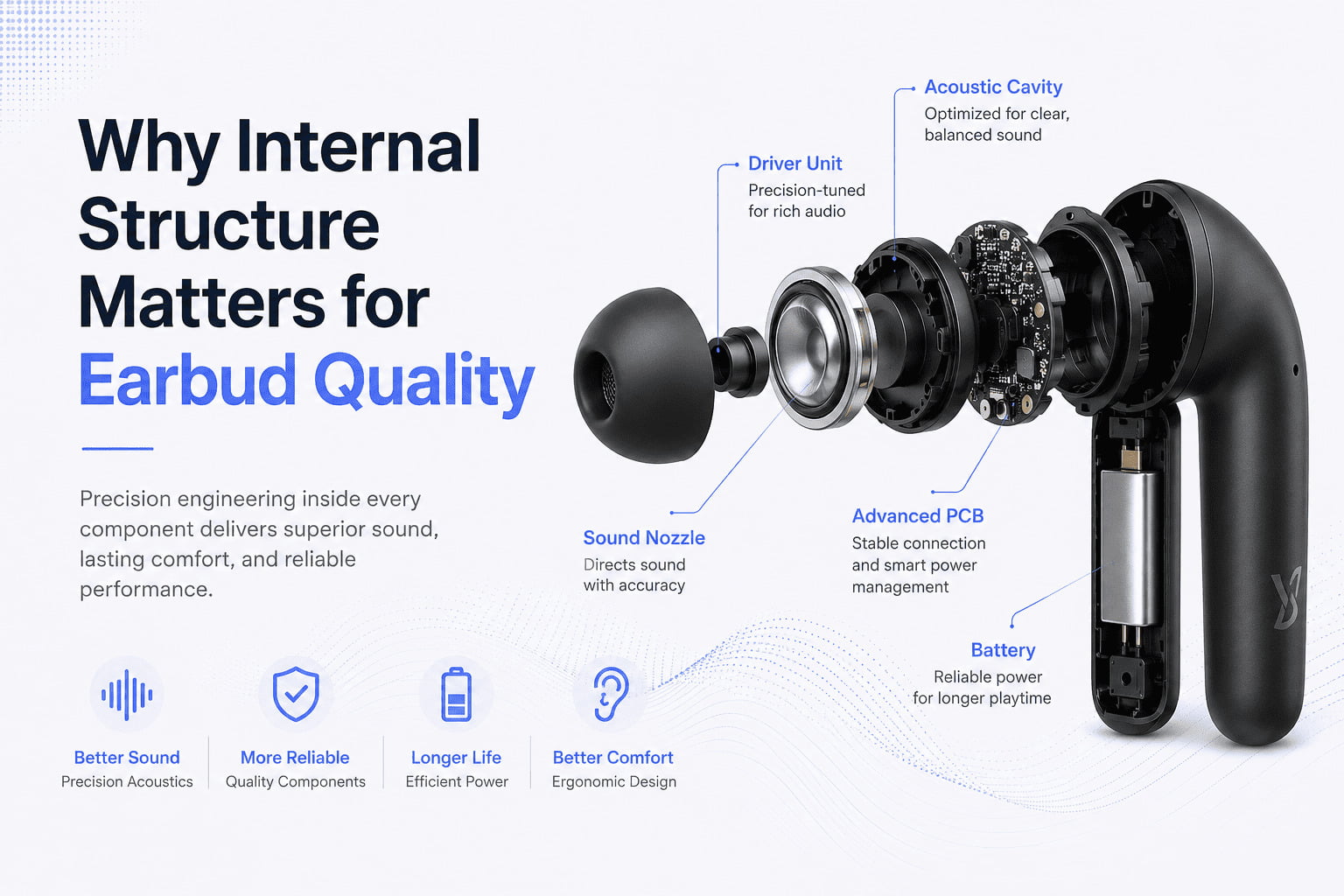
The internal structure of Bluetooth earbuds profoundly affects sound quality, durability, and consistency. Key elements like driver units, acoustic cavity design, and precise assembly, rather than just the chipset, determine the final audio experience and long-term reliability.
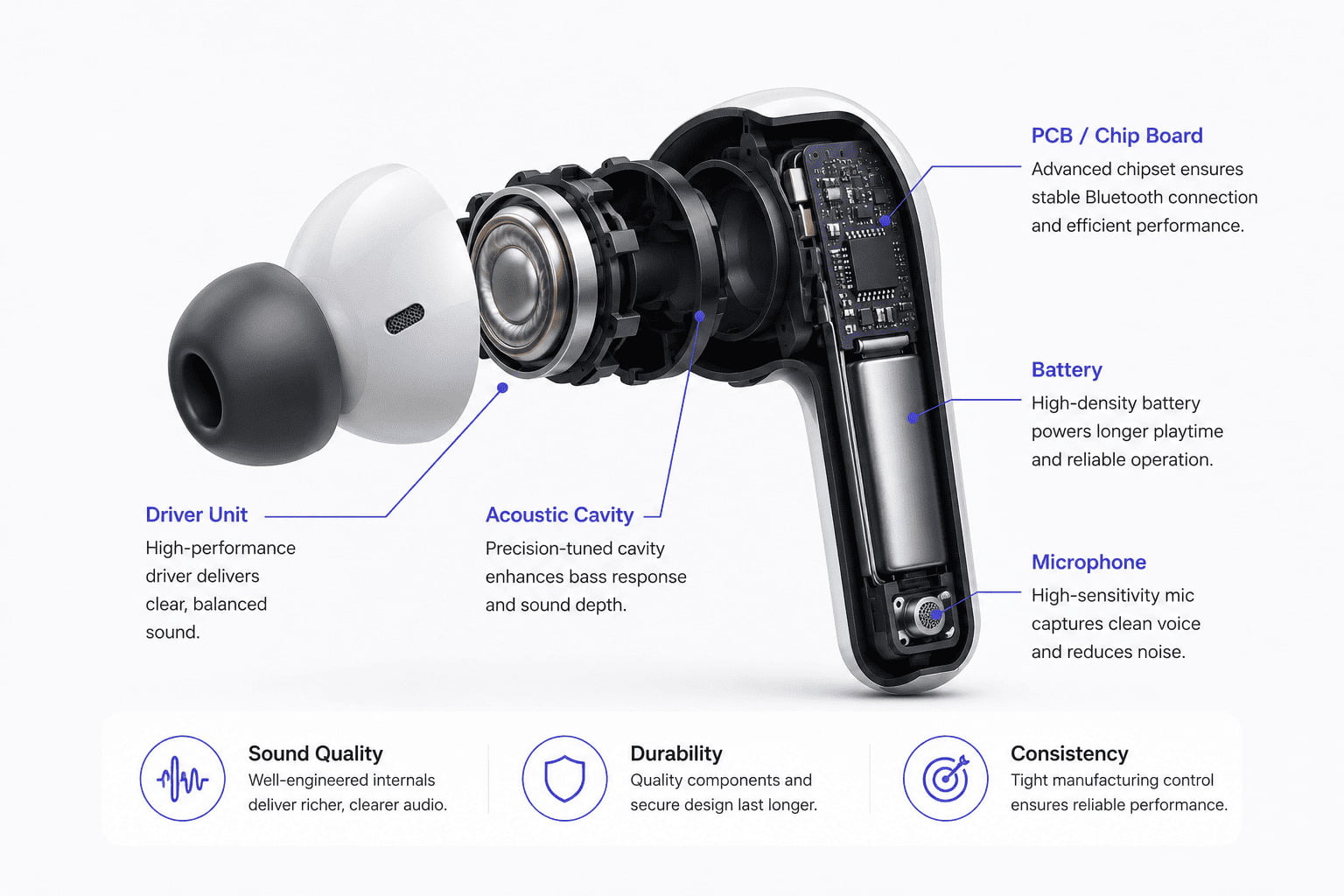
From my observations on countless factory floors, I've seen firsthand how these hidden decisions shape the final product. It's easy to get lost in spec sheets, but understanding the physical construction reveals why some earbuds sound great, and others fall short. Let's peel back the layers and see what really goes on inside.
How Do Components Like Drivers and Cavities Influence Sound?
Ever wonder why two earbuds with the "same chip" can sound so different? The problem isn't the chip; it's the fundamental components and their interaction.
The driver unit generates sound, and the acoustic cavity shapes it1. Together, they form a critical acoustic system. A chipset provides the signal, but drivers and cavity design ultimately dictate frequency response, bass depth, and overall clarity2, making sound quality a system output.
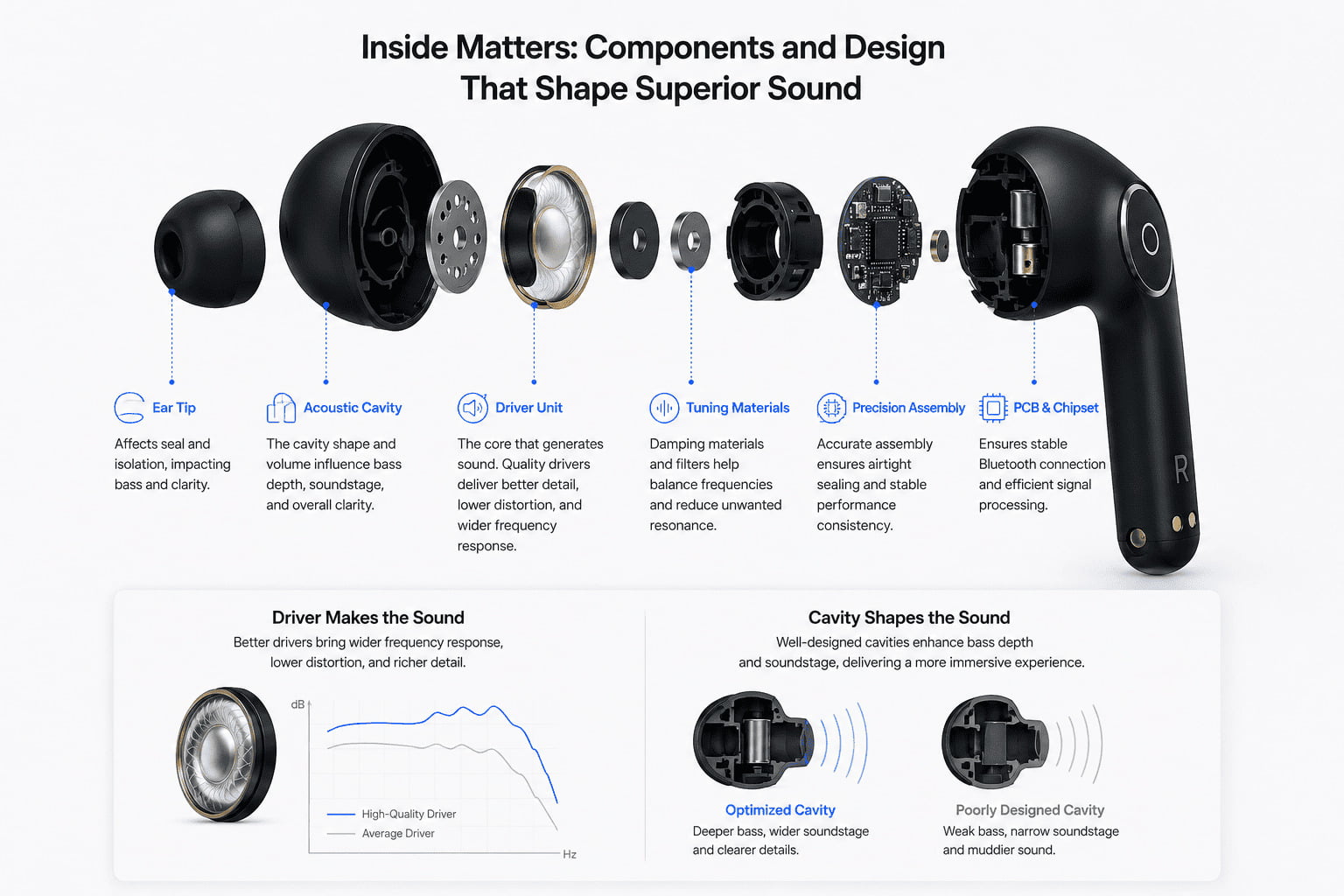
When I walk through the production lines, I always pay close attention to how factories manage driver units and cavity molding. I have seen how a factory optimizes cavity structures. It is not just about choosing an expensive driver. It is about how the driver interacts with its surrounding space. I've learned that the driver determines the potential frequency range. However, the acoustic cavity is like a small concert hall for that sound3. Its shape, volume, and material directly influence resonance4. This affects how bass frequencies resonate and how mid-range and treble tones project. A well-designed cavity can enhance a mid-tier driver’s performance. A poorly designed one can make a premium driver sound flat. This is where the "same chip, different sound" reality truly begins. Suppliers must validate driver-cavity pairings across production batches. This ensures that the acoustic signature remains consistent. I ask clients to consider this. How does the factory manage these two critical parts? It directly impacts the final audio quality perception, which is what your end-users will experience. Over my years, I've noticed that factories with robust R&D in acoustic engineering, even if not designing the chip, consistently produce better-sounding products because they understand this synergy. It isn't just about components; it's about their harmonious integration.
Driver Unit's Role
- Function: Converts electrical signals into sound waves.
- Impact: Determines frequency response range and maximum output.
- Procurement Insight: Look for suppliers who can demonstrate consistent driver performance across batches.
Acoustic Cavity Design
- Function: Shapes sound waves; controls resonance.
- Impact: Influences bass depth, soundstage, and overall clarity.
- Procurement Insight: Inquire about molding tolerances and how they ensure cavity consistency.
This dual relationship is key for good sound.
What Role Does Acoustic Tuning Play in Overall Performance?
You have the drivers and the cavity, but still, something feels off with the sound? The missing piece is often acoustic tuning—the silent architect of sound quality.
Acoustic tuning is the critical process of fine-tuning an earbud's sound profile using physical dampening, porting, and digital signal processing. It ensures that the combined drivers and cavity deliver a balanced, pleasing, and consistent audio experience that meets specific brand requirements, regardless of the chipset used.
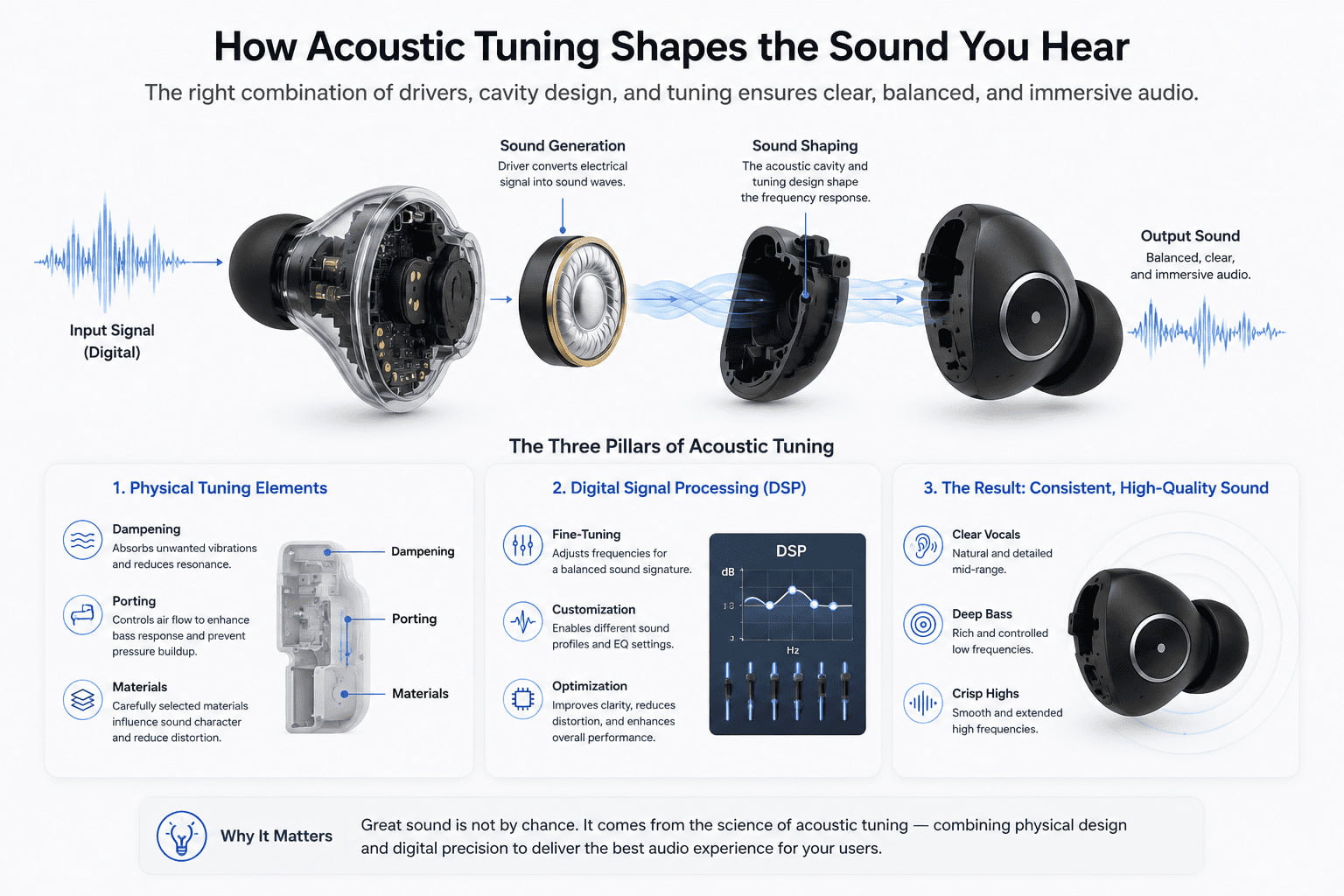
I've often seen brand managers confused when they get a sample with great hardware but poor sound. They ask why. From my perspective, observing production, I see that acoustic tuning is where the raw hardware becomes a polished product. It is an art and a science combined. It involves subtle physical changes. These include adding acoustic filters, adjusting port sizes, and sometimes using specific materials to dampen unwanted resonances. Beyond the physical aspects, digital signal processing (DSP) algorithms fine-tune the sound profile5. This is where a factory can truly differentiate its output. A good tuning process ensures a consistent frequency response. This is vital for customer satisfaction. It prevents harsh treble or boomy bass. I've observed factories with dedicated acoustic labs for this purpose. They use specialized equipment to measure sound output. They then adjust components until the desired sound signature is achieved. This ensures that every earbud leaving the line sounds as intended. It is not about making a "perfect" sound. It is about making a "consistent" and "desired" sound that aligns with your brand’s audio profile. For procurement, asking about a supplier's acoustic tuning capabilities is crucial. It directly impacts your brand's reputation for sound quality. Without proper tuning, even the best components will underperform, leading to dissatisfied customers and increased returns.
Physical Tuning Elements
- Dampening: Using materials to absorb unwanted vibrations.
- Porting: Designing air vents to control bass response and pressure.
- Impact: Modifies the sound directly from the driver and cavity.
Digital Signal Processing (DSP)
- Function: Software algorithms that adjust audio frequencies.
- Impact: Allows for fine-tuning sound profiles and custom EQs.
- Procurement Insight: Ask how suppliers integrate DSP, especially for custom sound profiles.
Acoustic tuning makes the sound consistent.
Why Is Manufacturing Precision Key for Consistent Quality?
You've picked the perfect design and great components, but production samples still vary in quality? The culprit is often inconsistent manufacturing precision.
Manufacturing precision ensures that every earbud produced adheres to the exact design specifications. This consistency, covering everything from SMT assembly and acoustic cavity molding to driver matching and final assembly, is paramount for delivering reliable performance and uniform sound quality across large production batches.
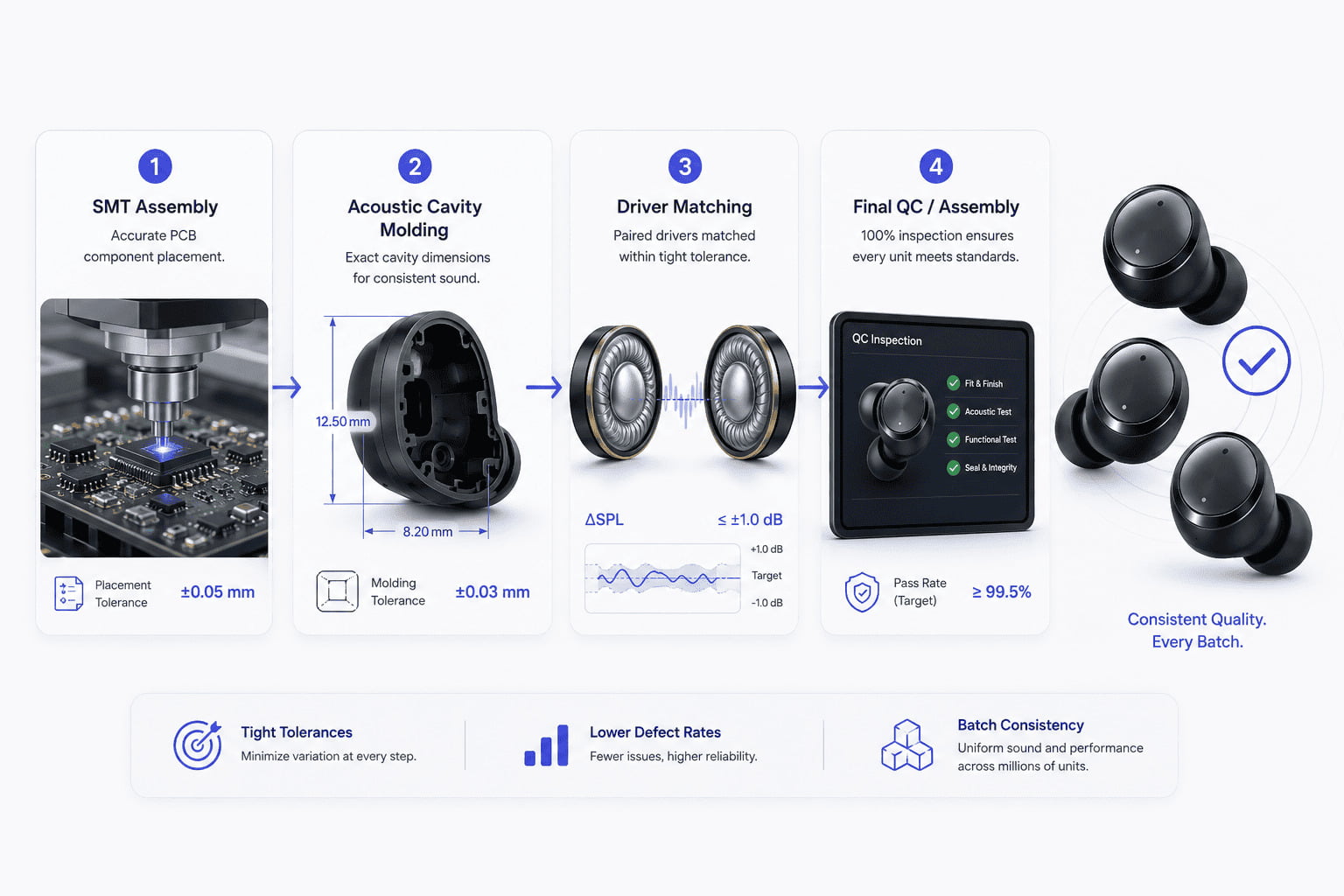
As an independent observer on the factory floor, I have walked through many production lines. I can tell you that "same chip, different sound quality" often comes down to this. It's not about a faulty chip. It's about how the pieces are put together. I've observed production lines where the attention to detail is remarkable. I've also seen lines where corners are cut. Small deviations in molding tolerances for the acoustic cavity can alter sound6. Imperfect SMT assembly of the main circuit board can introduce noise or connectivity issues7. Driver matching protocols are also critical. Factories should pair drivers that have similar performance characteristics8. This prevents one earbud from sounding different from the other. This consistency is not glamorous, but it is the backbone of reliable quality. It directly affects the defect rate. It impacts after-sales costs for your brand. When I audit suppliers, I always look for their quality control points during assembly. I check how they verify structural integrity and acoustic consistency. This is especially true for large volume orders. A slight variance multiplied by a million units becomes a huge problem. From my experience talking to brand managers, this is often the root cause of customer complaints. Ensuring consistent quality at scale is a primary concern for any B2B buyer. It speaks volumes about a supplier's operational excellence.
Precision in Key Manufacturing Stages
- SMT Assembly: Accurate placement of tiny electronic components on the PCB.
- Acoustic Cavity Molding: Maintaining exact dimensions for consistent sound.
- Driver Matching: Pairing drivers with similar performance for stereo balance.
Impact on Product
- Consistency: Uniform sound quality and performance across all units.
- Reliability: Lower defect rates and increased product lifespan.
- Procurement Insight: Request details on QC checkpoints for assembly precision and batch consistency testing.
Precision matters for reliable quality.
How Do Design Choices Impact Cost and Reliability?
You want cutting-edge features but need to manage your budget and prevent product returns? Balancing design choices with cost and reliability is a tightrope walk.
Good internal structural design is about strategic trade-offs, balancing desired features, cost constraints, and manufacturability. Over-engineering can increase complexity, defect rates, and after-sales costs without proportional benefit, while smart design focuses on optimized solutions for consistent quality at scale.
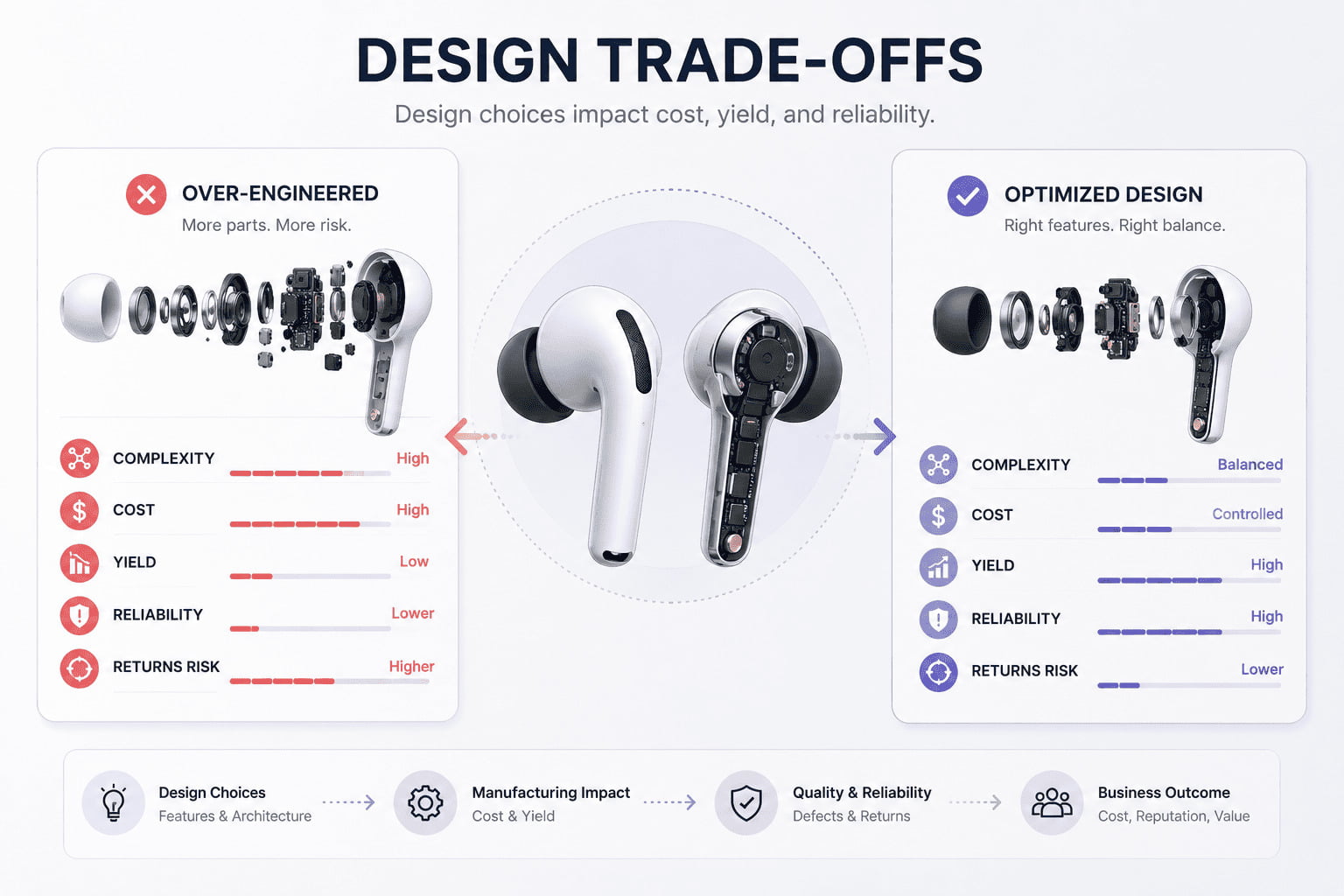
When I consult with clients, a common question is, "How can we get advanced features without breaking the bank or having tons of returns?" My answer, based on factory observations, always comes back to smart design choices. It’s a misconception that more features always mean a better product. I've observed that good structural design isn't about stacking every possible feature. It is about understanding the core task requirements and applying appropriate solutions. For instance, an overly complex multi-driver setup might look good on paper. However, it can significantly increase manufacturing complexity. This raises potential points of failure and drives up costs. It also impacts the yield rate. A higher yield rate means fewer defective units9. This is important for large-volume procurement. Simpler, well-executed designs often lead to higher yield rates10. They also result in lower after-sales costs. This is because there are fewer things that can go wrong. The price of an earbud often reflects this. It pays for validated acoustic designs. It covers tighter tolerance control. It also includes lower failure rates. This is not necessarily just for more expensive parts. It is for the consistency in manufacturing. Procurement managers must look beyond the initial Bill of Materials (BOM) cost. They should evaluate the supplier's capability to deliver consistent, reliable products through intelligent design. This directly impacts your total cost of ownership. It also affects your brand's reputation in the long run. I always advise clients to consider the total cost, not just the unit cost, over the product's lifecycle.
Design Trade-offs
- Complexity vs. Yield: Simpler designs often lead to higher production yields.
- Features vs. Cost: Each added feature must justify its impact on manufacturing cost and risk.
- Reliability vs. Materials: Choosing materials that balance performance with long-term durability.
Procurement Impact
- Cost Control: Smart design minimizes over-engineering and reduces production costs.
- Reduced Returns: Higher reliability leads to fewer product defects and warranty claims.
- Long-Term Value: Focus on a supplier's ability to consistently execute optimized designs.
Design choices balance cost and reliability.
Conclusion
The internal structure of Bluetooth earbuds profoundly influences their quality, from sound to reliability. It is critical for procurement to look past basic specs and evaluate a supplier's structural design and manufacturing consistency.
"Acoustic resonance - Wikipedia", https://en.wikipedia.org/wiki/Acoustic_resonance. Audio engineering literature confirms that transducers (drivers) convert electrical energy into mechanical sound waves, while the surrounding acoustic cavity acts as a resonant chamber that modifies frequency response through its geometry and volume. Evidence role: mechanism; source type: education. Supports: the basic acoustic principle that drivers convert electrical signals to sound waves and that acoustic cavities modify those waves through resonance. Scope note: General acoustic principles may not address the specific implementation challenges in miniaturized earbud designs. ↩
"Psychoacoustics - Wikipedia", https://en.wikipedia.org/wiki/Psychoacoustics. Audio engineering defines frequency response as the measure of output amplitude across the audible spectrum, bass depth as the system's ability to reproduce low frequencies with adequate level and extension, and clarity as the perceptual quality related to low distortion, good transient response, and minimal frequency masking. Evidence role: definition; source type: education. Supports: the definitions of frequency response as the amplitude variation across frequencies, bass depth as low-frequency extension and impact, and clarity as the absence of distortion and masking. Scope note: Clarity is a subjective perceptual quality that correlates with but is not fully captured by objective measurements. ↩
"[PDF] Modeling acoustic resonators: From theory to application", https://physics.byu.edu/docs/publication/2821. Acoustic engineering principles demonstrate that enclosed spaces, whether large concert halls or small cavities, exhibit resonant modes and boundary reflections that modify the frequency response and spatial characteristics of sound waves, though the specific modal behavior differs with scale. Evidence role: general_support; source type: education. Supports: the principle that enclosed spaces create resonances and modify sound through reflections and standing waves, applicable at different scales. Scope note: The analogy is conceptual; miniaturized cavities exhibit different dominant acoustic phenomena than large architectural spaces. ↩
"[PDF] VOLUME DETERMINATION USING ACOUSTIC RESONANCE", https://www.jhuapl.edu/Content/techdigest/pdf/V12-N02/12-02-Rothman.pdf. Acoustic physics establishes that cavity resonances are determined by geometry and volume through wave equation solutions, while boundary materials affect resonance through their acoustic impedance, absorption coefficients, and reflection characteristics. Evidence role: mechanism; source type: education. Supports: the physical principles governing acoustic cavity resonance, including dependence on geometry, volume, and boundary material properties. ↩
"Audio equalization - Wikipedia", https://en.wikipedia.org/wiki/Audio_equalization. Digital audio processing literature describes DSP techniques such as parametric equalization, finite impulse response (FIR) filtering, and dynamic processing as standard methods for precisely adjusting frequency response, phase characteristics, and dynamic range to achieve target sound profiles. Evidence role: mechanism; source type: education. Supports: the use of digital signal processing techniques including equalization, filtering, and dynamic range processing to modify audio frequency response and characteristics. ↩
"Modeling the frequency response of an acoustic cavity ...", https://jontalle.web.engr.illinois.edu/Public/040ModelOfCavityImages.23.pdf. Acoustic theory demonstrates that resonant frequencies of cavities are directly dependent on volume and geometry, with the Helmholtz resonance formula showing that even small dimensional changes proportionally shift resonant frequencies and thus frequency response. Evidence role: mechanism; source type: paper. Supports: the relationship between acoustic cavity dimensions and resonant frequency, showing that dimensional variations affect acoustic performance. Scope note: Theoretical relationships may not fully capture the complex multi-mode resonances in miniaturized earbud cavities. ↩
"[PDF] A Comprehensive Taxonomy of PCB Defects - University of Florida", https://faculty.eng.ufl.edu/dforte/wp-content/uploads/sites/657/2022/02/A_Comprehensive_Taxonomy_of_PCB_Defects.pdf. Electronics manufacturing literature identifies that SMT assembly defects including inadequate solder joints, component misalignment, and contamination can create high-resistance connections, signal path discontinuities, and electromagnetic interference that manifest as noise or connectivity failures. Evidence role: mechanism; source type: education. Supports: the principle that SMT assembly defects such as cold solder joints, tombstoning, or poor component placement can cause signal integrity issues, noise, and intermittent connections. ↩
"A Review of Acoustic Impedance Matching Techniques for ... - PMC", https://pmc.ncbi.nlm.nih.gov/articles/PMC7411934/. Audio engineering standards emphasize that transducers in stereo pairs should be matched for sensitivity and frequency response within specified tolerances to ensure proper stereo imaging and channel balance. Evidence role: expert_consensus; source type: education. Supports: the principle that matched transducer pairs are necessary for accurate stereo imaging and consistent audio quality. ↩
"What is manufacturing yield? - Precognize", https://precog.co/glossary/manufacturing-yield/. Manufacturing quality terminology defines yield rate as the ratio of acceptable units to total units produced, where higher yield directly indicates fewer defective or non-conforming units in production output. Evidence role: definition; source type: education. Supports: the definition of manufacturing yield as the percentage of units produced that meet quality specifications. ↩
"Yield learning concept", http://escml.umd.edu/Courseware/YieldLea/YLConcept.htm. Manufacturing engineering literature establishes that design complexity increases the number of potential failure modes and assembly steps, thereby reducing yield rates, while Design for Manufacturability (DFM) principles emphasize simplification to improve production quality and efficiency. Evidence role: expert_consensus; source type: education. Supports: the principle that design complexity inversely correlates with manufacturing yield due to increased opportunities for defects. ↩