
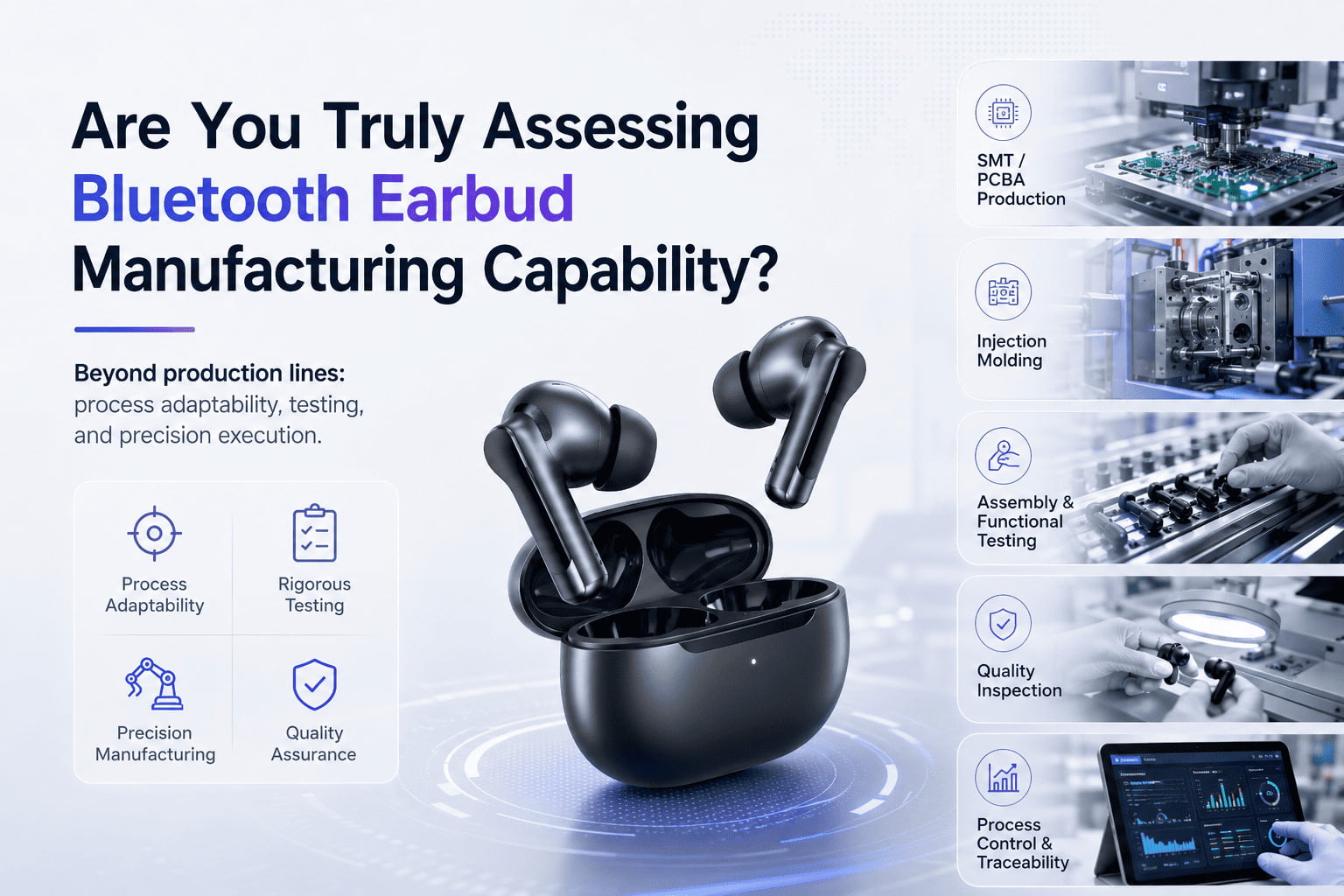
You might think you know what "manufacturing capability" means for Bluetooth earbuds. Problem is, many buyers fixate on superficial metrics. This often leads to unexpected problems and unmet custom needs later. I’ll show you how to look deeper.
True manufacturing capability goes beyond the number of production lines or a list of equipment; it means a factory can adapt core processes—from SMT and injection molding to assembly and testing—to fit your specific product use case, ensuring your custom features perform exactly as intended.
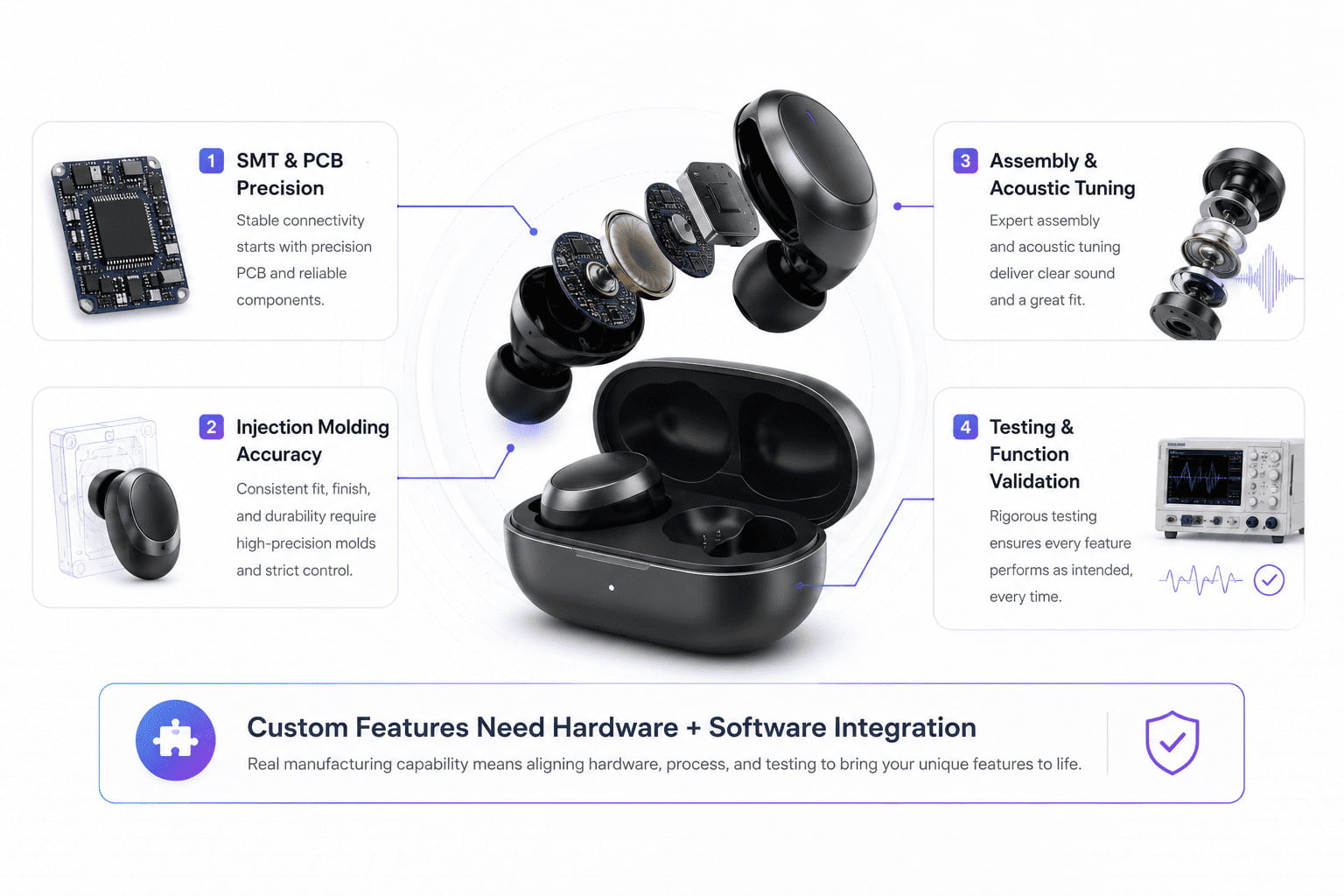
My years working with earbud factories have given me a unique look behind the curtain. I've seen firsthand how procurement managers, despite their experience, often miss the subtle but critical signals of a truly capable manufacturing partner. It's not about the glossy brochures; it's about the factory's ability to pivot and refine its processes to meet real-world demands. Let's break down what that really means for your next earbud project.
Is Custom Earbud Functionality Just a Software Update?
You might assume that adding a special function to your earbuds is simply a matter of software. The problem is, many buyers overlook the hardware implications. This can lead to a factory saying "yes" to a feature but failing to deliver its true performance. I want to explain why this thinking can create big issues.
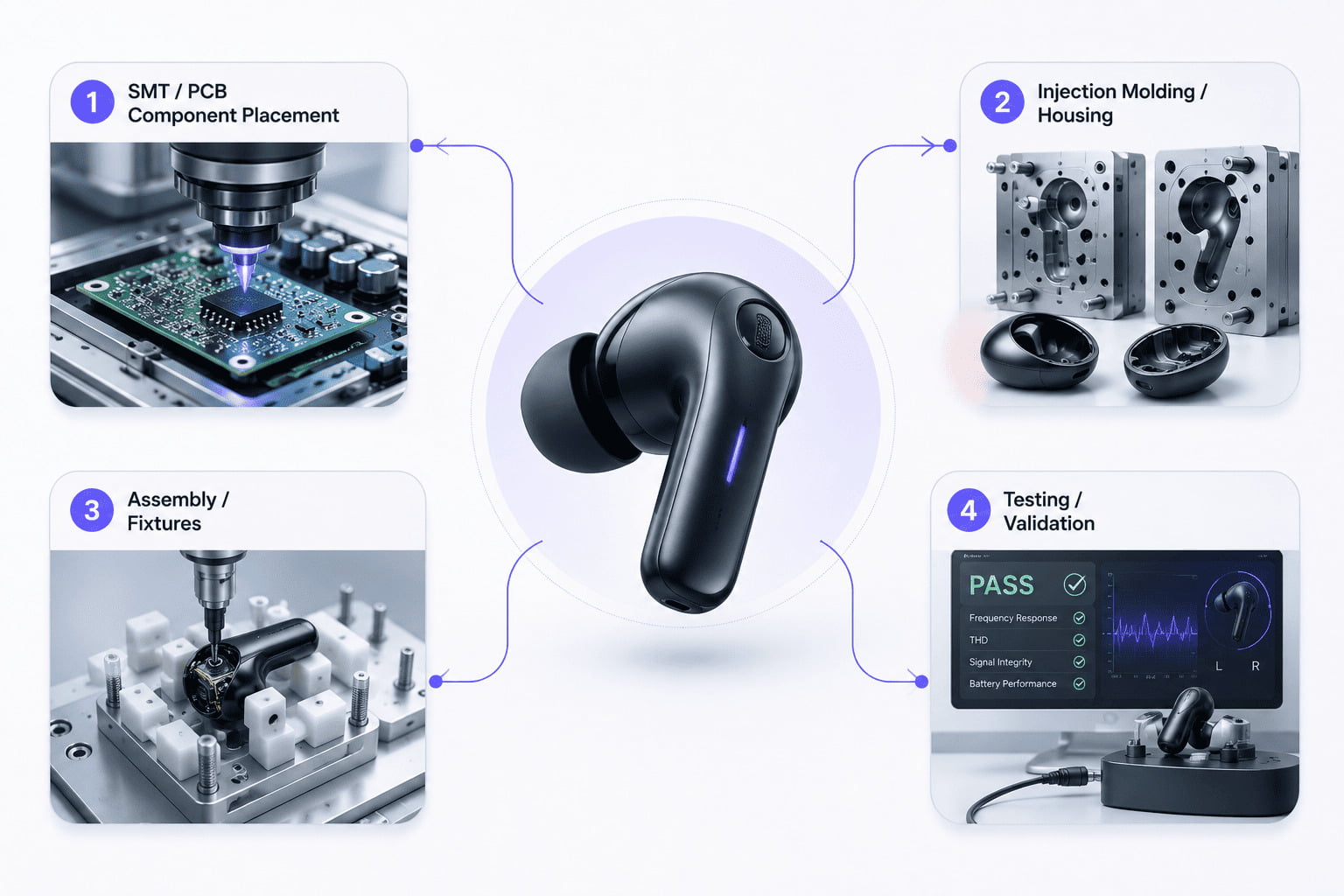
Custom earbud functionality relies heavily on tangible hardware adjustments across multiple manufacturing stages—including precise SMT component placement, specialized injection molding for housing, careful assembly, and rigorous testing—rather than just a simple software configuration.
Beyond the Code: The Hardware Backbone of Customization
When a customer comes to me asking for a unique feature, like enhanced durability for extreme sports or specific touch controls, my first thought isn't "which software update?" It's "how will this impact the physical manufacturing process?" In my experience, a factory that truly understands customization sees it as an integrated hardware and software challenge. For example, if you want a custom sound profile, it’s not just about the audio codec. It involves the precise tuning of the acoustic cavity, which means specific requirements for the injection molding process1 to ensure exact dimensions and material density.
- SMT (Surface Mount Technology)2 Precision: Imagine you need specialized sensors for health tracking in your earbuds. These aren't just popped onto any circuit board. The SMT process must be meticulously calibrated for the placement of these tiny, sensitive components. Any deviation can impact functionality or signal integrity. I've seen how factories with true capability have engineers who can adapt the SMT program for unique component layouts, not just use a standard template. This is far from a simple software adjustment; it's about altering the fundamental electronic assembly.
- Injection Molding for Acoustics and Fit: The earbud housing isn't just cosmetic. Its design is critical for sound delivery and comfort. If a customer wants a unique ergonomic fit or a particular acoustic signature, the injection molding process needs to be precisely controlled. This means specialized mold designs, material selection, and strict parameter control during molding to achieve consistent results. Without this level of control, the promise of a custom fit or sound profile remains just that—a promise. I've observed that factories lacking this depth can only offer standard housing with a logo change, limiting true product differentiation.
- Assembly Sequence and Tooling: Even the way earbuds are put together can change for custom features. If a new sensor or a larger battery is introduced, the assembly line might need new fixtures, jigs, or even a modified sequence of steps. A factory with true process flexibility can adapt its assembly stations to accommodate these changes. I remember one project where a client needed a unique waterproof rating. This required specific sealing techniques during assembly and specialized tooling to ensure every unit met the IPX standard3. This wasn't a software trick; it was a hands-on, process-driven solution.
- Testing Protocol Adaptation: Finally, custom features demand custom testing. A factory can't just run its standard battery of tests if you've added a unique health sensor or a new interaction method. They need to develop specific test protocols to validate the performance of these new functionalities. This often involves new test equipment or software that can accurately measure the custom feature's performance against your specifications. In my view, if a factory just runs its standard tests, it’s not really capable of verifying your custom solutions. True capability means adapting quality control to your specific innovations.
Does More Production Lines Mean More Flexibility for Your Earbuds?
You might look at a factory with many production lines and assume it means high flexibility. The problem is, line count often gives a misleading picture of a factory's true adaptability. This can lead you to choose a factory that can't actually meet your unique product needs, despite its impressive size. I will show you why the number of lines isn't the real indicator.
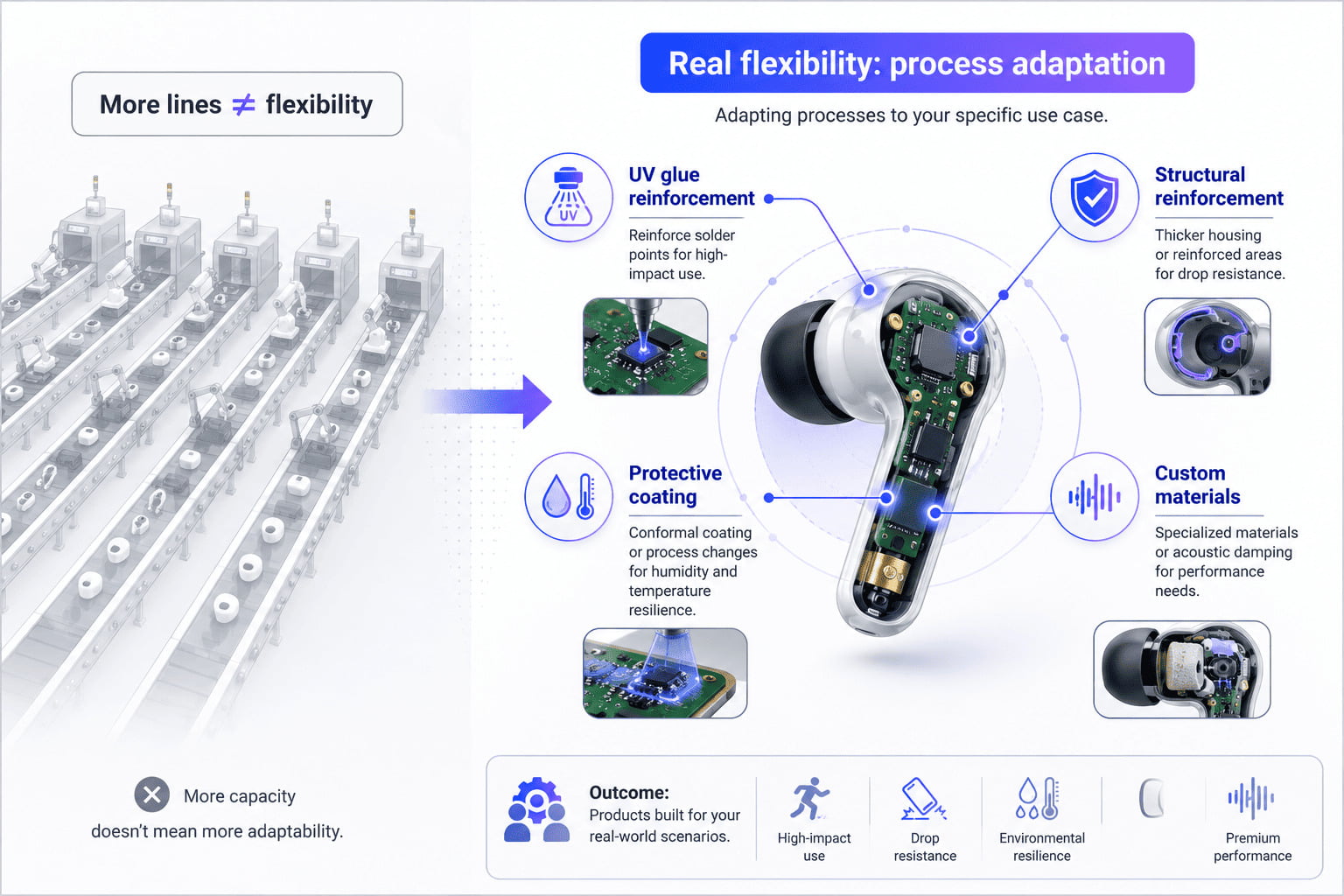
Having more production lines doesn't automatically translate to greater flexibility for custom earbud manufacturing; instead, true flexibility is evident in a factory's ability to adapt specific processes—such as reinforcing solder joints with UV glue for high-impact use cases or modifying structural components—to meet the unique durability and performance demands of your product's intended usage scenario.
The Real Signal: Process Adaptation for Real-World Scenarios
I’ve walked through countless earbud factories, and one common misconception I encounter is the idea that a high number of assembly lines equals high flexibility. In my experience, this is rarely true. Many lines might just mean more capacity for producing standard products, not an inherent ability to adapt. The real signal of a flexible factory lies in its willingness and capability to adjust its processes based on your product’s specific use case.
- Adapting for High-Intensity Use: Consider earbuds designed for professional athletes or construction workers. These aren't just standard earbuds; they need to withstand significant shock, vibration, and sweat. I recall a specific project where a client's early samples were failing in stress tests because internal components, particularly solder joints, were breaking under repeated impact. A factory focused purely on line count would likely say, "That's just the nature of it," or "Our standard process is robust." However, a truly capable factory came back with a solution: applying a specialized UV glue to reinforce critical solder points4. This wasn't a standard step; it required new equipment, a new process station, and trained operators. This specific process adjustment, which I saw implemented and tested, directly addressed the client's unique durability requirements. This is flexibility.
- Structural Reinforcement for Drops: Another common scenario is earbuds that are frequently dropped, perhaps for children's use or for field workers. Standard plastic casings might crack. A flexible factory won't just tell you to choose a different material. They might suggest modifying the injection mold to allow for thicker structural components in specific high-impact areas without significantly altering the overall design or weight. This means adapting the design from a manufacturing perspective, then implementing that change on the production line, including possibly adjusting cooling times during molding or revising assembly techniques. This kind of deep process modification is the hallmark of real adaptability, far more than just adding another assembly line.
- Environmental Resilience: What if your earbuds need to operate flawlessly in extreme temperatures or high humidity? This might require specialized coatings applied during assembly or a modified curing process for internal components. I've observed factories adapting their cleanroom environments or adding new stations for conformal coating applications5—steps that deviate significantly from standard earbud production. This isn't about running more products down a conveyor belt; it's about changing how products are made to meet environmental challenges. A factory’s ability to implement such nuanced changes across different stages of production is a far better indicator of flexibility than its sheer scale.
- Beyond Standard Materials: Sometimes, flexibility means integrating non-standard materials for specific performance needs, like specialized shock-absorbing gels or custom acoustic dampeners. This requires a factory to be able to source, handle, and integrate these materials into their existing processes, potentially developing new methods for bonding or sealing. My experience shows that factories willing to invest in these process adaptations for unique material integration are the ones that can truly deliver on highly customized product visions, proving that flexibility comes from deep process engineering, not just capacity.
Why Do Similar-Looking Earbuds Have Such Different Price Tags?
You might look at two seemingly identical earbuds and wonder why their prices vary wildly. The problem is, many buyers assume the price difference comes from arbitrary markups or minor branding. This often leads to choosing the cheaper option, only to face quality issues later. I want to explain what hidden processes truly drive these cost disparities.
The significant price difference between similar-looking earbuds often stems from crucial manufacturing steps that lower-priced factories omit to cut costs, specifically critical processes like precise acoustic cavity control6, optimized antenna layout, and rigorous quality checks that are essential for ensuring superior audio performance and stable connectivity.
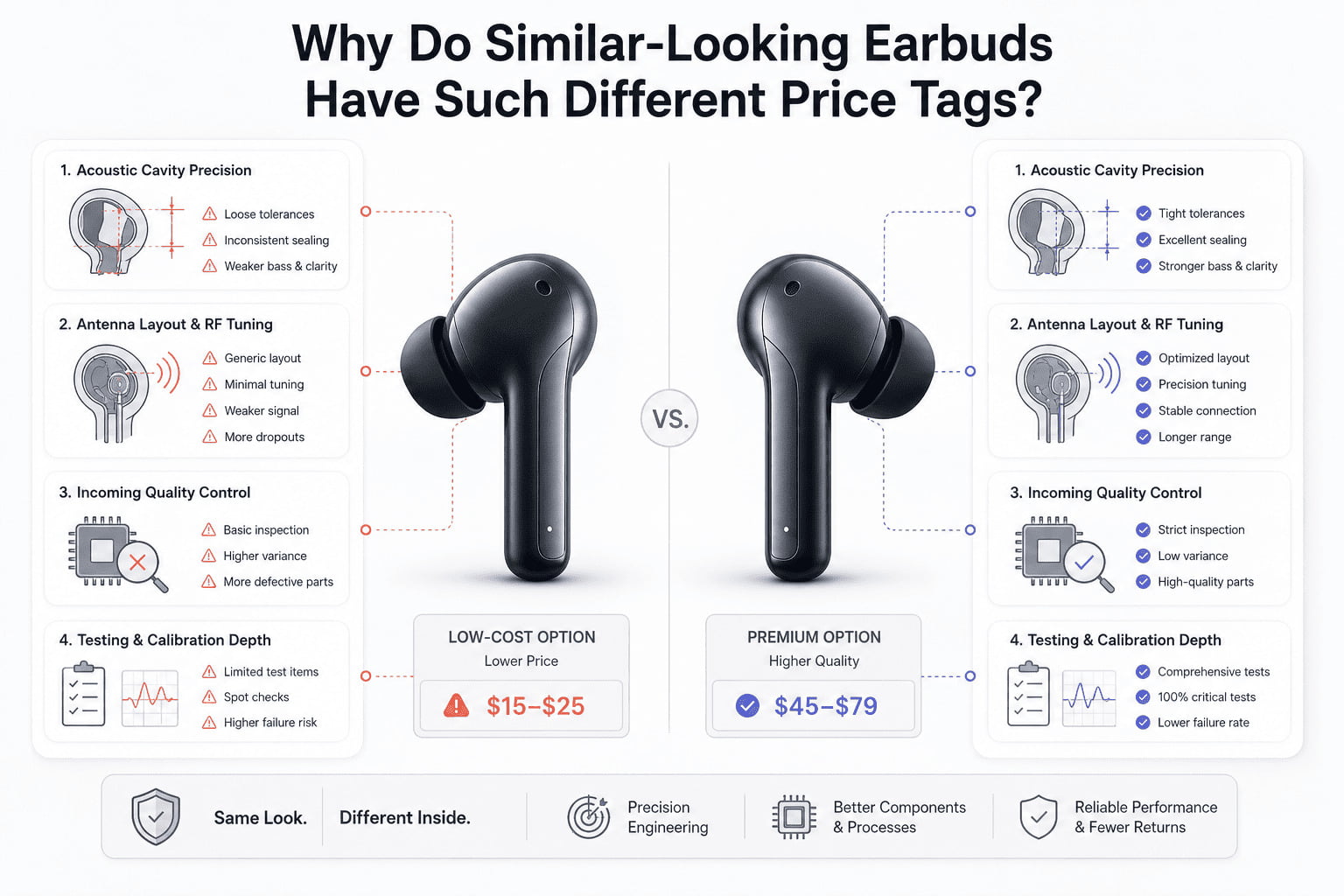
The Hidden Costs of Cutting Corners: Process Omissions
I've been involved in many projects where clients were confused by vast price differences for earbuds that, on the surface, looked almost identical. From my vantage point on the factory floor, I can tell you the price discrepancy rarely comes from arbitrary markups. Instead, it nearly always reflects a difference in the depth and rigor of the manufacturing processes involved. Lower prices often mean crucial steps have been skipped or shortcuts taken, leading to compromises in performance and reliability that aren't immediately visible.
- Acoustic Cavity Precision: The sound quality of an earbud depends heavily on the acoustic chamber inside its housing. This isn't just about the speaker driver; it's about the precise dimensions, sealing, and material properties of the cavity around it. A high-quality factory invests in extremely precise injection molding, using expensive molds and strict quality control to ensure every cavity is perfect. I’ve seen cheaper factories use worn molds or less precise molding parameters, leading to slight variations in the cavity. These small differences can severely impact bass response, treble clarity, and overall sound staging. The cost saving here comes from reduced tooling investment and looser quality checks, but the buyer pays for it in compromised audio performance.
- Antenna Layout and Tuning: Stable Bluetooth connectivity is paramount. While the chipset is important, the physical antenna layout and its integration into the earbud’s structure are equally critical. A premium factory will dedicate engineering time to optimize antenna placement within the compact earbud housing, often requiring specialized tooling and careful assembly to avoid interference. They will also conduct extensive RF testing7 during production to ensure consistent signal strength. I've observed that budget factories often use generic antenna designs or simplify the integration process, leading to weaker signals, frequent disconnections, and reduced range. The cost reduction comes from minimizing engineering effort and skipping expensive RF calibration and testing.
- Component Quality and Inspection: Not all components are created equal, even if they look similar. A higher price often reflects the use of higher-grade components—be it a more stable battery, a more durable cable, or higher-quality audio drivers. More importantly, it reflects the rigorous incoming quality control (IQC)8 processes for these components. A good factory will have strict inspection protocols, often testing a percentage of incoming components to ensure they meet specifications. In my experience, lower-priced options often reduce or skip these IQC steps, relying on the supplier's word. This increases the risk of defective components making it into the final product, leading to higher defect rates and customer returns down the line.
- Testing and Calibration Depth: The final testing phase is another major differentiator. A premium earbud undergoes multiple layers of testing: acoustic performance, battery life under various conditions, connectivity stability, microphone performance, and environmental durability. These tests often require specialized, expensive equipment and dedicated personnel. I’ve witnessed that cheaper production lines often cut back on the thoroughness or duration of these tests, or they might only perform basic functional checks. For instance, instead of comprehensive audio curve analysis, they might just do a simple "sound check." This significantly reduces production costs but means potential flaws, whether in sound, battery, or connectivity, go undetected until they reach the end-user.
Are Advanced Features Like ANC Only About the Chipset?
You might believe that advanced features like Active Noise Cancellation (ANC)9, Environmental Noise Cancellation (ENC)%%%FOOTNOTE_REF10%%%, or [low latency](https://en.wikipedia.org/wiki/Latency(audio))11 are solely dependent on the chosen chipset. The problem is, this overlooks the critical role of physical manufacturing processes. This can lead to disappointment when your high-spec chip doesn't deliver the expected performance. I will explain why process details are just as vital.
Advanced earbud features like ANC, ENC, and low latency are not solely determined by the chipset; their effective performance critically relies on precise manufacturing process details including optimal microphone placement, perfect acoustic chamber sealing through injection molding, and meticulous PCBA layout, all of which ensure consistent and high-quality functionality.
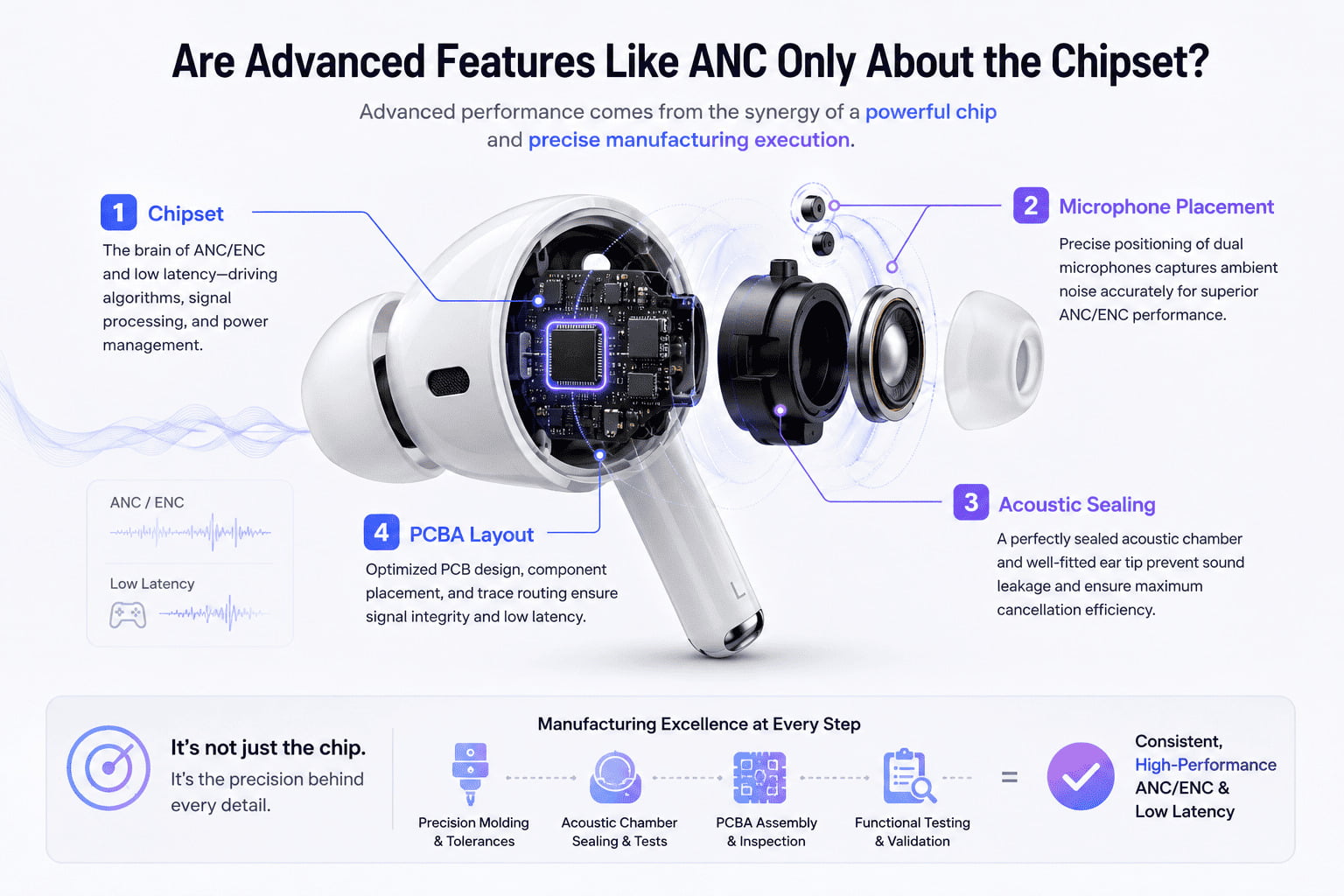
The Process Magic Behind High-Performance Features
When clients talk about features like ANC or low latency, their minds often go straight to the "brain" of the earbud – the chipset. And yes, the chipset is fundamental. But from my perspective, having observed these products come to life on the assembly line, the most powerful chipset in the world means little if the physical manufacturing processes don't support its capabilities. The true performance of these advanced features is a synergy between clever silicon and meticulous execution on the factory floor.
- Microphone Placement and Housing for ANC/ENC: Active Noise Cancellation (ANC) and Environmental Noise Cancellation (ENC) rely heavily on microphones capturing ambient sound and your voice. The exact position of these tiny microphones within the earbud housing is absolutely critical. Even a millimeter's difference can degrade performance. A factory with strong process capability will have precise tooling and assembly jigs to ensure each microphone is placed identically across all units. Furthermore, the housing itself must provide optimal isolation or directivity for the microphone without introducing its own acoustic distortions. I've seen how careful injection molding and precise assembly are paramount here; it's not just about soldering a mic onto a board.
- Acoustic Sealing for ANC Effectiveness: For ANC to work effectively, the earbud's acoustic chamber must be perfectly sealed. Any tiny gaps or inconsistent seals can allow external noise to bypass the cancellation system, significantly reducing its effectiveness. This comes down to the quality of the injection molding for the earbud shells and the precision of the assembly process. A capable factory will have stringent quality checks for sealing, often employing specialized air-leakage tests to ensure acoustic integrity. My experience shows that factories that cut corners on molding quality or rushed assembly often deliver ANC performance that is inconsistent or simply underwhelming, despite having a top-tier ANC chipset.
- PCBA Layout and Signal Integrity for Low Latency: Low latency, especially crucial for gaming or video, depends on the chipset processing data quickly, but also on the physical layout of the Printed Circuit Board Assembly (PCBA). The arrangement of components, the length of traces, and shielding on the PCBA all affect signal integrity and potential interference. A factory with deep process understanding will work with design engineers to ensure the PCBA layout is optimized for the chipset's low-latency capabilities and can manufacture these boards consistently. This involves precise SMT placement and careful routing to minimize electrical noise and ensure swift data transfer, aspects that are directly controlled by the manufacturing process and not just the chip itself.
- Component Tolerances and Consistency: Beyond major components, the numerous smaller capacitors, resistors, and filters on the PCBA also play a role in the performance of advanced features. These components have tolerances. A capable factory understands how to source components with tight tolerances and ensures their SMT process accurately places them. This consistency across thousands of units is vital for maintaining the intended performance of ANC algorithms or low-latency pathways. I've observed that factories focused on true quality implement rigorous component selection and placement verification, ensuring that the intended acoustic or low-latency performance from the chipset isn't undermined by process inconsistencies.
Conclusion
Understanding earbud manufacturing goes beyond surface-level metrics. Real capability means a factory can adapt processes for your specific use cases, ensuring custom features truly perform. This insight helps you identify partners who deliver actual value, not just low prices.
"Injection moulding - Wikipedia", https://en.wikipedia.org/wiki/Injection_moulding. Injection molding can achieve dimensional tolerances of ±0.1-0.5mm depending on part geometry and material, with process parameters including melt temperature, injection pressure, and cooling time directly affecting dimensional consistency. Evidence role: mechanism; source type: education. Supports: the precision capabilities and parameter control requirements of injection molding processes. Scope note: General injection molding capabilities; specific acoustic cavity requirements for earbuds would require specialized engineering data ↩
"Surface-mount technology - Wikipedia", https://en.wikipedia.org/wiki/Surface-mount_technology. Surface Mount Technology (SMT) is an electronics assembly method where components are mounted directly onto the surface of printed circuit boards, requiring precise automated placement typically within ±0.05mm tolerances for modern miniaturized devices. Evidence role: definition; source type: encyclopedia. Supports: the technical definition and precision requirements of Surface Mount Technology in electronics manufacturing. Scope note: General SMT definition; specific tolerances for earbud components may vary by manufacturer ↩
"IP code - Wikipedia", https://en.wikipedia.org/wiki/IP_code. The IPX rating system, defined in IEC standard 60529, classifies the degree of protection against water ingress, with ratings from IPX0 (no protection) to IPX9K (protection against high-pressure, high-temperature water jets). Evidence role: definition; source type: institution. Supports: the official definition and requirements of IPX waterproof rating standards. ↩
"Underfill: A Review of Reliability Improvement Methods in ... - PMC", https://pmc.ncbi.nlm.nih.gov/articles/PMC12389694/. Adhesive underfill materials, including UV-curable epoxies, are commonly applied in electronics manufacturing to redistribute mechanical stress and improve solder joint reliability under thermal cycling and mechanical shock conditions. Evidence role: mechanism; source type: research. Supports: the use of adhesive underfill materials to improve solder joint mechanical reliability. Scope note: General electronics reliability practice; specific effectiveness for earbud impact scenarios would require product-specific testing data ↩
"Conformal coating - Wikipedia", https://en.wikipedia.org/wiki/Conformal_coating. Conformal coating is a thin polymeric film (typically 25-250 micrometers) applied to printed circuit boards to protect electronic components from moisture, dust, chemicals, and temperature extremes, commonly used in harsh environment applications. Evidence role: definition; source type: education. Supports: the definition and protective function of conformal coatings in electronics manufacturing. ↩
"Helmholtz resonance - Wikipedia", https://en.wikipedia.org/wiki/Helmholtz_resonance. Acoustic cavity design directly influences speaker performance through resonance effects; cavity volume and geometry determine resonant frequencies and can significantly affect bass response, with variations of even a few percent in volume potentially causing audible frequency response changes. Evidence role: mechanism; source type: education. Supports: the acoustic principles by which cavity dimensions affect speaker frequency response. Scope note: General acoustic principles; specific sensitivity to dimensional variations depends on earbud design and target frequency response ↩
"Equipment Authorization – RF Device | Federal Communications ...", https://www.fcc.gov/oet/ea/rfdevice. Radio frequency (RF) testing for wireless devices typically includes measurements of transmit power, receiver sensitivity, frequency accuracy, and spurious emissions to ensure compliance with regulatory standards (such as FCC, CE) and verify performance specifications for range and connectivity reliability. Evidence role: general_support; source type: institution. Supports: the purpose and scope of RF testing for wireless consumer devices. Scope note: General RF testing scope; specific test parameters and acceptance criteria vary by product type, wireless protocol, and manufacturer requirements ↩
"Incoming Quality Control (IQC) - Knowledge Base - NexPCB", https://knowledgebase.nexpcb.com/articles/incoming-quality-control-iqc//. Incoming Quality Control (IQC) is a manufacturing quality assurance process that inspects purchased components and materials upon receipt, typically using statistical sampling methods (such as AQL sampling per ISO 2859 standards) to verify conformance to specifications before materials enter production. Evidence role: definition; source type: education. Supports: the definition and typical practices of incoming quality control in manufacturing. Scope note: General IQC definition; specific sampling rates and inspection criteria vary widely by industry, component criticality, and supplier relationship ↩
"Noise-cancelling headphones", https://en.wikipedia.org/wiki/Noise-cancelling_headphones. Active Noise Cancellation (ANC) is a sound reduction technique that uses microphones to capture ambient noise, then generates an inverted sound wave (anti-phase signal) through speakers to destructively interfere with and cancel the unwanted noise. Evidence role: definition; source type: encyclopedia. Supports: the technical definition and operating principle of Active Noise Cancellation technology. ↩
"Active noise control - Wikipedia", https://en.wikipedia.org/wiki/Active_noise_control. Environmental Noise Cancellation (ENC) is a voice processing technology that uses microphone arrays and digital signal processing algorithms to reduce background noise during voice calls, improving speech intelligibility for the listener on the other end, distinct from ANC which reduces ambient noise for the wearer. Evidence role: definition; source type: other. Supports: the definition and purpose of Environmental Noise Cancellation in audio devices. Scope note: Industry terminology that lacks standardized definition; implementation varies significantly by manufacturer ↩
"Latency (audio) - Wikipedia", https://en.wikipedia.org/wiki/Latency_(audio). Human perception research indicates that audio-visual synchronization becomes noticeably degraded when audio latency exceeds approximately 45-100ms, with gaming applications requiring even lower latencies (under 40ms) for responsive gameplay, while typical Bluetooth audio latency ranges from 100-300ms without optimization. Evidence role: general_support; source type: research. Supports: the perceptual thresholds for audio latency in multimedia applications. Scope note: Perceptual thresholds vary by individual and application context; cited ranges represent general research findings ↩