
Many buyers find the Minimum Order Quantity, or MOQ, confusing or arbitrary. This misunderstanding can lead to procurement headaches and missed opportunities. Let's uncover the factory perspective behind these numbers.
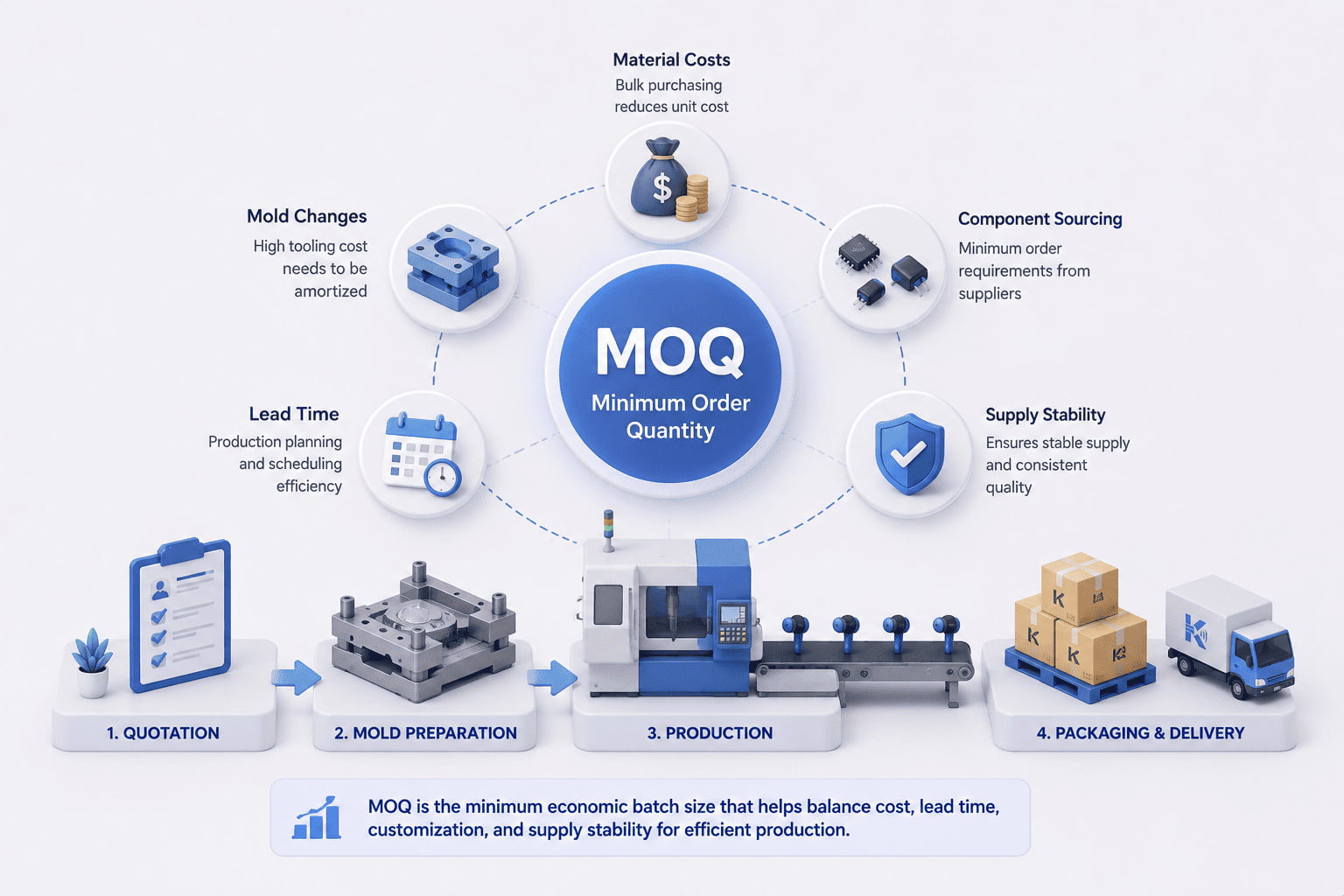
MOQ for Bluetooth earbuds is not arbitrary. It reflects the minimum economic batch size for efficient production, considering factors like material costs, mold changes, and component sourcing. It balances cost, lead time, customization, and supply stability.
As someone deeply involved in the manufacturing side, from quoting to production, I often see the questions and sometimes frustration around MOQ. It is a critical part of our business, and understanding it can greatly benefit your procurement strategy. Let's dive into what really drives these numbers.
Is MOQ Just an Arbitrary Factory Rule?
Buyers often see MOQ as an obstacle to flexibility. This view, however, misses the complex production realities behind every number we give. Let's uncover the true drivers behind these quantities.
MOQ is a practical necessity in manufacturing. It ties directly to production efficiency, machine setup costs, minimum material order quantities, and labor allocation for specific runs. It ensures viable operations for both parties.
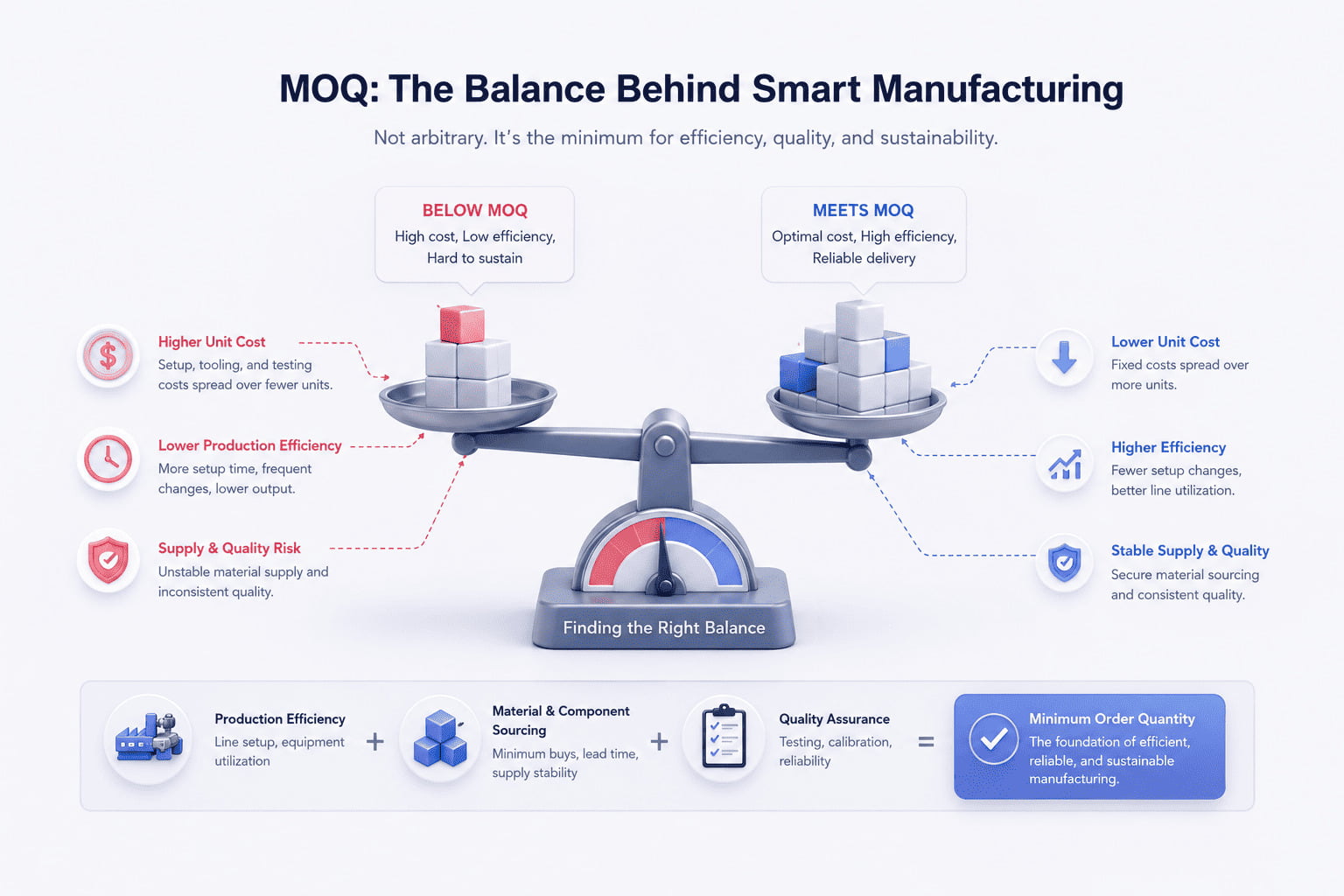
In my experience working in a Bluetooth earphone OEM/ODM factory, I've seen firsthand that MOQ is never an arbitrary number. It is a calculated threshold that ensures production remains economically viable. Think about our production lines: setting up machines, calibrating equipment, and assigning skilled labor for a specific product run involves significant upfront time and cost1. If we run a very small batch, these fixed setup costs are spread across fewer units. This dramatically increases the unit cost, sometimes to a point where it is not competitive for you or profitable for us. For example, if we need to change a mold for a specific earbud shell, it means stopping the injection molding machine, removing the old mold, installing the new one, and then running test shots to ensure quality. This entire process can take hours, sometimes even a full shift, before mass production of your specific color or design can even begin.
Then, there are the materials themselves. Upstream suppliers for critical components like Bluetooth chipsets, lithium batteries, or even specific acoustic drivers have their own minimum order quantities2. We cannot simply order five pieces of a specialized chipset because a buyer wants a low MOQ for their finished product. These components are bought in bulk, often thousands of units, to get a reasonable price and ensure a steady supply3. If your order falls below the minimum for these parts, we either cannot fulfill it, or we must absorb the cost of excess material, which then reflects in a higher unit price for your smaller order. Even packaging materials, like custom-printed boxes or manuals, come with their own MOQs from our print suppliers4. A short run of custom boxes costs almost as much to set up as a larger run, making per-unit costs skyrocket for small orders. So, when we talk about MOQ, we are really talking about the point where all these different elements—production efficiency, material sourcing, and operational costs—converge to create a feasible manufacturing run. It's about finding that balance where we can deliver quality at a competitive price.
Production Efficiency & Setup Costs
The cost and time involved in starting a production run are fixed. For instance, my team needs to prepare assembly lines, calibrate testing equipment, and train staff for specific product features. A small order means these setup costs are spread over only a few items. This makes each item very expensive. If we switch colors for an earbud shell, the injection molding machine needs a thorough cleaning and material change. This downtime directly affects our factory's overall output.
Upstream Material Sourcing Challenges
We depend on many suppliers for components. Chipsets, batteries, and drivers usually have their own MOQs. We buy these in large quantities to secure good prices and stable supply. If your order for finished earbuds is very small, it might not meet the MOQ for even one of these basic components. We cannot simply order a few chips. This means we either need to use existing stock, if available, or order the larger MOQ ourselves and charge you for the higher cost. This directly influences the MOQ we quote.
| Factor | Impact on MOQ Explanation |
|---|---|
| Line Setup Cost | Fixed cost divided by production volume. Higher MOQ lowers per-unit setup cost5. |
| Mold Changes | Time and labor for retooling. Frequent changes for low MOQ runs reduce output. |
| Material MOQ | Upstream suppliers dictate minimum buys for key components (chips, batteries, shells). |
| Testing | Calibration and quality checks are fixed per batch, irrespective of size. |
Does All Customization Have the Same MOQ?
You might think all custom orders are alike, needing the same minimums. But in reality, the type of customization deeply changes MOQ requirements. Understanding this difference is key to smart procurement.
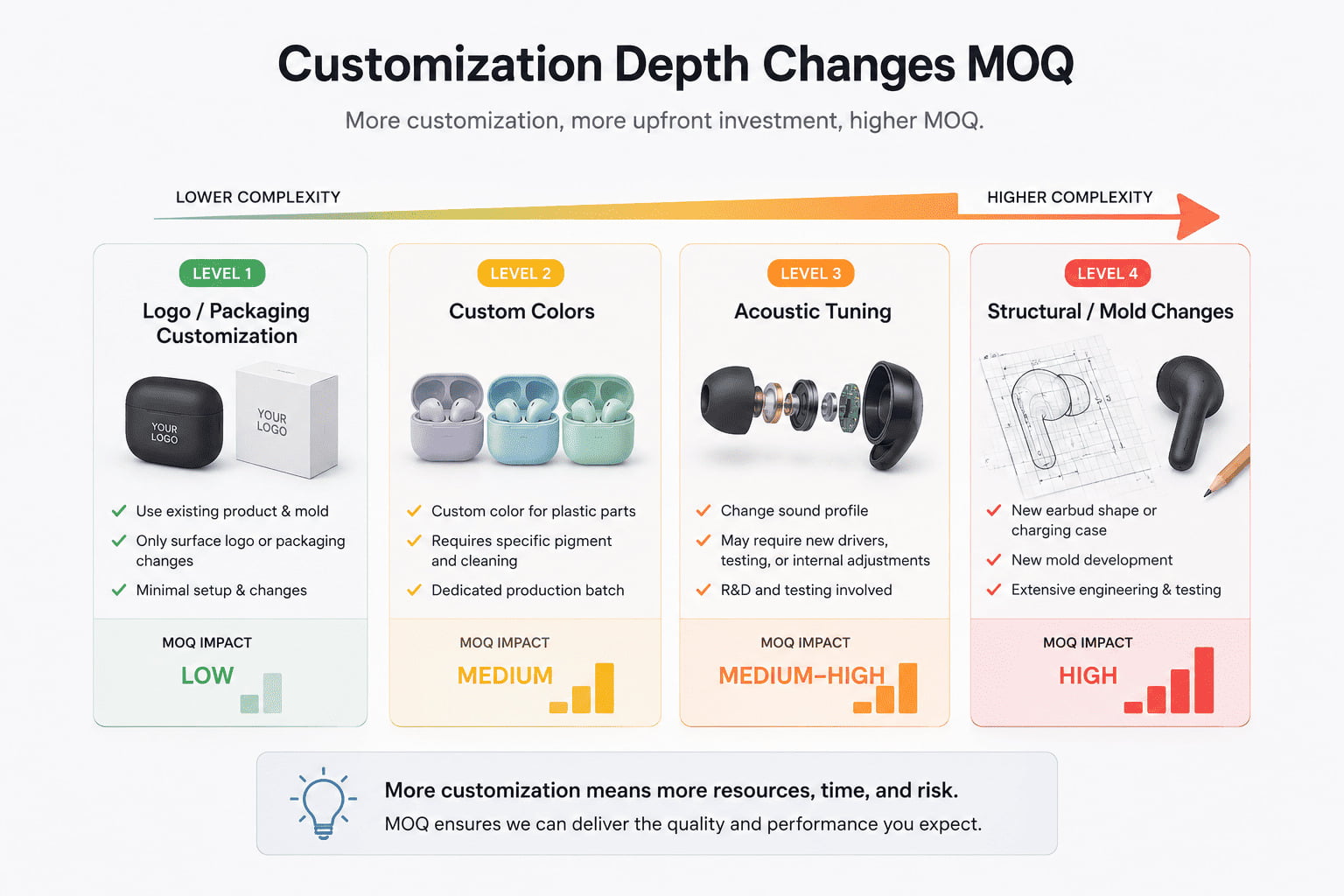
No, MOQ varies significantly with customization depth. Simple logo printing on a standard model has a lower MOQ than custom colors, unique acoustic tuning, or entirely new structural designs, each requiring different production efforts.
From my perspective on the factory floor and in the quotation team, I can tell you that not all customization is created equal when it comes to MOQ. The level of effort and resources we need to commit varies wildly, and so does the MOQ. For example, if you want your logo laser-engraved onto an existing earbud model that we already mass-produce in a standard color, the MOQ will be relatively low. We are simply taking an already finished product and adding a cosmetic touch. The production line is already running; we just add a step. The same goes for custom packaging using an existing earbud; our packaging suppliers might have a low MOQ for printing, and the earbud itself is standard.
However, things change quickly when you ask for custom colors for the earbud shells. This means we have to order a specific pigment batch6, which comes with its own supplier MOQ. Then, our injection molding machines need to be cleaned thoroughly and filled with this new colored plastic. This is not a quick process, and we cannot simply run a few hundred units without incurring significant waste and downtime. So, the MOQ for custom colors is usually much higher than for simple logo customization. If you need structural changes, like a completely new earbud shape or a redesign of the charging case, that is a full OEM project. This requires new mold creation, which is a massive upfront investment in terms of cost and engineering time. Our design engineers and tooling team spend weeks, sometimes months, perfecting these new molds. To justify this investment, the order volume, and therefore the MOQ, must be substantial. Acoustic tuning also falls into a higher MOQ category. Adjusting sound profiles requires specific components, driver changes, and extensive testing7 in our acoustic labs. This involves dedicated R&D time and specialized materials, pushing the MOQ higher than simple branding. Each layer of customization adds complexity and cost, and that complexity directly translates into a higher MOQ to make the project feasible for us.
Customization Tiers and Their MOQ Implications
Customization is a spectrum. On one end, we have simple branding. On the other, we have full product development. Each point on this spectrum has different MOQ needs. It is important for you, as the buyer, to know where your request falls.
- Logo or Packaging Customization: This is often the simplest and comes with the lowest MOQ. We use existing product designs and molds. We only customize the surface (logo printing) or the external packaging. Our lines are already producing the base product.
- Custom Colors: This needs a medium MOQ. When you want a specific color for the plastic parts, we need to order special pigments and run a dedicated batch in our injection molding department. This requires stopping and cleaning machines, which takes time and resources.
- Acoustic Tuning: This is also a medium to high MOQ. Changing the sound profile means we might need different drivers, different internal layouts, or specific acoustic damping materials. This involves research, testing, and sometimes custom component orders.
- Structural or Mold Changes: This requires the highest MOQ. Creating new molds for unique earbud shapes or charging cases is a large investment8. It involves our engineering team, mold making, and extensive testing. The MOQ must cover this significant upfront cost.
| Customization Level | MOQ Impact | Examples |
|---|---|---|
| Logo/Packaging (Standard) | Low | Existing product, custom box, manual, or laser logo. |
| Custom Color | Medium | New color injection for earbud shells or charging case. |
| Acoustic Tuning | Medium-High | Specific sound profile adjustment requiring component changes. |
| Structural/Mold Changes | High (New Mold) | Completely new earbud shape or internal layout. |
Is a Low MOQ Always the Best Option?
Low MOQ often sounds like a dream for many buyers, offering flexibility and lower risk. But chase the lowest quantity without thinking, and you might hit unexpected walls. It's often not the perfect solution for long-term strategy.
Low MOQ is beneficial for market testing or small trials. However, for deep OEM/ODM or stable mass production, it often brings trade-offs: higher unit costs, limited configuration options, extended lead times, and potential production inefficiencies that impact quality consistency.
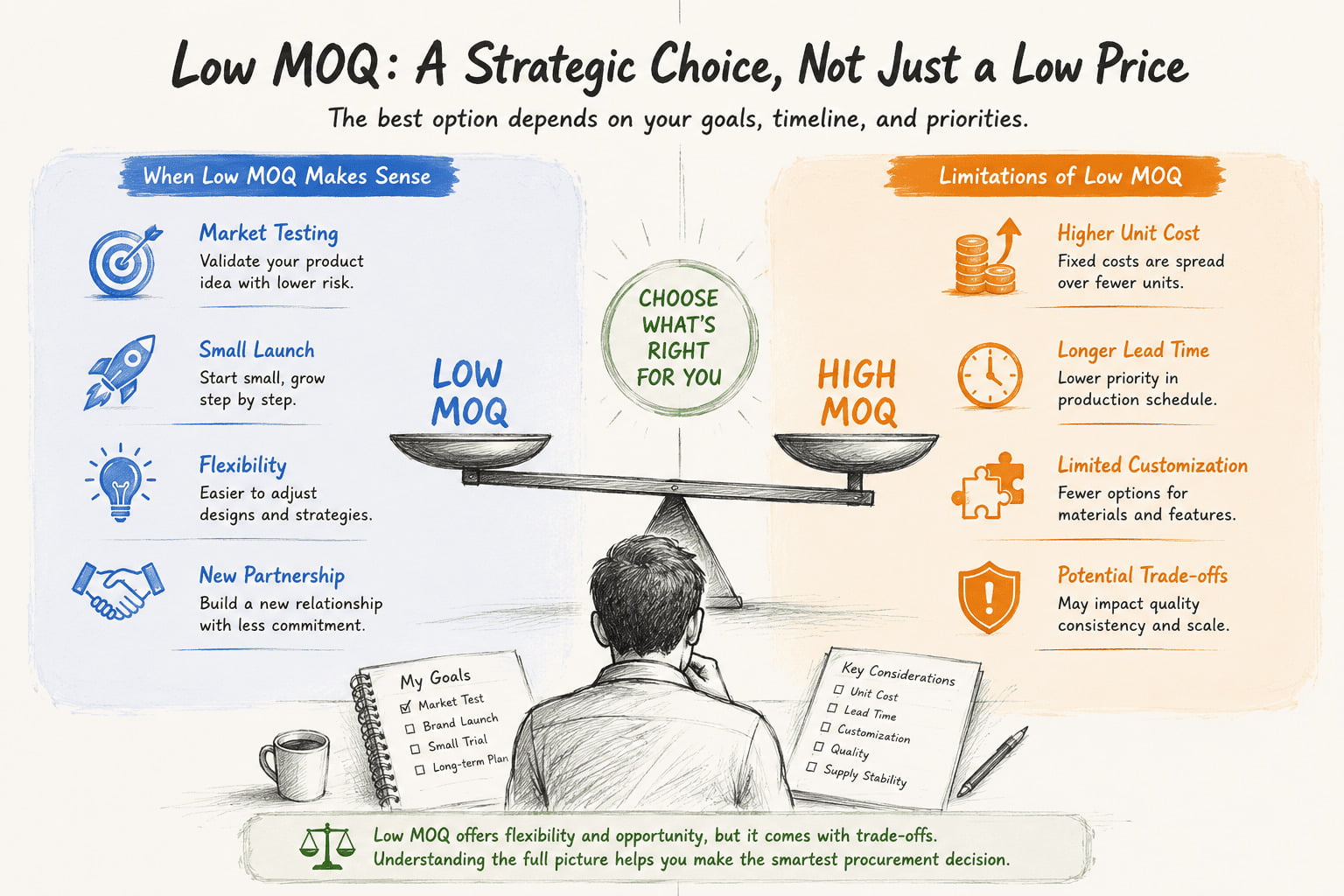
From where I stand, a low MOQ is certainly not always the best option. While it has its place—perfect for market testing a new product idea, running a small promotional campaign, or testing a new supplier relationship—it comes with significant limitations that buyers often overlook. For one, the unit cost almost always increases. As I mentioned earlier, our fixed costs for setting up a production run do not change whether we are making 500 units or 50,000 units9. Spreading those costs over a small quantity makes each individual earbud significantly more expensive. My quotation team constantly navigates this challenge, explaining to buyers why a 500-unit order costs disproportionately more per unit than a 5,000-unit order.
Moreover, low MOQ often comes with trade-offs. Small orders usually have limited customization options, as sourcing specialized components in low quantities is often impractical due to supplier MOQs. Production schedules also tend to prioritize larger orders, which can lead to longer lead times for smaller batches. In addition, frequent line adjustments for short runs may create more variability in quality compared to stable, high-volume production10. While low MOQ provides flexibility, it often reduces cost efficiency, customization potential, production priority, and overall consistency.
The True Cost of Low MOQ
Low MOQ might seem like a bargain, but it has hidden costs. You might pay more per unit. You might get fewer choices for customization. The delivery time might be longer than you expect. These are all real trade-offs we deal with daily.
- Higher Unit Cost: This is the most direct impact. All fixed setup costs, labor, and minimal material waste get divided by fewer units, pushing up the price per item. We cannot offer the same economies of scale.
- Limited Customization: For small orders, we usually offer only basic branding (logo) or standard product options. Custom components or deep design changes are typically not feasible for low MOQs. Our suppliers for specialized parts have their own minimums that small orders cannot meet.
- Extended Lead Time: Small orders can get less priority in our production schedule. We often have to fit them in between larger runs, leading to longer wait times. Our larger clients with bigger orders often fill our primary production slots.
- Potential Quality Variation: While we always strive for high quality, frequent line changes for low MOQ runs can introduce more opportunities for calibration issues or slight inconsistencies compared to long, stable production runs.
Operational Challenges with Small Batches
Running many small batches reduces our overall factory efficiency. Each setup change, each material switch, and each calibration takes time. This affects our ability to produce efficiently for all clients.
| Aspect | Low MOQ Implication | High MOQ Implication |
|---|---|---|
| Unit Cost | Higher (fixed costs spread thin) | Lower (economies of scale) |
| Customization | Limited (supplier prefers standard components) | Broad (justifies custom component orders) |
| Lead Time | Potentially longer (lower priority in schedule) | Shorter/more predictable (dedicated runs) |
| Supply Reliability | Lower (less commitment from factory) | Higher (stronger partnership, stable supply) |
| Inventory Risk | Lower (less stock to manage) | Higher (more stock to manage) |
What Should Procurement Managers Ask About MOQ?
You need to ask the right questions to truly understand MOQ's impact. Without clear inquiries, you could face hidden costs or unexpected limitations. Don't leave critical details unaddressed.
Procurement managers should ask if MOQ applies to existing components or custom parts, what specific customizations it includes (logo, packaging, shells), and how lower quantities affect pricing, lead time, and available specifications.
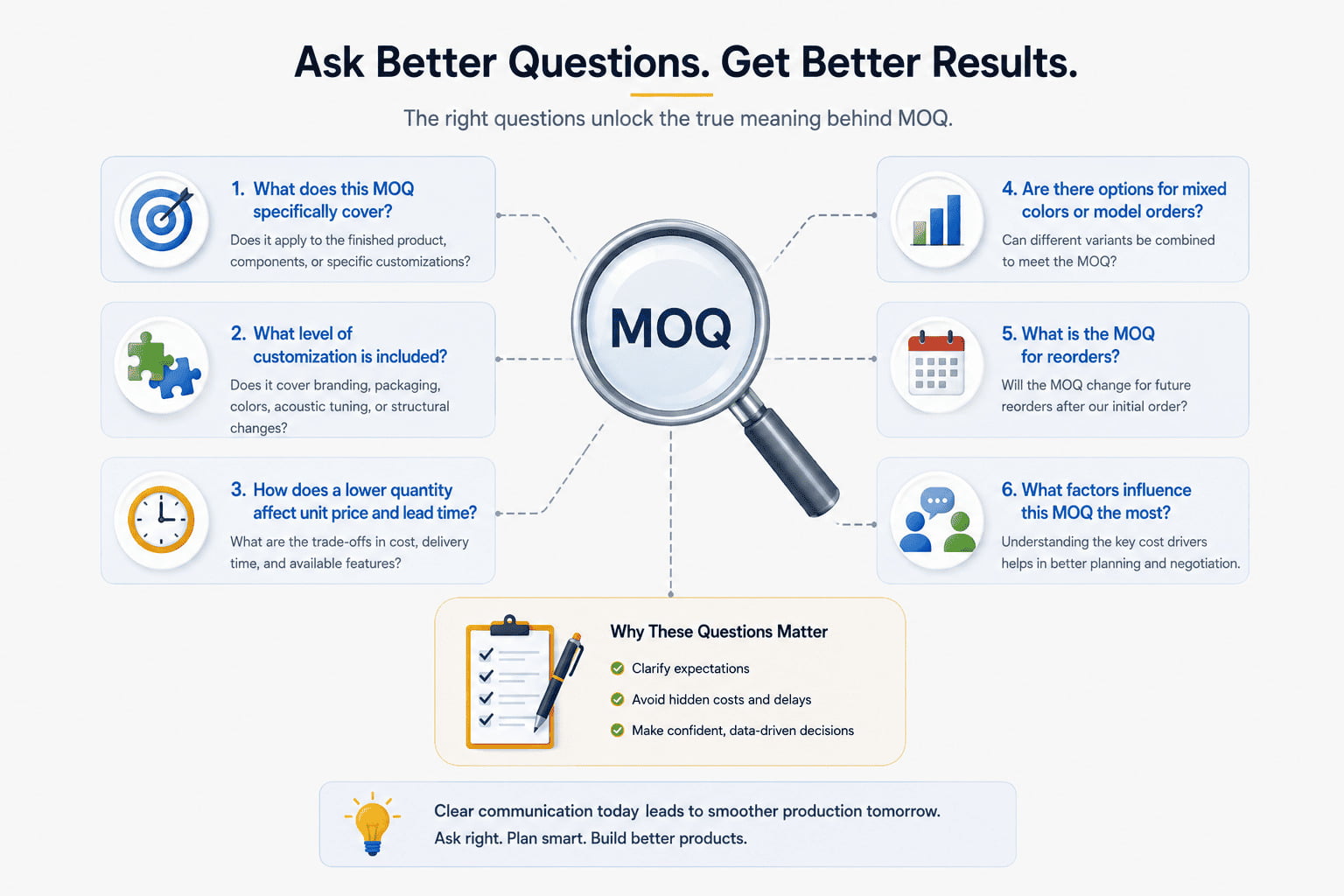
As someone who has prepared countless quotations and discussed MOQ with procurement managers, I can tell you that asking the right questions is crucial. It helps clarify expectations and prevents misunderstandings down the line. First, you should always ask: "What does this MOQ specifically cover?" This might sound basic, but it is vital. Does the MOQ apply to the existing finished product, meaning you can only customize branding? Or does it refer to the minimum quantity needed to produce custom-colored shells, or even a completely new mainboard? For example, I've had conversations where a buyer assumed the MOQ covered a custom internal component, but it only applied to the outer casing with their logo. Making this distinction upfront clarifies the true scope of your order.
Second, inquire about the different levels of customization included. Ask, "What level of customization is included in this MOQ? Does it cover custom branding, packaging design, or specific structural/acoustic changes?" This helps you understand if the quoted MOQ for "custom" earbuds allows for a new shell design or only for printing your logo on a standard model. These are very different cost and production scenarios. Third, and critically, always ask, "If our order is below the stated MOQ, how does it impact the unit price, lead time, and available features?" We can sometimes accommodate smaller orders, but there are always trade-offs. You need to know these trade-offs upfront. Will the unit price jump by 20%? Will the lead time double? Will certain advanced features or custom color options become unavailable? Understanding these consequences helps you make an informed decision. Finally, consider asking, "Are there options for mixed color or model orders to meet MOQ, or does each variant require its own MOQ?" Sometimes, for certain standard models, we can allow a mix of colors to help you reach the total quantity, but this is not always possible for highly customized components. Asking these focused questions shows you understand the production process, and it helps us give you the most accurate and helpful information for your procurement needs.
Deconstructing the Quoted MOQ
An MOQ number from a factory is not just one simple thing. It is a complex figure based on many factors. You need to break it down to understand what you are really committing to.
- Component-Specific MOQs: Ask if the MOQ applies to the entire finished product or to individual components. For example, the MOQ for a custom-designed charging case might be higher than the MOQ for the earbud itself.
- Customization Tiers: Confirm what specific customizations are covered. Is it just logo branding, or does it include custom material colors, acoustic tuning, or even new structural designs? Each level changes the MOQ.
Essential Questions for a Clear Picture
Asking precise questions helps you get the full picture. Do not assume anything. Always clarify how the MOQ affects all parts of your order.
- Impact of Lower Quantities: Always ask what happens if you cannot meet the MOQ. How does it affect the price per unit, the delivery time, and the available product features?
- Mixed Orders: Inquire if you can combine different product colors or minor variations to meet the total MOQ. This can offer flexibility for your product line.
- Reorder MOQs: For long-term planning, ask what the MOQ will be for future reorders once you have established a relationship with us. Sometimes reorder MOQs are lower.
| Question to Ask | Why It Matters |
|---|---|
| What does this MOQ specifically cover? | Differentiates between standard model MOQ and custom component MOQ. |
| What are the price/lead time implications for lower quantities? | Reveals true cost of flexibility vs. commitment. |
| Are mixed orders (colors, minor variants) permissible? | Allows for meeting MOQ with diverse product offerings. |
| What is the MOQ for reorders after initial partnership? | Can reveal long-term flexibility and supplier relationship potential. |
Conclusion
MOQ is a production reality, not a barrier. By understanding its drivers and asking precise questions, buyers can optimize procurement for cost, customization, and reliable supply in Bluetooth earbuds manufacturing.
"[PDF] A Setup Reduction Methodology from Lean Manufacturing for ...", https://www.eng.auburn.edu/~aesmith/files/A%20Setup%20Reduction%20Methodology%20from%20Lean%20Manufacturing.pdf. Setup costs, including machine preparation, tooling changes, and quality calibration, constitute a significant fixed expense in batch manufacturing, with research showing these costs can represent 15-30% of total production costs for small batch runs. Evidence role: mechanism; source type: research. Supports: the economic significance of setup costs as a major component of manufacturing overhead. Scope note: Percentage ranges vary significantly by industry and production type ↩
"Minimum Order Quantity (MOQ): Formula, Tips, & Benefits | NetSuite", https://www.netsuite.com/portal/resource/articles/inventory-management/minimum-order-quantity-moq.shtml. Supply chain research documents that MOQ requirements cascade through multiple tiers, with semiconductor and specialized component suppliers typically imposing MOQs ranging from hundreds to thousands of units, which manufacturers must absorb or pass through to customers. Evidence role: mechanism; source type: research. Supports: the existence and impact of tiered MOQ requirements throughout electronics supply chains. Scope note: Specific MOQ values vary widely by component type, supplier, and market conditions ↩
"Before You Offer Volume Discounts, Crunch the Numbers: Here's How", https://som.yale.edu/story/2024/you-offer-volume-discounts-crunch-numbers-heres-how. Procurement economics demonstrates that bulk purchasing typically yields 10-40% cost reductions through economies of scale, while also improving supply chain reliability by securing supplier commitment and reducing transaction costs per unit. Evidence role: mechanism; source type: education. Supports: the economic principles underlying volume-based pricing and supply reliability in procurement. Scope note: Discount percentages vary significantly by industry, product category, and supplier relationships ↩
"Minimum Order Quantities: What They Are and Why We Have Them", https://www.ecoenclose.com/blog/minimum-order-quantities-what-they-are-and-why-we-have-them/?srsltid=AfmBOormbPpboXtFa_g8Ji49ZSJdm6ITaCMdVJKJnFiEMIV9mDZiX0gk. The commercial printing industry typically imposes MOQs for custom work because setup costs for plate preparation, color calibration, and press configuration represent fixed expenses that must be amortized across production runs, with digital printing offering lower MOQs than traditional offset methods. Evidence role: general_support; source type: other. Supports: the prevalence of MOQs in commercial printing due to setup-intensive processes. Scope note: MOQ levels vary significantly between printing technologies and complexity of customization ↩
"Allocating Fixed Costs", http://www.econ.ucla.edu/riley/104/SLIDES/Allocating%20Fixed%20Costs.htm. Cost accounting principles establish that fixed costs, when allocated across production units, result in declining per-unit costs as volume increases—a relationship expressed as Fixed Cost per Unit = Total Fixed Cost ÷ Number of Units, demonstrating the mathematical basis for economies of scale. Evidence role: mechanism; source type: education. Supports: the inverse relationship between production volume and per-unit fixed costs. ↩
"Plastic Pigments - The complete guide on How Colorants Work | 3devo", https://www.3devo.com/blog/complete-guide-plastic-pigments-how-colorants-work. Custom plastic coloring typically requires specialized color masterbatch or pigment compounds that suppliers produce in minimum batches, often 25-100 kg, due to the setup costs of color formulation, mixing equipment cleaning, and quality verification processes. Evidence role: mechanism; source type: other. Supports: the technical requirements and MOQ constraints associated with custom plastic coloring. Scope note: Minimum batch sizes vary by supplier, color complexity, and material type ↩
"Product Development Support - Upstream Audio & Acoustics", https://upstreamaudio.com/index.php/services-offered/proddev/. Acoustic tuning in consumer audio products involves iterative processes of driver selection, enclosure design modification, damping material optimization, and extensive frequency response testing in controlled environments, requiring specialized engineering expertise and measurement equipment that represents significant development overhead. Evidence role: mechanism; source type: education. Supports: the technical complexity and resource intensity of acoustic customization in audio products. Scope note: The description covers general processes but does not quantify specific time or cost requirements ↩
"Understanding Injection Mold Cost for Parts and Tooling - Protolabs", https://www.protolabs.com/resources/design-tips/11-tips-to-reduce-injection-molding-costs/. Injection mold tooling for consumer electronics components typically represents capital investments ranging from $5,000 to $100,000+ per mold depending on complexity, with manufacturers amortizing these costs across production volumes, making high MOQs necessary to achieve acceptable per-unit tooling costs. Evidence role: statistic; source type: other. Supports: the significant capital investment required for injection mold tooling. Scope note: Cost ranges are approximate and vary significantly based on part complexity, precision requirements, and geographic location ↩
"Standard Cost Variance Calculations and Analysis - NJIT", https://web.njit.edu/~wolf/scvca.htm. Production economics demonstrates that fixed costs—including setup, tooling, and initial quality verification—remain constant regardless of batch size, resulting in a hyperbolic relationship where per-unit costs rise sharply as production volume decreases, a fundamental principle in manufacturing cost analysis. Evidence role: mechanism; source type: education. Supports: the economic principle that fixed costs create higher per-unit costs at lower production volumes. ↩
"New Control Approaches to Enable Quality Assurance and Process ...", https://www.ncbi.nlm.nih.gov/books/NBK570305/. Quality management research indicates that frequent production changeovers can introduce additional sources of variation through repeated equipment adjustments, operator learning curves, and process stabilization periods, with studies showing that longer production runs typically achieve tighter process control and more consistent output once initial setup variation is eliminated. Evidence role: mechanism; source type: research. Supports: the relationship between production stability and quality consistency. Scope note: The magnitude of quality impact depends heavily on process maturity, equipment sophistication, and operator skill levels ↩