Worried about launch dates for your new earbuds? The timeline for bringing new earbuds to market can seem like a mystery. Let's break down the real steps from concept to your customers' hands.
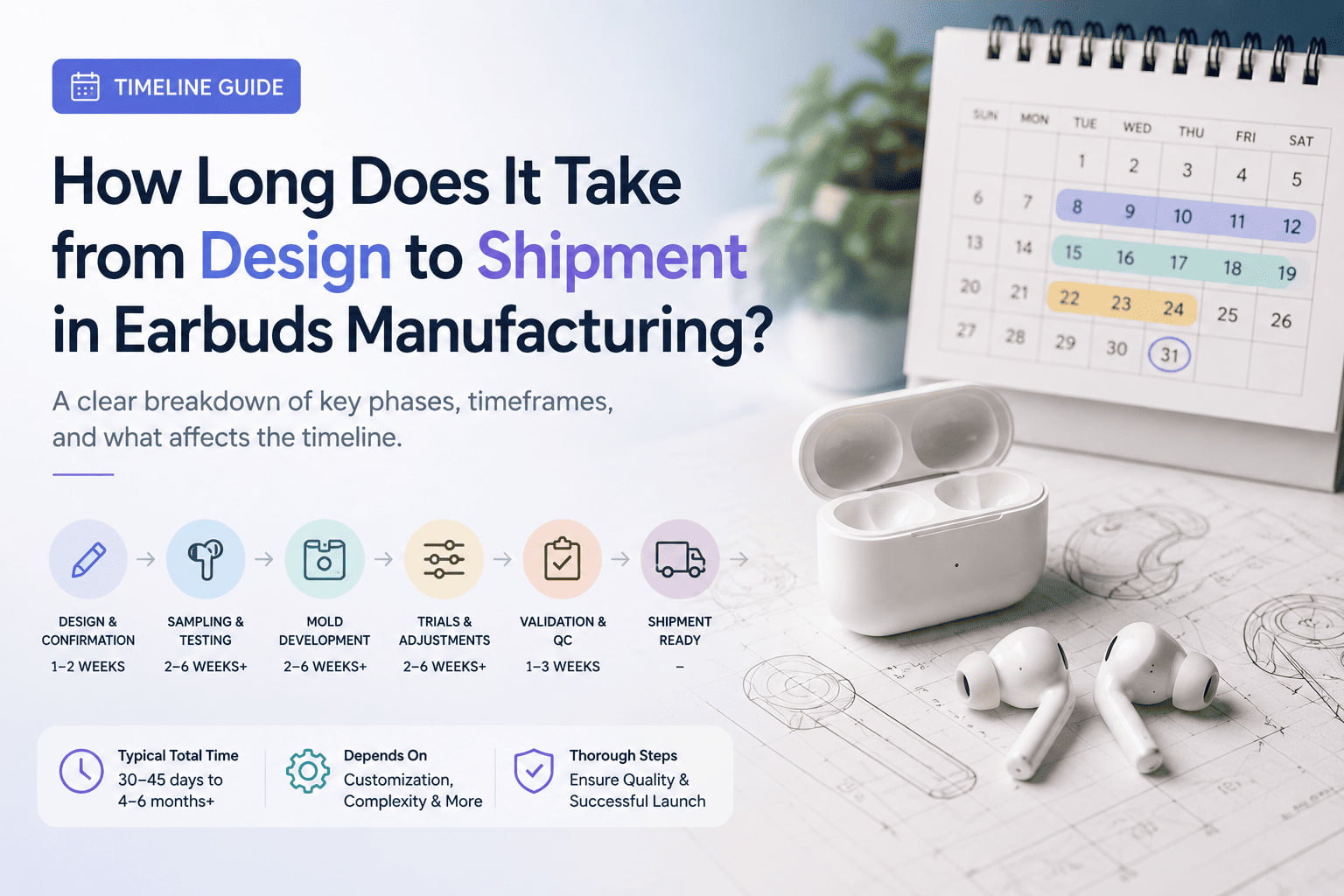
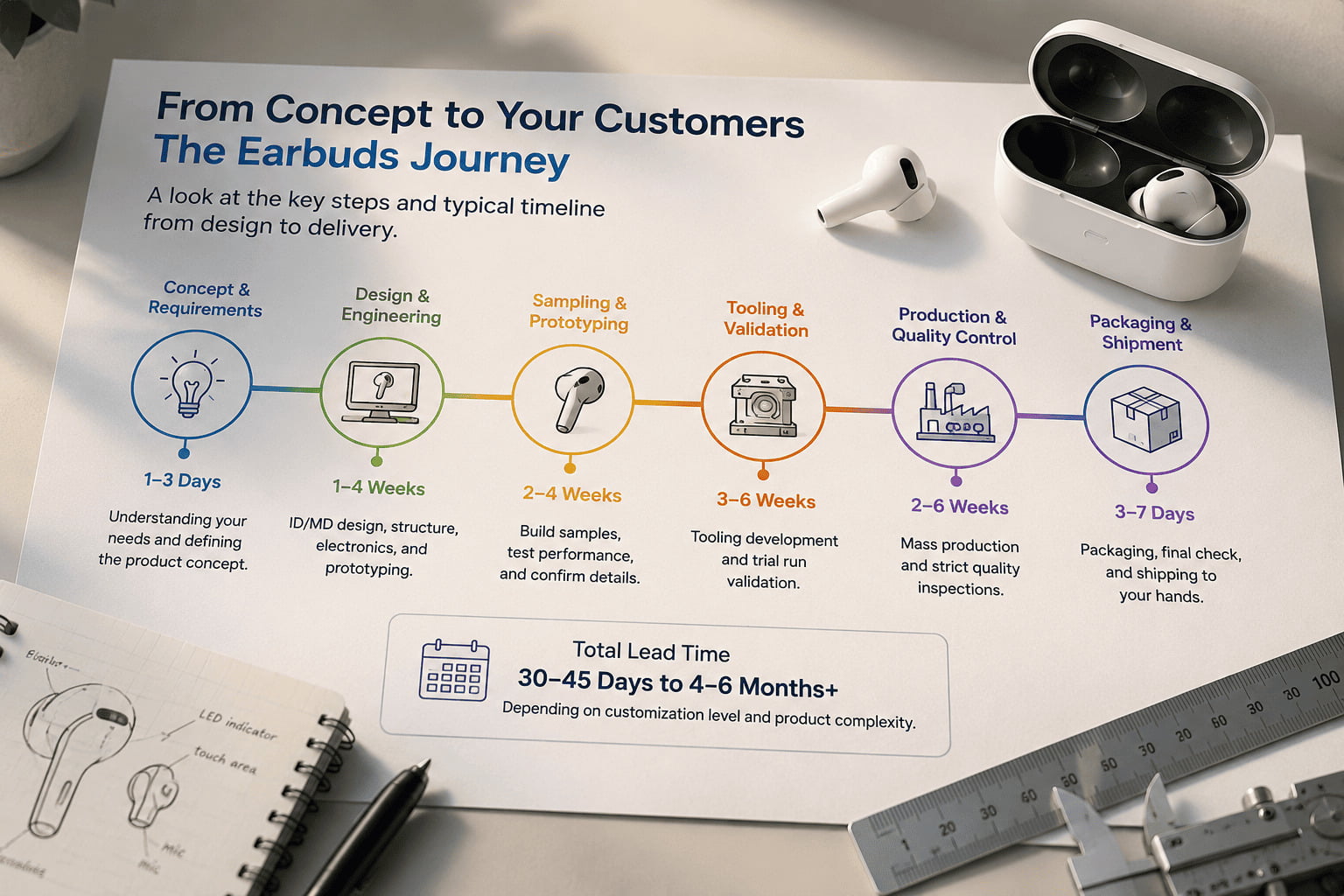
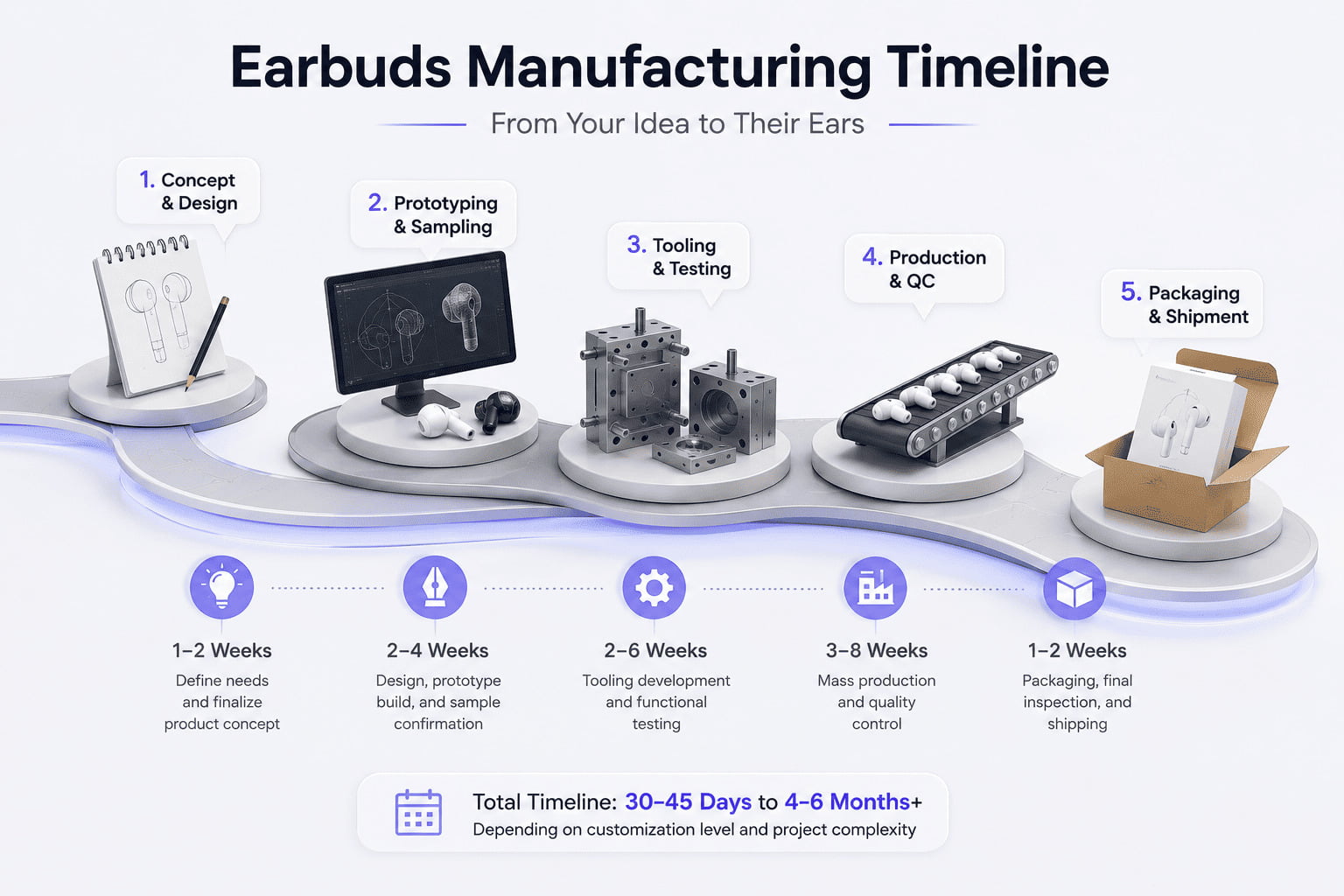
The total time from design to shipment for earbuds varies greatly. It depends on customization levels, from existing models needing 30-45 days1 to full new designs requiring 4-6 months2, sometimes more. Key phases include design, sampling, tooling, production, and quality control.
As an OEM/ODM manufacturer, I have helped many brands bring their earbud ideas to life. What I have learned over 15 years is that understanding the full journey is key. Let's look closer at what really goes into scheduling a successful product launch.
What Kinds of Customization Affect Earbuds Manufacturing Timelines?
Thinking all earbud projects take the same time? That's a common mistake that can delay your launch. We categorize projects to give clearer timelines.
Earbuds manufacturing timelines depend on the customization level. These range from simple branding on existing models, to packaging/appearance changes, acoustic/structural adjustments, or full new ID designs and tooling, each needing different time commitments.
When a customer comes to us, the first thing we discuss is their level of customization. This is the biggest factor for the total project timeline. We do not treat all earbud projects as having the same timeline. I have seen how a clear understanding here prevents many problems later on.
Basic Customization: Existing Model with Branding
This is the quickest path. You choose an existing earbud model from our catalog. Then, we focus on adding your brand logo. This usually involves laser engraving or pad printing3 on the earbuds or charging case. We also customize the packaging with your design. This type of project can take about 30 to 45 days from confirming all details to shipment. The time is mostly for material preparation, printing, assembly, and quality checks.
Medium Customization: Packaging and Appearance Changes
This level goes a bit further. Besides branding, you might want specific color combinations not in our standard offerings. Maybe you need different finishes on the plastic, or a slightly modified shape for a button. This can involve minor mold adjustments for external parts. It also adds time for new artwork approvals for the earbuds themselves, not just the packaging. This type of project often takes between 45 and 70 days. We need extra time for sourcing specific materials, color matching, and maybe small tooling modifications.
Advanced Customization: Acoustic or Structural Adjustments
Here, we start to change the core of the earbud. You might want a specific sound profile, requiring different drivers or acoustic tuning4. Or you might need internal structural changes to fit a new battery size, or specific chip. These changes need more engineering work. We will create prototypes, test them, and make adjustments. This process involves new material sourcing and more extensive testing. These projects typically range from 2 to 3 months. The design, sampling, and testing phases are longer here.
Full Customization: New ID and Tooling
This is the most complex and longest path. You have a completely new industrial design (ID) in mind. This means designing the earbud and case from scratch. It requires new mechanical designs and new molds for every single component. This involves extensive sampling, multiple rounds of testing5, and fine-tuning. For these projects, the timeline is usually 4 to 6 months, sometimes even longer for very complex designs. The mold development alone is a significant part of this time. We work closely with our clients through every step, from concept sketches to final product, ensuring each detail meets their vision.
| Customization Level | Typical Timeline | Key Activities |
|---|---|---|
| Existing Model + Branding | 30-45 days | Logo application, custom packaging, basic assembly |
| Packaging + Appearance Changes | 45-70 days | Custom colors, finishes, minor mold adjustments, specific material sourcing |
| Acoustic + Structural Adjustments | 2-3 months | New drivers, acoustic tuning, internal layout changes, prototyping, extensive testing |
| Full New ID + Tooling | 4-6+ months | Industrial design, mechanical design, new molds for all parts, multiple sampling rounds, extensive validation |
Is "Production Lead Time" the Same as "Design-to-Shipment Lead Time"?
Do you only factor in production days for your launch? Many buyers overlook crucial steps, leading to missed deadlines. Let's see the full picture beyond just manufacturing.
No, "production lead time" is not the same as "design-to-shipment lead time." Production is only one part. The full process includes design approval, sampling, mold making, material prep, trial production6, QC, and shipment readiness.
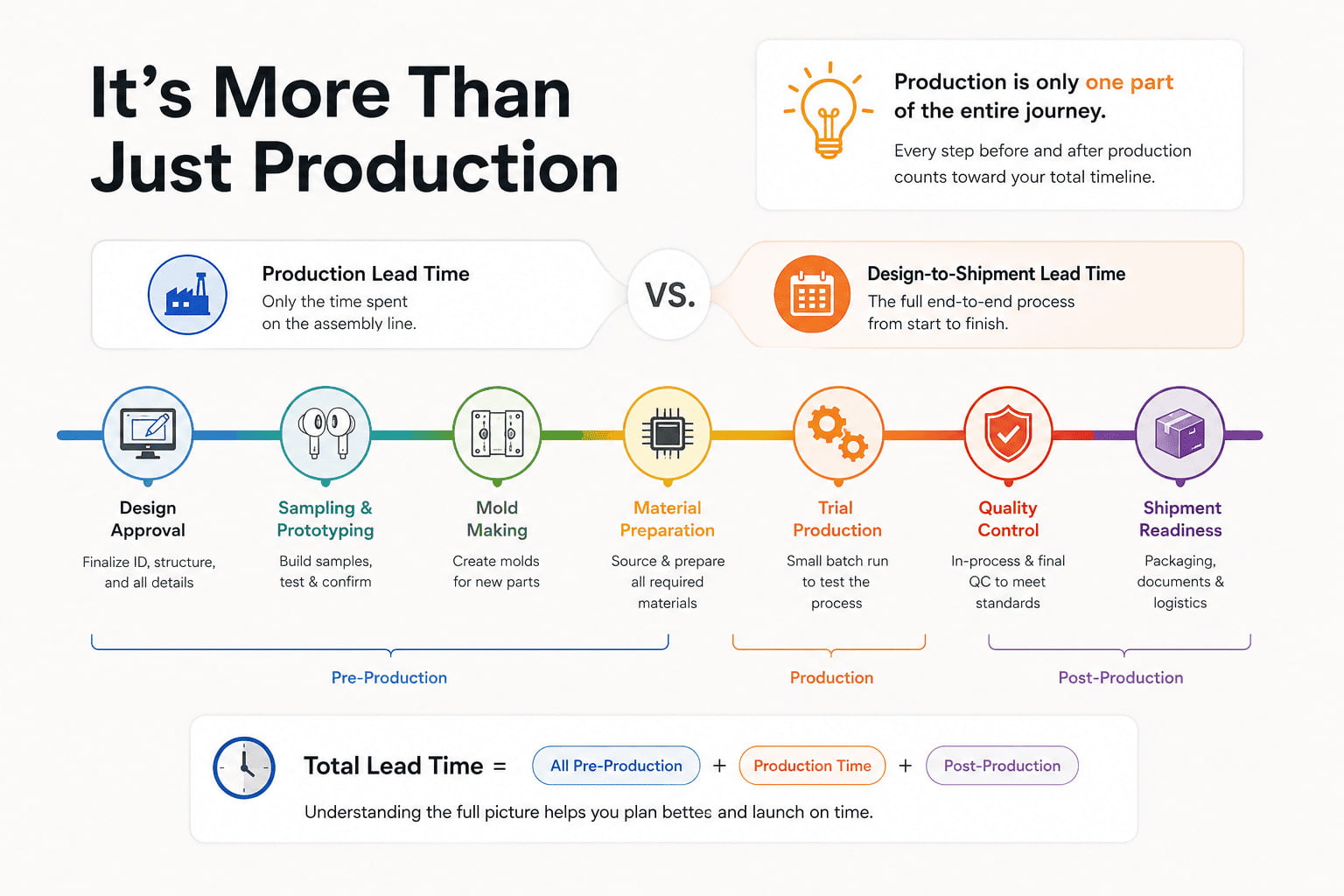
I often hear clients talk about "production lead time" as if it is the only time that matters. This is a common misunderstanding. Production lead time refers to the days our assembly lines are actively building the earbuds. However, a successful project involves many critical steps before production even begins and after it finishes. Over my years, I have learned that overlooking these steps is a main cause for project delays.
Design Approval Phase
Before anything gets built, we need to get the design just right. This involves finalizing the industrial design (ID), which is what the earbuds look like. Then comes the mechanical design, which is how all the internal parts fit together. We also specify the materials, colors, and finishes. Every detail needs to be confirmed and approved by the client. This phase ensures we are all on the same page. It can take several weeks, especially if there are many revisions.
Sampling and Prototyping
Once the design is approved, we move to creating samples. These are the first physical versions of your earbuds. We make functional samples to check how they work. Then we make golden samples, which are the exact look and feel of the final product. There are often several rounds of samples. Each round needs client review and approval. This can involve sending samples back and forth, making small adjustments, and re-sampling. This stage helps us catch issues early.
Mold Making
If your project involves new parts, we need to create new molds. This is a precise process. Molds are essential tools that shape plastic parts. The time for mold making varies greatly. I will talk more about this later. After molds are made, we run initial parts to check their quality and fit. Sometimes molds need adjustments. This phase adds a significant chunk of time, often weeks or more.
Material Preparation
Before mass production, all materials must be sourced and prepared. This includes chips, batteries, speaker drivers, microphones, and various plastic resins. Each component has its own lead time. We must ensure all parts meet quality standards upon arrival. This phase is crucial for keeping the production line running smoothly. It is something we plan for carefully based on our suppliers' schedules.
Trial Production
Before full-scale mass production, we do a trial run. This is a small batch of earbuds made on the actual production line. It helps us test the assembly process. We look for any bottlenecks or issues. This trial run also helps train our workers and fine-tune equipment settings. It helps catch any problems that might arise during large-scale manufacturing.
Quality Control (QC)
Quality control runs throughout the entire process. It starts with incoming material inspection7. It continues through in-process checks during assembly. Finally, there is a full functional test and appearance check on finished products. We follow strict international standards like ISO 28598. This ensures every earbud meets your specifications. QC is not a final step; it is an ongoing commitment to quality.
Shipment Readiness
After production and QC, the earbuds are packaged, labeled, and prepared for shipment. This involves preparing all necessary export documents and coordinating with logistics partners. This final phase makes sure your product reaches its destination efficiently. All these steps combined make up the true design-to-shipment lead time. Each step is important for a successful launch.
How Long Does New Mold Development Really Take?
Need new molds but unsure about the timeline? Getting this wrong can set your whole project back significantly. Let's discuss what impacts mold development time.
New mold development time varies based on design complexity. While 40 days is a common average for simple parts9, intricate designs with multiple components and tight tolerances can take much longer. This phase also needs sampling and adjustments.
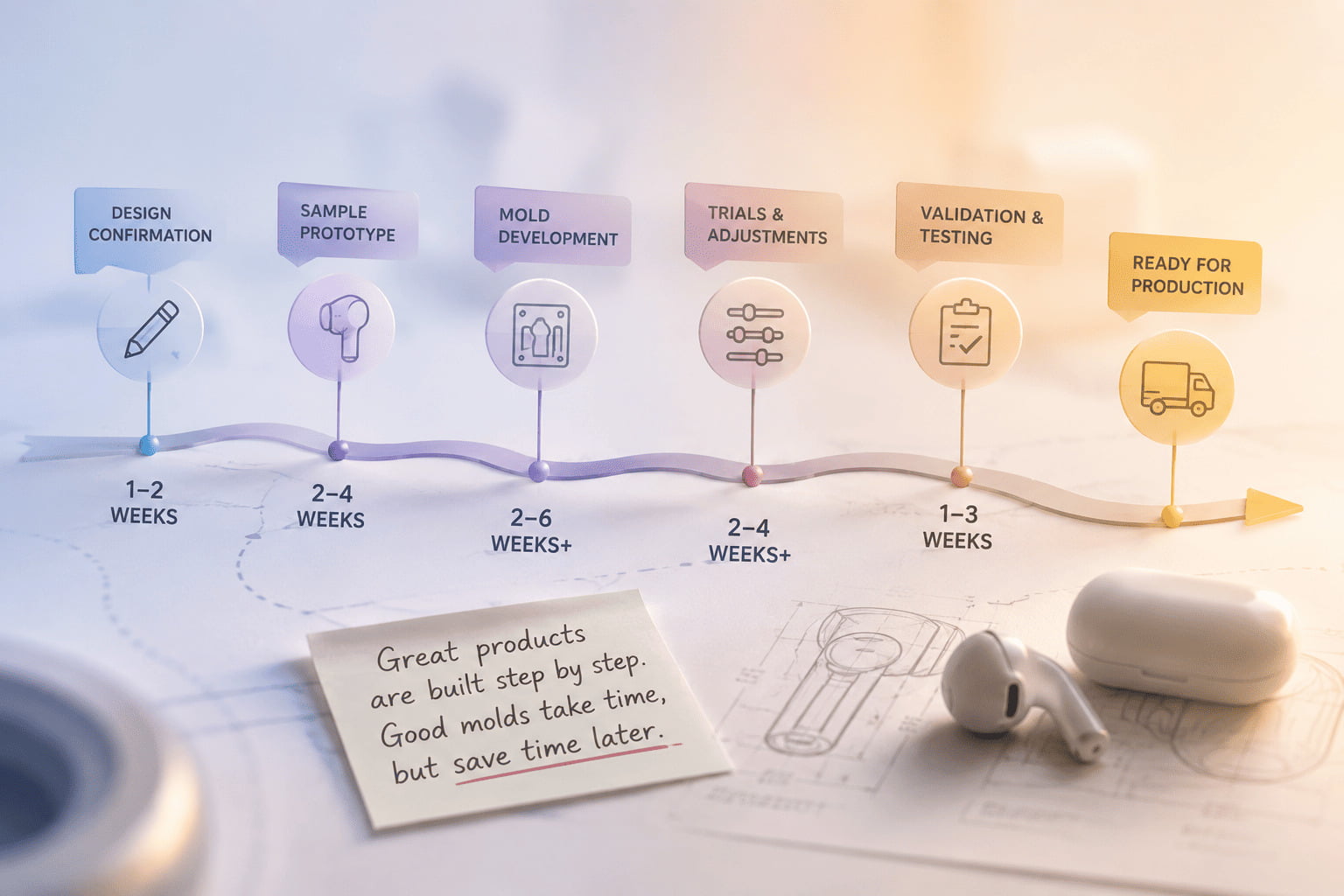
When a client wants a unique design for their earbuds, new molds are often needed. This is a very important step. I have seen many project schedules depend heavily on mold development. It is rarely a fixed number of days. It is more about the specific needs of the design. Saying "molds take 40 days" is a common average for relatively simple parts. However, it is not a promise for every project.
Factors Affecting Mold Time
Several factors influence how long mold development takes. The most important is the complexity of the earbud shape. If the earbud has a simple, smooth exterior, the mold will be less complex. If it has intricate curves, multiple buttons, or very small details, the mold design becomes much harder. The number of components needing new molds also adds time. A simple case might need just two molds, but a complex earbud body can need several, each for a different part. The material chosen for the earbud also plays a role. Some plastics are harder to work with, needing more precise molds10.
Iterations and Adjustments
Mold making is rarely a one-time process. After the initial molds are made, we run trial shots. These are the first plastic parts made from the new mold. We check these parts for precision, fit, and finish. It is common for these first parts to need adjustments. Maybe a dimension is slightly off. Perhaps the plastic does not flow perfectly into every corner. This means the mold itself needs to be re-worked. This can involve polishing, adding material, or machining away small sections. Each adjustment requires time, then another trial run. This back-and-forth ensures the mold produces perfect parts before mass production.
Importance for Overall Timeline
The mold development phase directly impacts when mass production can begin. If molds are rushed or not precise enough, the parts they produce will have defects. This would lead to major quality issues during assembly. It would also lead to problems for end-users. We take mold development seriously. This focus ensures that the foundation of your product is solid. Spending extra time here saves a lot of trouble and delays down the line. It ensures that when mass production starts, the parts are consistently perfect.
Why Is Rushing Design Confirmation and Testing a Bad Idea?
Feeling pressured to fast-track your earbud launch? Skipping steps now often leads to bigger problems and costs later. Let's see why careful confirmation protects your success.
Rushing design confirmation, sample approval, and testing significantly increases risks. It can lead to mass production defects, higher after-sales costs, and ultimately, a damaged brand reputation. Taking time upfront saves time and money later.
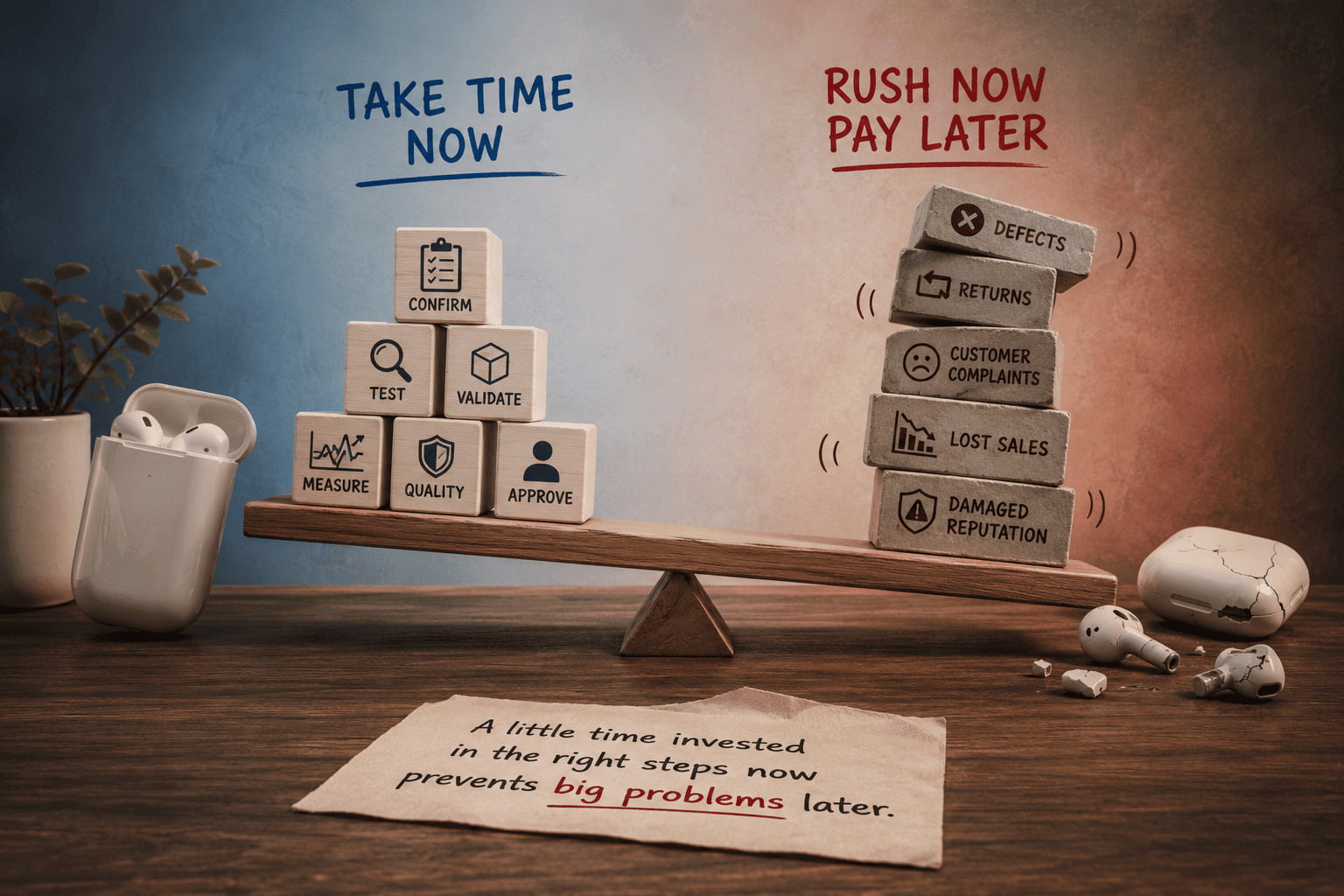
I have witnessed many times how a rush decision at the start can cause huge headaches later. Some clients try to compress the design, sampling, and testing phases to meet an aggressive launch date. On paper, it might look like they saved a few weeks. In reality, this often leads to much bigger delays and costs once mass production starts. We always advise our partners to be thorough in these early stages. It protects their investment and their brand.
Increased Defects in Mass Production
When you skip detailed sample confirmation or reduce testing, you miss the chance to find problems early. For example, a small design flaw might not appear in one or two samples. But when thousands of units are produced, this flaw becomes a major defect rate. It could be an issue with how two parts fit together. It could be a speaker driver that rattles at certain frequencies. It might be a battery that does not charge correctly. These issues multiply in mass production. Stopping the line to fix them is very costly and time-consuming.
Higher After-Sales Costs and Customer Issues
Products with defects directly lead to after-sales problems. Customers will return faulty earbuds. They will write negative reviews. They will claim warranties. Each return costs money in shipping, repair, or replacement11. Negative reviews can damage your brand's image. This is much harder to fix than spending extra time in the testing phase. Good quality control at the factory means fewer problems for your customers. It means less money spent on customer service and replacements later.
Missed Market Windows and Brand Reputation Damage
The goal of rushing is usually to hit a market launch window. However, if the rushed product has quality issues, the actual launch might be delayed even more. Recalling products or halting sales to fix problems can take much longer than the initial thorough testing would have. This can cause you to miss your target sales season entirely. More importantly, it can damage your brand's reputation for quality. Consumers expect reliable products. A bad first impression can be very hard to overcome.
Financial Impact of Rushing
The financial impact of rushing is significant. It includes the cost of re-working defective units. It includes the cost of replacing materials. It includes the cost of shipping faulty products back and forth. It includes the cost of lost sales. All these costs add up quickly. Our experience in end-to-end manufacturing and strict QC processes teaches us that an investment in careful upfront work is always worth it. It ensures a smoother process and a higher quality final product. This strategy protects our clients' profits and their standing in the market.
Conclusion
Understanding the true design-to-shipment timeline for earbuds prevents costly mistakes. Plan for customization levels, factor in all phases, and prioritize thorough testing for a successful launch.
"Cutting Edge: Production - Cornell University", https://courses.cit.cornell.edu/cuttingedge/production/04_production.htm. Industry benchmarks for consumer electronics manufacturing indicate that basic customization projects involving branding and packaging modifications typically require 4-6 weeks from order confirmation to shipment, though actual timelines vary by product complexity and manufacturer capacity. Evidence role: general_support; source type: research. Supports: typical lead times for basic customization in consumer electronics manufacturing. Scope note: General electronics manufacturing data may not specifically address earbud production timelines ↩
"Why Focusing on Lead Time—Not Just Efficiency—Drives Success", https://interpro.wisc.edu/lead-time-drives-manufacturing-success/. Research on new product development in consumer electronics indicates that projects requiring new industrial design and injection molding tooling typically span 4-8 months from concept to production readiness, with tooling development alone accounting for 6-12 weeks of this timeline. Evidence role: general_support; source type: research. Supports: typical timelines for new product development involving custom tooling in consumer electronics. Scope note: General product development research may not capture earbud-specific manufacturing considerations ↩
"Permanent Part Marking Methods Guide for 2025 - Laserax", https://www.laserax.com/blog/permanent-part-marking-methods. Laser engraving and pad printing are established marking technologies widely used in consumer electronics manufacturing, with laser engraving providing permanent marks through material ablation or color change, while pad printing transfers ink patterns onto three-dimensional surfaces using silicone pads. Evidence role: mechanism; source type: education. Supports: common marking and branding methods used for plastic electronic components. ↩
"Characterization and Clinical Use of Bone Conduction Transducers ...", https://pmc.ncbi.nlm.nih.gov/articles/PMC9953386/. In earphone design, the transducer type (dynamic, balanced armature, or planar magnetic drivers) and acoustic chamber geometry significantly influence frequency response and sound signature, with manufacturers adjusting driver specifications, damping materials, and acoustic pathways to achieve target sound profiles. Evidence role: mechanism; source type: education. Supports: how driver selection and acoustic design affect sound characteristics in earphones. ↩
"Iterative design - Wikipedia", https://en.wikipedia.org/wiki/Iterative_design. Engineering design methodology emphasizes iterative testing and validation cycles during product development, where prototypes undergo multiple rounds of functional, durability, and user testing to identify design flaws and verify performance against specifications before production commitment. Evidence role: expert_consensus; source type: education. Supports: the role of iterative testing in product development processes. ↩
"Page 9 | FDA", https://www.fda.gov/inspections-compliance-enforcement-and-criminal-investigations/inspection-guides/page-9. Manufacturing process validation commonly includes pilot or trial production runs, where small batches are produced using final tooling and processes to verify production capability, identify process issues, train operators, and establish quality control parameters before full-scale manufacturing begins. Evidence role: general_support; source type: education. Supports: the purpose and practice of trial production in manufacturing. ↩
"What Is Incoming Quality Control? Why It's Important? - Qualityze", https://www.qualityze.com/blogs/incoming-quality-control. Quality management standards such as ISO 9001 emphasize incoming inspection as a critical control point, where organizations verify that purchased materials and components meet specified requirements before entering production processes, thereby preventing defects from propagating through manufacturing. Evidence role: general_support; source type: institution. Supports: incoming material inspection as a component of quality management systems. ↩
"[PDF] ISO 2859-1 - UNT Chemistry", https://chemistry.unt.edu/~tgolden/courses/iso2859-1.pdf. ISO 2859 is an international standard that specifies sampling procedures for inspection by attributes, providing statistical methods for acceptance sampling used across manufacturing industries to determine whether batches of products meet quality specifications. Evidence role: definition; source type: institution. Supports: the nature and application of ISO 2859 as a quality control standard. ↩
"Advanced Injection Molding Methods: Review - PMC", https://pmc.ncbi.nlm.nih.gov/articles/PMC10489002/. Industry data on injection molding indicates that mold development for moderately complex plastic parts typically requires 4-8 weeks, with simple single-cavity molds at the lower end and multi-cavity or precision molds requiring longer development periods. Evidence role: general_support; source type: research. Supports: typical lead times for injection mold development in manufacturing. Scope note: General molding industry timelines may vary significantly based on specific part geometry and tolerance requirements ↩
"The Complete Guide to Injection Molding Materials - Basilius Inc.", https://www.basilius.com/blog/the-complete-guide-to-injection-molding-materials/. Different thermoplastic materials exhibit varying shrinkage rates, flow characteristics, and thermal properties during injection molding, with engineering plastics and materials having high shrinkage rates or tight dimensional tolerances requiring more precise mold design and tighter manufacturing tolerances to achieve specified part dimensions. Evidence role: mechanism; source type: education. Supports: how plastic material properties affect mold design and precision requirements. ↩
"A circular reverse logistics framework for handling e-commerce returns", https://www.sciencedirect.com/science/article/pii/S2772390922000531. Supply chain research on reverse logistics indicates that product returns generate multiple cost categories including transportation, inspection, repair or refurbishment labor, replacement inventory, and administrative processing, with studies showing that return costs can range from 20-65% of the original product price depending on product category and return reason. Evidence role: general_support; source type: research. Supports: the cost components associated with product returns and warranty claims. Scope note: Cost percentages vary significantly by industry and product type ↩