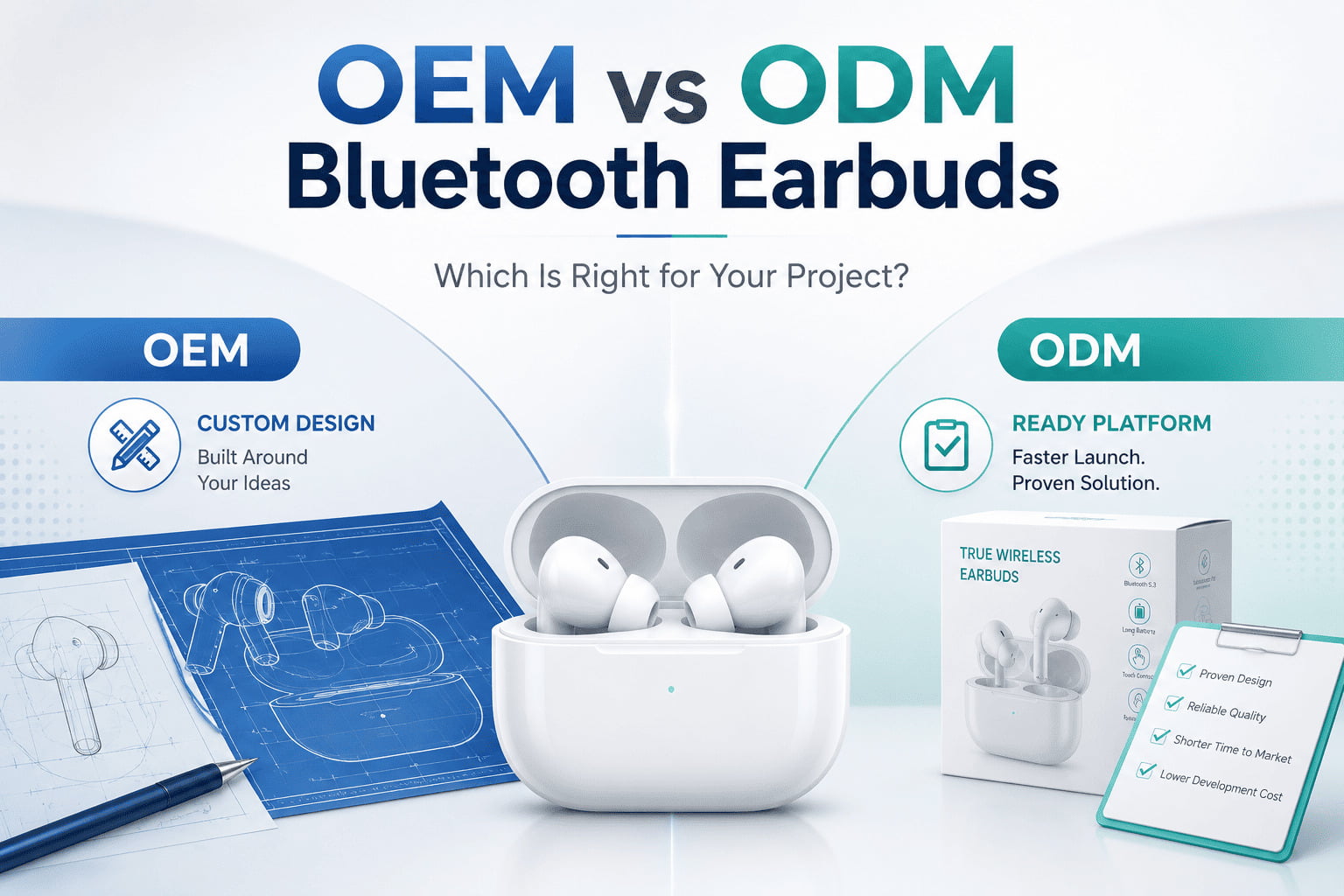
OEM vs ODM Bluetooth Earbuds: Which Is Right for Your Project?
Confused about OEM versus ODM for your next Bluetooth earbud launch? A wrong decision risks budget overruns and missed market opportunities. Let me guide you to the choice that aligns with your specific business goals.
Choosing between OEM and ODM for Bluetooth earbuds depends on your project's stage, budget, launch timeline, differentiation goals, and risk tolerance. OEM offers deep customization for unique designs, while ODM provides faster market entry and lower development risks using established platforms.
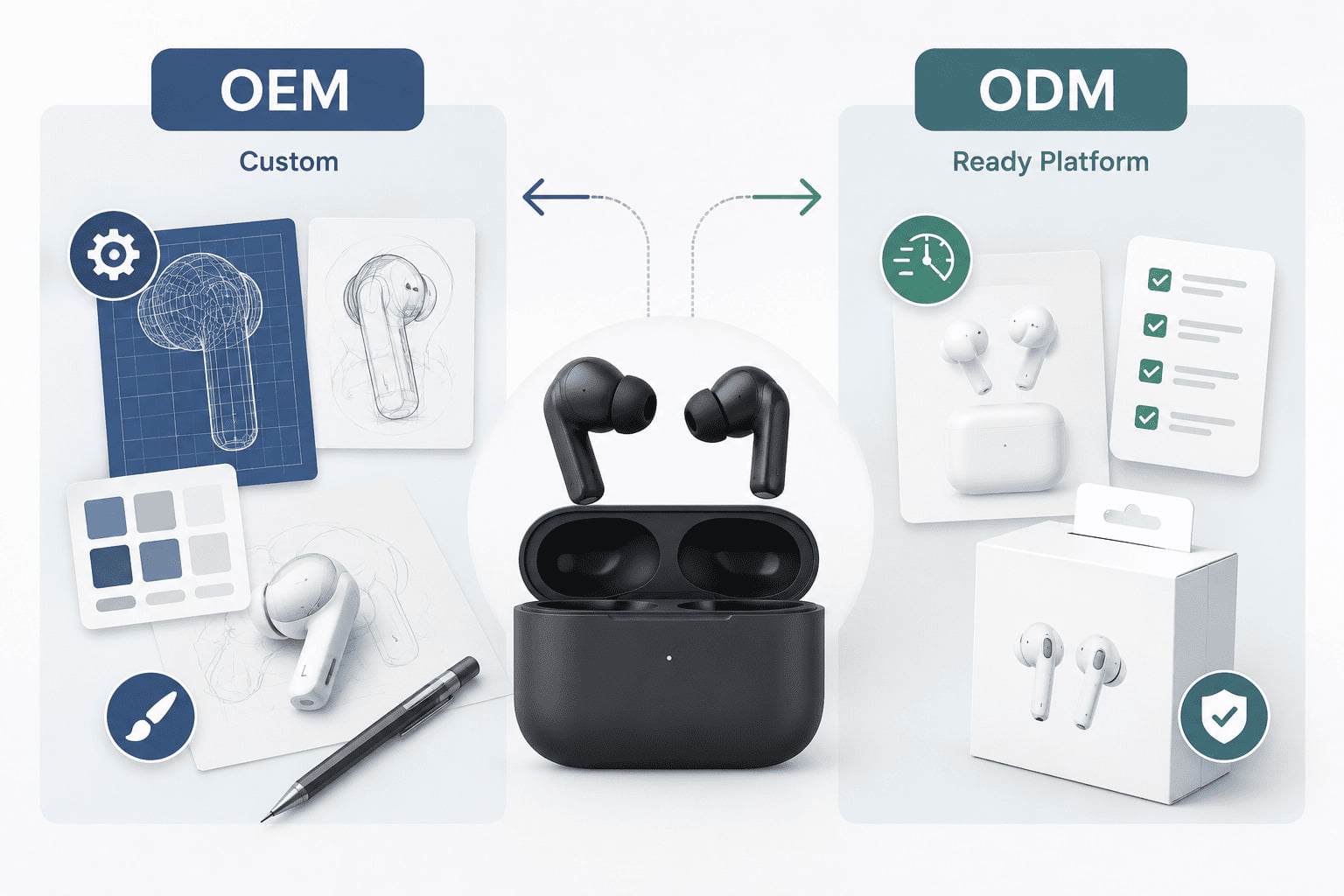
I have worked with many brand owners and procurement managers who face this exact question. It is rarely just about understanding terms. It is about making a practical choice for your specific project. Let me share how I help my clients make this important decision.
Are You Avoiding Unnecessary Delays and Costs?
Worry about project delays or unexpected development costs? Picking the wrong manufacturing model can create these headaches. I can help you minimize these risks from the start.
Avoiding unnecessary delays and costs in Bluetooth earbud development requires choosing the right manufacturing model. This means aligning your project's specific needs—like timeline and budget—with either the established efficiencies of ODM or the tailored innovation of OEM.

When clients first come to me, they often use "OEM" and "ODM" interchangeably, or they assume OEM is always the "better" or "more customized" route. I always tell them to reframe their thinking. The real question is not what these acronyms mean. It is about managing risk and achieving their goals. I have seen projects where a client insisted on OEM, only to realize months in that an ODM base with thoughtful modifications would have met their needs faster and for less cost. This happens because OEM starts from a fresh concept1. This means more unknowns. You need to develop new molds, conduct more extensive testing, and refine the design through several iterations. Each step can add time and expense2. With ODM, you start with a proven blueprint. The tooling exists. The basic structure is stable. This reduces the number of potential pitfalls. My experience shows that buyers who consider the project stage first—are they at concept stage or looking to launch quickly?—make better decisions. This framework helps us think about the risks associated with each path.
| Feature | OEM (Original Equipment Manufacturing) | ODM (Original Design Manufacturing) |
|---|---|---|
| Starting Point | From your design concept | From our existing product design |
| Tooling | New molds often required | Existing molds used |
| Development Time | Longer, due to design, prototyping, and tooling | Shorter, faster time to market |
| Development Cost | Higher, includes mold costs and extensive R&D | Lower, leverages existing R&D and tooling |
| Design Risk | Higher, new design needs more validation | Lower, proven design already tested |
| Production Stability | Requires more initial testing and adjustment | Generally more stable earlier, built on existing processes |
| Customization Depth | Full control over design, features, and materials | Customization within existing design framework (e.g., chipset, tuning) |
| Ideal For | Unique product vision, long-term planning, ample budget and time | Fast market entry, moderate differentiation, cost-efficiency |
Can ODM Deliver True Product Differentiation?
Do you think ODM means just slapping your logo on a generic product? Many clients do. I can tell you, ODM offers powerful ways to stand out.
ODM can deliver true product differentiation through strategic modifications. This includes customizing the chipset, acoustic tuning, speaker drivers, ANC solutions, and packaging. It allows brands to create unique user experiences on a proven hardware platform, avoiding full ground-up development risks.
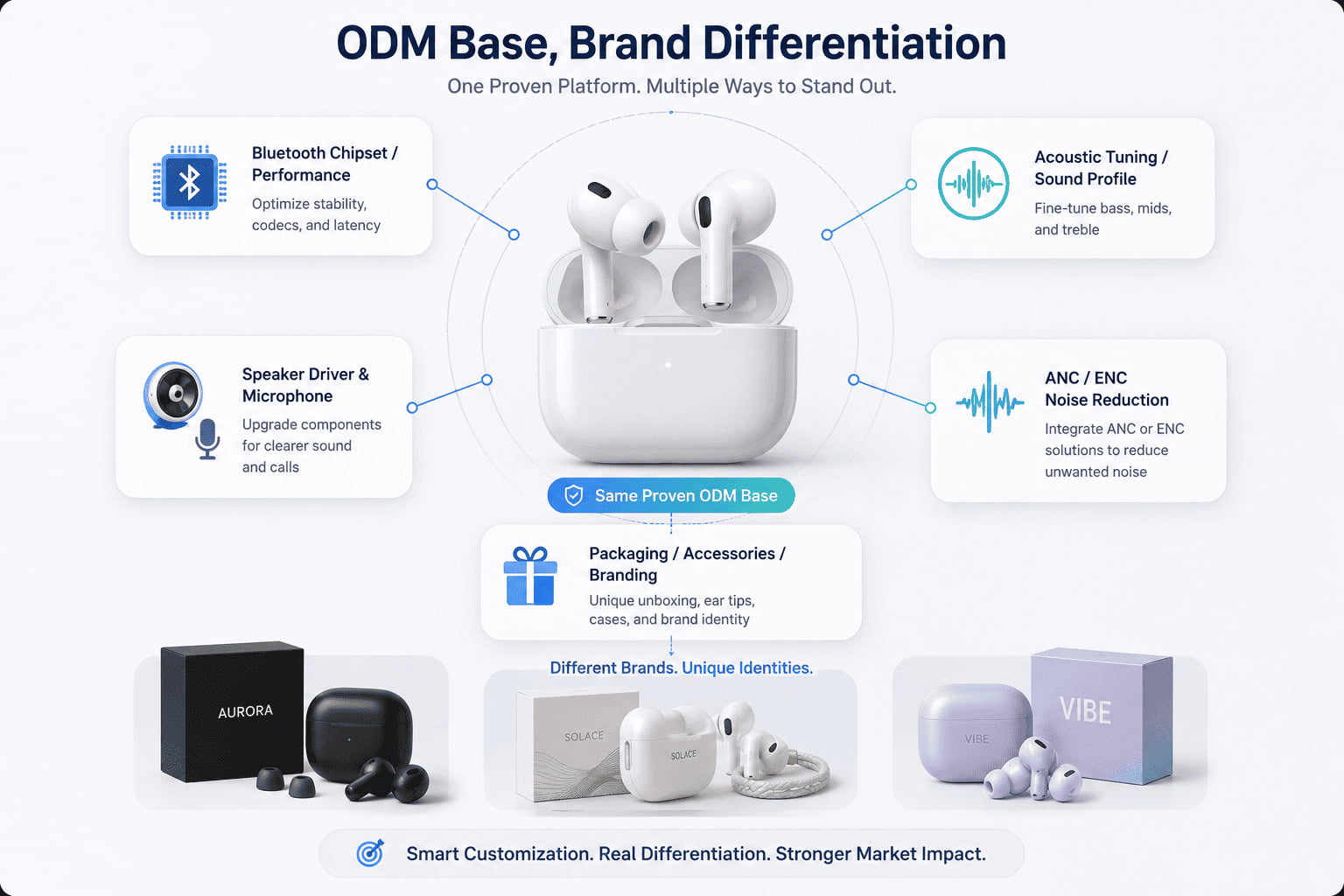
Many clients initially think ODM means simply "white-labeling" or "logo printing." I always correct this idea. In my experience, a mature ODM earbud model provides a solid foundation. But it is far from a "one-size-fits-all" solution. You can achieve significant differentiation. For example, we often customize the Bluetooth chipset3. This impacts connection stability, audio codecs, and even specific low-latency gaming modes. We also tune the acoustics. This means adjusting the sound profile—the bass, mids, and treble—to match your brand's audio signature. Think of it like fine-tuning a car engine. The body is the same, but the performance feels unique. Another key area is the speaker driver and microphone. Upgrading these components directly impacts sound quality and call clarity. We can integrate different ANC (Active Noise Cancellation)4 or ENC (Environmental Noise Cancellation) solutions, offering varying levels of noise reduction. The packaging and accessories also play a huge role in perception. A unique unboxing experience, custom ear tips, or a distinctive charging case can make a product feel truly different, even if the core structure is an ODM base. I have seen brands successfully launch very competitive products using this approach. They leverage the proven engineering of an ODM model while injecting their unique identity. This allows them to focus their resources on marketing and sales, rather than reinventing the wheel in hardware development.
Is OEM Always the Path to Higher Quality?
Many people assume OEM automatically means superior quality. I have seen that this is not always true. Starting from scratch often brings its own challenges.
OEM is not automatically higher quality because it starts with a new design, requiring extensive testing and adjustments to achieve stability. This process often involves more sampling, refinement, and adaptation before mass production can guarantee consistent quality, potentially introducing more initial risks than a mature ODM platform.
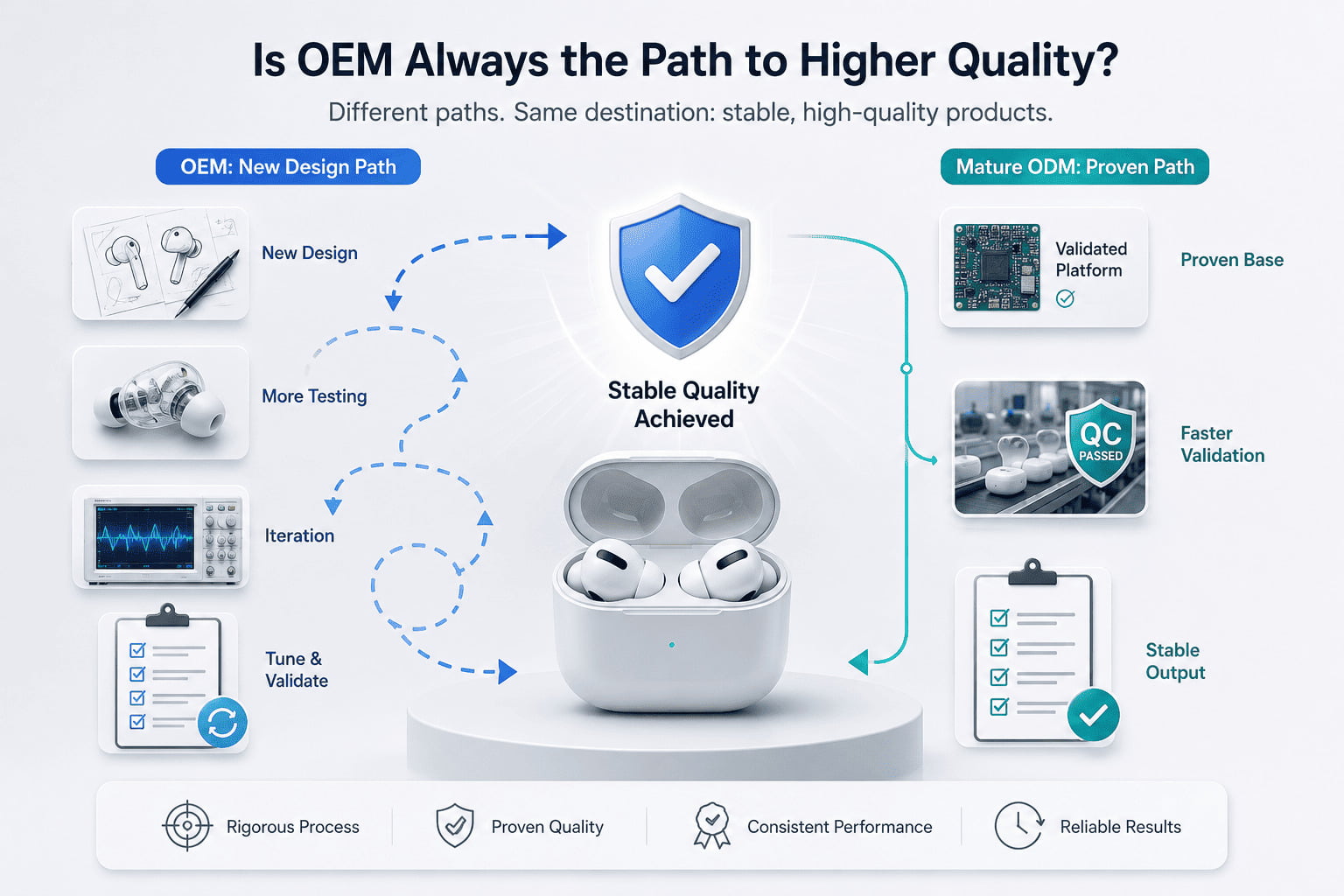
I often hear clients say they want an OEM product because they believe it will inherently be higher quality. From my perspective as a manufacturer, this is a misunderstanding. OEM means you are creating something brand new, from the ground up. This process is exciting, but it also carries more inherent risks in terms of production stability and consistent quality in the initial stages. When you begin an OEM project, you are entering a phase of extensive research and development. We design new molds, source new components, and integrate them in novel ways. Each new component and each new structural design needs rigorous testing. This includes multiple rounds of prototyping, acoustic testing, battery performance checks, connectivity stability tests, and drop tests5. It is a detailed and often iterative process. My team and I work closely with clients, sending samples, gathering feedback, and making adjustments. Sometimes, a beautiful industrial design proves challenging to manufacture efficiently or consistently. It takes time to iron out these details. A mature ODM model, on the other hand, has already gone through much of this. The design is proven, the components are optimized for that specific structure, and the production line has already perfected the assembly process. This often means that a mature ODM product can achieve stable, high-quality production faster than a brand-new OEM design. OEM can absolutely lead to a superior, unique product, but it requires patience, a robust testing plan, and a willingness to iterate to reach that high level of consistent quality.
| Aspect | OEM Project Path | Mature ODM Project Path |
|---|---|---|
| Initial Design | New concept, unique structure | Existing, proven structure |
| Testing Intensity | High: multiple prototypes, extensive validation of new elements | Moderate: focuses on modified components, re-validation of tuning |
| Sampling Rounds | More: to refine design, fix structural issues, optimize performance | Fewer: primarily for confirming customizations and final tuning |
| Production Ramp-up | Slower: requires perfecting new assembly processes, QA checks | Faster: leverages established production lines and QC procedures |
| Quality Stability | Builds up over time, after initial adjustments and optimizations | Generally stable from the start, known performance parameters |
| Risk of Iteration | Higher: unforeseen challenges with new designs or component integration | Lower: challenges mostly limited to new customizations |
| Time to Stable Output | Longer, often involving initial smaller runs for fine-tuning | Shorter, as manufacturing processes are already optimized and tested |
How Do You Choose Between OEM and ODM for Your Next Project?
Are you struggling to decide between OEM and ODM? It is a common challenge. I will give you a practical framework to make your choice clear.
To choose between OEM and ODM, evaluate your project's goals. Opt for ODM if you need a faster launch, lower development risk, and differentiation on a proven platform. Choose OEM when you have a clear, unique design vision, sufficient budget, a longer timeline, and are focused on long-term product planning.
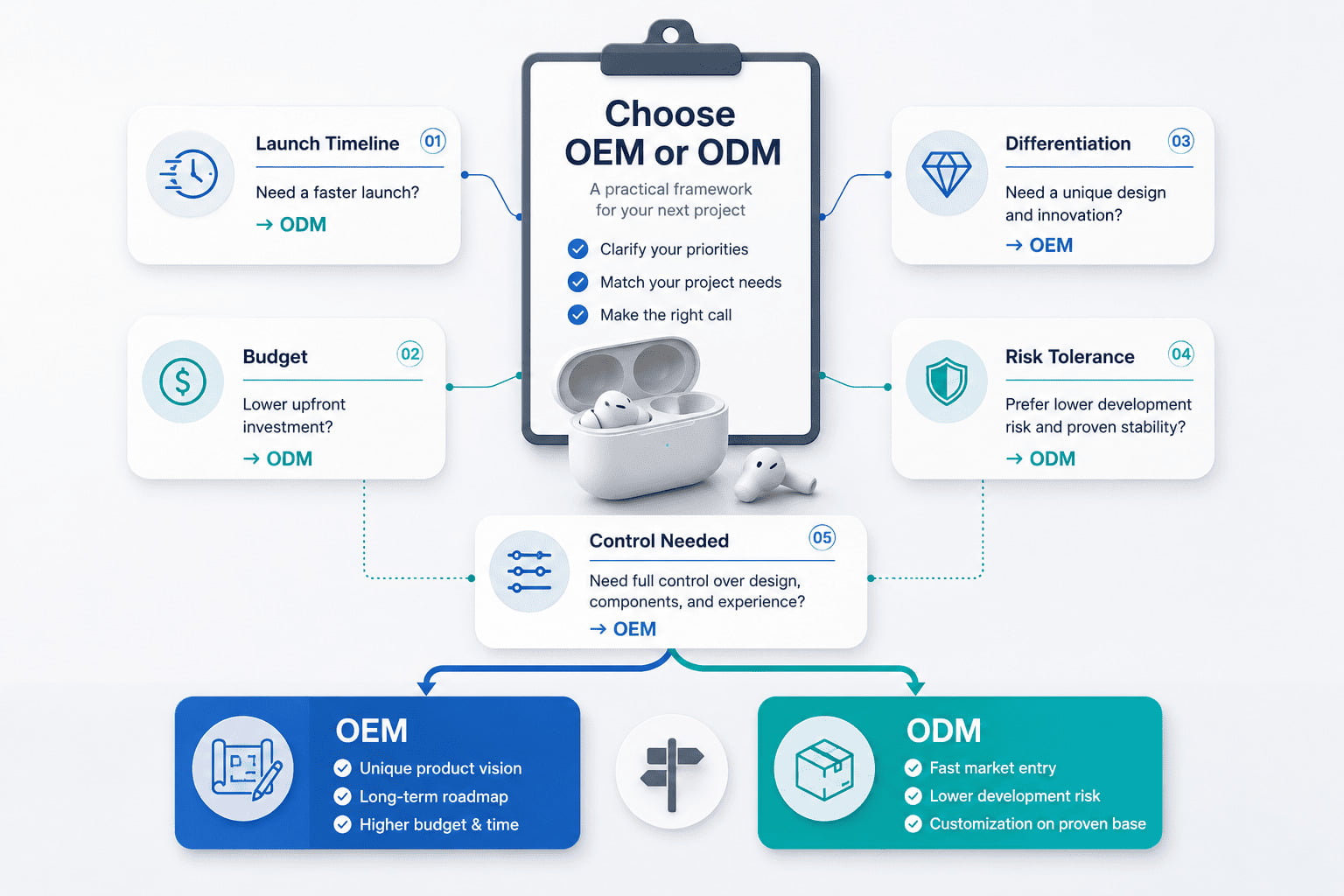
When clients ask me for a definitive answer, I always say there is no single "best" choice. The right answer depends entirely on their specific business needs. I guide them through a series of questions. First, what is your launch timeline? If you need to hit the market in three to six months6, ODM is usually the way to go. The existing molds and validated designs significantly cut down development time. If you have nine months to a year, or even longer7, OEM becomes a viable option. Second, what is your budget for R&D and tooling? OEM requires a substantial investment in new molds8 and extensive engineering. ODM leverages existing investments, reducing your upfront costs. Third, how unique does your product truly need to be? If your core need is a product that performs well, looks good with your branding, and has specific features like good ANC, ODM offers plenty of customization options. We can tune the sound, select specific chipsets, and refine the user experience within an established design. However, if your vision is for a truly groundbreaking industrial design or a fundamentally new user interaction, then OEM is necessary. I often find that some buyers initially request OEM because they want "the best," but after reviewing their budget and timeline, they realize ODM with smart customization fits their actual needs much better. Conversely, some clients know they need a long-term flagship product with a distinctive design; for them, OEM is the only path, and they are prepared for the journey.
| Decision Factor | Choose ODM If... | Choose OEM If... |
|---|---|---|
| Project Stage | Need a product based on a mature, proven platform | Have a clear conceptual design or a truly novel idea |
| Launch Timeline | Aim for fast market entry (e.g., 3-6 months) | Have a longer development window (e.g., 9-12+ months) |
| Development Budget | Prioritize lower upfront R&D and tooling costs | Have a substantial budget for new mold creation and engineering |
| Differentiation Need | Focus on feature set, acoustic tuning, branding, and packaging | Require a unique industrial design, form factor, or core innovation |
| Tolerance for Risk | Prefer lower development risk, proven production stability | Are prepared for higher initial development risks and iterations |
| Control Desired | Need control over components, firmware, and aesthetics | Demand full control over every aspect of design and engineering |
| Long-Term Planning | Seeking to expand product lines quickly with proven models | Developing a flagship product or a new proprietary technology |
Conclusion
Choosing between OEM and ODM is a strategic decision for your Bluetooth earbud project. I help you align your timeline, budget, and differentiation needs with the right manufacturing model. This ensures a successful launch.
"Original equipment manufacturer - Wikipedia", https://en.wikipedia.org/wiki/Original_equipment_manufacturer. This definition aligns with standard manufacturing terminology where OEM refers to production based on the buyer's specifications and design, distinguishing it from ODM's use of the manufacturer's existing designs. Evidence role: definition; source type: encyclopedia. Supports: the defining characteristic that OEM involves manufacturing products from a client's original design concept. ↩
"Navigating new product development: Uncovering factors and ...", https://pmc.ncbi.nlm.nih.gov/articles/PMC10788447/. Product development research confirms that iterative design processes, new tooling creation, and validation testing are primary drivers of extended timelines and higher costs in custom manufacturing projects. Evidence role: general_support; source type: research. Supports: the relationship between product development stages (tooling, prototyping, testing) and increased time and cost in manufacturing. Scope note: while supporting the general principle, specific cost and time impacts vary significantly by product category and complexity ↩
"Bluetooth", https://en.wikipedia.org/wiki/Bluetooth. Technical documentation from semiconductor manufacturers and wireless technology resources explains that Bluetooth chipsets integrate the radio, baseband processor, and protocol stack, directly determining supported audio codecs, connection stability, latency characteristics, and power consumption profiles. Evidence role: mechanism; source type: education. Supports: how Bluetooth chipsets determine connectivity features, audio codec support, and power efficiency in wireless audio devices. ↩
"Noise-cancelling headphones - Wikipedia", https://en.wikipedia.org/wiki/Noise-cancelling_headphones. Active noise cancellation operates on the principle of destructive interference, using microphones to detect ambient sound and generating inverse sound waves through speakers to cancel the unwanted noise, a technique documented in acoustics literature since the mid-20th century. Evidence role: mechanism; source type: encyclopedia. Supports: the technical principle by which active noise cancellation reduces unwanted ambient sounds. ↩
"General Use Products: Certification and Testing | CPSC.gov", https://www.cpsc.gov/Business--Manufacturing/Testing-Certification/General-Use-Products-Certification-and-Testing. Industry standards organizations and quality assurance frameworks document that consumer electronics development typically requires multi-dimensional testing including functional performance, durability, safety, and regulatory compliance validation across development stages. Evidence role: general_support; source type: institution. Supports: the types of testing typically required in consumer electronics development to ensure product quality and safety. Scope note: while these testing categories are standard practice, specific test protocols and requirements vary by product type, target market, and applicable regulations ↩
"What is OEM vs ODM Contract Manufacturing? - Komaspec", https://www.komaspec.com/about-us/blog/what-is-oem-vs-odm-manufacturing/. Manufacturing industry analyses indicate that ODM approaches typically reduce time-to-market compared to ground-up development by leveraging existing designs, tooling, and validated production processes, though specific timelines depend on customization scope and production readiness. Evidence role: general_support; source type: other. Supports: the relative speed advantage of ODM manufacturing for bringing products to market. Scope note: the cited 3-6 month timeframe represents an optimistic scenario and actual timelines vary based on customization complexity, component availability, and production capacity ↩
"New product development - Wikipedia", https://en.wikipedia.org/wiki/New_product_development. Product development literature indicates that custom hardware development involving new industrial design, tooling creation, and validation typically requires 9-18 months from concept to production readiness, reflecting the time needed for design iterations, prototyping, testing, and manufacturing process optimization. Evidence role: general_support; source type: other. Supports: the extended timeline typically required for custom OEM product development. Scope note: actual timelines vary significantly based on product complexity, team experience, component availability, and the degree of innovation involved ↩
"How to Estimate Injection Molding Cost? - Formlabs", https://formlabs.com/blog/injection-molding-cost/. Manufacturing engineering resources document that injection mold tooling costs can range from thousands to hundreds of thousands of dollars depending on complexity, size, and precision requirements, representing a significant upfront capital investment in new product development. Evidence role: statistic; source type: education. Supports: the substantial cost associated with creating new molds and tooling in manufacturing. ↩