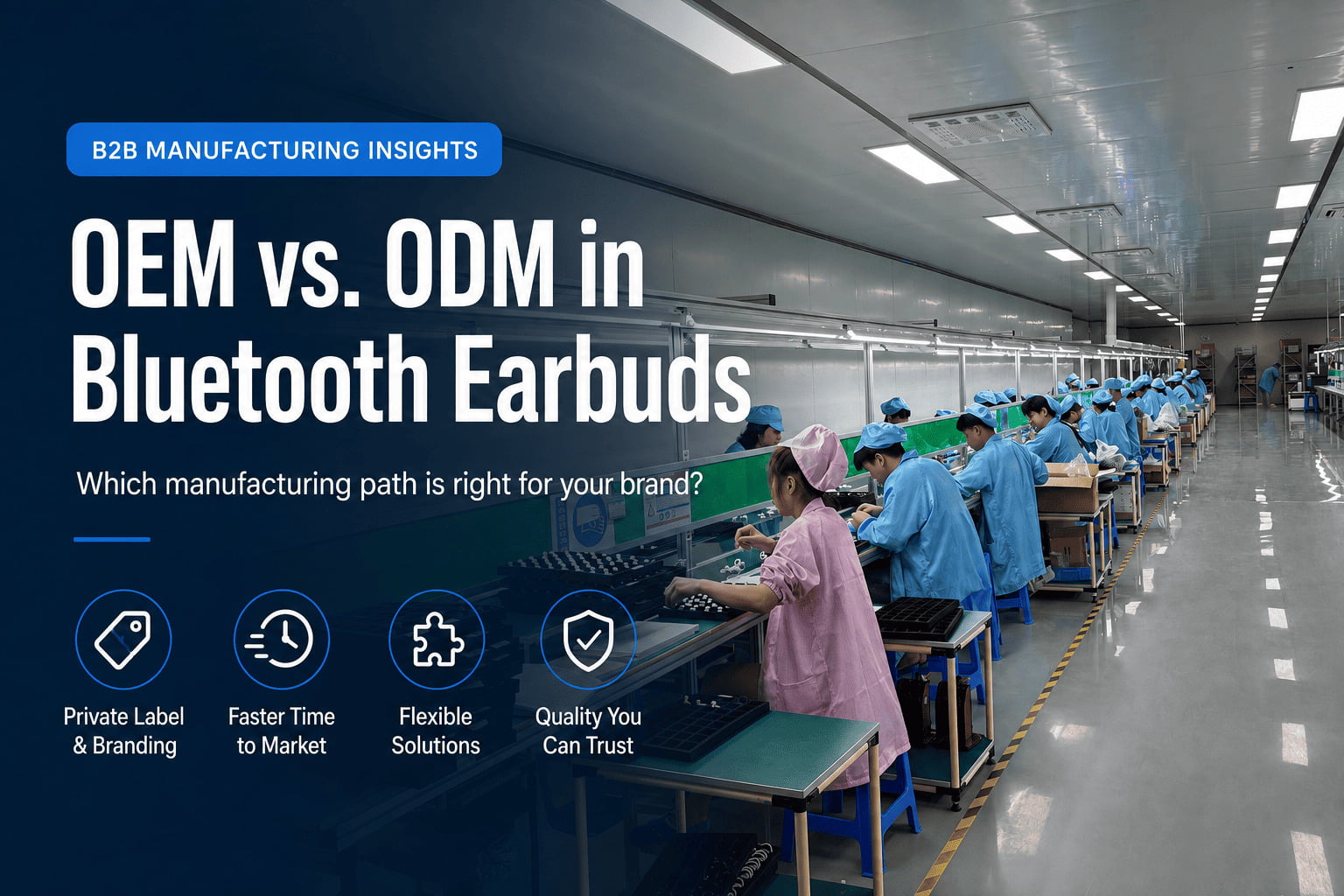
OEM vs. ODM in Bluetooth Earbuds: Which Manufacturing Path Is Right for You?
Navigating the world of Bluetooth earbud manufacturing can be complex, especially when faced with the choice between OEM and ODM. Many buyers struggle with understanding the practical differences, often leading to wasted time, budget overruns, and misaligned expectations. I’ve seen firsthand how crucial it is to match your order volume and customization depth to the correct manufacturing approach to ensure a successful product launch.
Choosing between OEM (Original Equipment Manufacturer) and ODM (Original Design Manufacturer) for Bluetooth earbuds fundamentally depends on your desired customization depth and order volume. OEM typically involves applying your branding to an existing product with minimal changes, suitable for smaller batches and surface-level modifications. ODM, conversely, allows for significant design and functional alterations, often requiring new molds and a higher minimum order quantity (MOQ) to distribute development costs effectively.
Understanding these distinctions is more than just knowing definitions; it's about making an informed strategic decision that impacts your project's feasibility, cost, and timeline. Let’s dive deeper into how your specific needs dictate the best path forward.
What Exactly Defines OEM for Bluetooth Earbuds, and When Should You Consider It?
The concept of OEM for Bluetooth earbuds might seem straightforward, but many buyers mistakenly think superficial changes qualify as something more. Have you ever considered that even seemingly minor branding adjustments could still fall under the OEM umbrella, yet some simple technical tweaks might push you towards a much more complex process?
OEM, or Original Equipment Manufacturing, for Bluetooth earbuds means you are essentially re-branding an existing product design1. This approach involves taking a ready-made earbud model from a manufacturer's catalog and applying your company’s logo, unique packaging, and possibly custom color options. It's the ideal choice when your primary goal is to bring a market-ready product under your brand quickly and cost-effectively, especially with lower order volumes.
Dive Deeper: The Nuances of OEM for Your Earbud Brand
When clients approach me asking about OEM, the first thing I explain is that we’re talking about customization that doesn't require fundamental changes to the product's core design or functionality. It's about personalizing an already developed and proven product. This is incredibly valuable for wholesalers, distributors, and brands looking to expand their product lines efficiently without investing heavily in research and development.
The biggest advantage of OEM is its efficiency. Since the product's internal components, circuit boards, and main housing design are already finalized, the manufacturing process is streamlined. This translates to faster production times and typically lower minimum order quantities (MOQs) compared to ODM. For buyers who need to react quickly to market trends or test new product categories without substantial upfront investment, OEM is an excellent starting point.
Here's a breakdown of typical OEM customization options for Bluetooth earbuds:
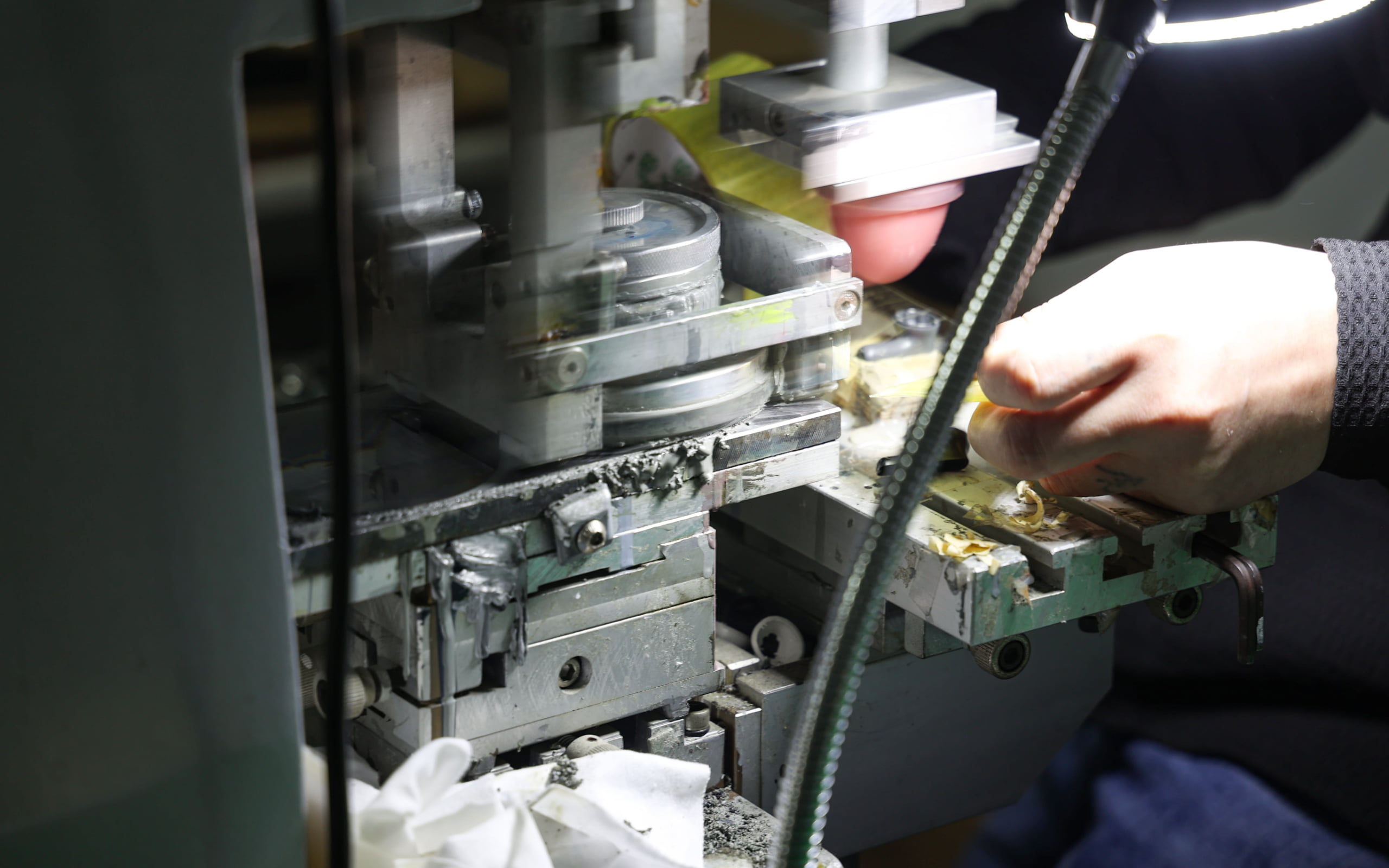
- Logo Application: This is the most common and often the simplest form of OEM customization. Your brand’s logo can be silk-screen printed, laser-engraved, or embossed directly onto the earbud charging case or the earbuds themselves. The method chosen often depends on the material of the product and the desired aesthetic.
- Packaging Design: Custom packaging is a powerful branding tool. With OEM, you can design your own retail box, user manual, and any internal trays or inserts. This allows you to control the unboxing experience, highlight key features, and communicate your brand's message effectively. This is a crucial element for market positioning, and I've seen customers gain significant market share just by optimizing their packaging presentation.
- Color Variations: While major structural changes are out, specific color requests for the earbud housing or charging case can sometimes be accommodated under OEM, provided the existing mold supports different material injections. However, this usually requires meeting a certain MOQ for that specific color run.
- Accessory Bundling: You can often choose which accessories to include, such as different sizes of ear tips, charging cables, or carrying pouches, to differentiate your product within the OEM framework.
- Software/Firmware Tweaks (Limited): In some cases, minor adjustments to existing firmware, such as custom boot-up sounds or LED light patterns, might be possible if the base hardware platform allows for it without extensive re-engineering. However, anything that requires new chipsets or significant coding often moves beyond the standard OEM scope.
What OEM is not is altering the fundamental internal architecture, acoustics, or physical shape of the earbuds. If you want to change the size of the speaker driver, add a new touch control gesture not supported by the existing chip2, or completely redesign the ergonomic fit, you're venturing into ODM territory. I’ve often seen clients mistakenly believe that asking for a slightly different button placement on an OEM model is a simple request, only to learn it would necessitate a new mold, dramatically increasing costs and MOQ. For those looking to distribute proven products quickly and cost-effectively, like many of our wholesalers and importers, OEM offers a dependable route to market. It's about leveraging existing quality and market readiness with your distinct brand identity.
When Does ODM Become the Right Choice for Your Bluetooth Earbud Project?
Many buyers associate ODM with complete product invention, but is that always the case, or can ODM be a more nuanced approach? What if you want significant modifications but don't need to start entirely from scratch?
ODM, or Original Design Manufacturing, for Bluetooth earbuds is the path to take when you require significant design modifications3, new features, or a unique form factor that isn't available off-the-shelf. It involves leveraging a manufacturer's existing intellectual property, designs, or development capabilities as a base, then extensively customizing or co-developing the product to meet your specific vision. This often requires new tooling (molds) and consequently demands higher MOQs to make the investment economically viable.
Dive Deeper: Unlocking Customization with ODM Solutions
The world of ODM is where true product differentiation can flourish. It's for brands that have a specific vision for their Bluetooth earbuds – perhaps a unique ergonomic shape, advanced noise-canceling capabilities, specialized sensor integration (like heart rate or sleep tracking), or a custom acoustic profile. While it's tempting to think of ODM as starting from zero, often it means building upon a manufacturer's robust existing platforms and experience, which significantly reduces development risk compared to pure ground-up R&D.
When I work with clients seeking ODM solutions, the conversation usually revolves around their specific market needs and how their ideal product deviates from standard offerings. This is where our experience in consumer markets, particularly in regions like Russia, helps inform what features truly resonate with end-users.
Key aspects of ODM customization include:
- Exterior Design Changes: This is a major differentiator. If you want a completely new earbud shape, charging case design, or a unique material finish that requires custom tooling, you are looking at ODM. This involves designing new molds, which are costly upfront investments that need to be amortized over the production volume.
- Functional Enhancements: Adding new features not present in existing models, such as advanced active noise cancellation (ANC), environmental noise cancellation (ENC)4, specific sensor integration (e.g., for health monitoring), or unique touch controls, typically falls under ODM. These changes often require modifications to the PCB (printed circuit board), firmware, or even the underlying chipsets5.
- Acoustic Tuning: Tailoring the sound signature to meet specific preferences – whether for a bass-heavy profile, crisp highs, or a balanced sound6 – can be part of an ODM project. This involves selecting specific drivers, optimizing their placement, and fine-tuning the acoustic chambers.
- Material Selection: While OEM might offer color changes, ODM allows for exploring different base materials for the earbud body or case, such as premium plastics, metals, or specialized coatings, each with its own tooling and manufacturing considerations.
- Connectivity and Chipset Upgrades: Integrating the latest Bluetooth versions, specific low-latency gaming modes, or unique multi-device pairing capabilities7 often requires ODM-level development to ensure hardware and software compatibility.
Crucially, the success of an ODM project hinges on clear communication and a well-defined product specification. Buyers should come prepared with detailed requirements, including design sketches, target specifications, and desired features. A capable ODM partner, like those we collaborate with, can translate these visions into manufacturable products, providing expertise on feasibility, material science, and regulatory compliance (CE, RoHS, FCC, etc.)8.
However, it’s vital to understand that ODM is an investment in both time and money. The initial mold development, R&D for new features, and certification processes require a longer lead time and a higher financial commitment upfront. This is why our standard MOQ for deep customization projects starts around 3,000 units – it ensures the significant investment in molds and development can be economically spread across the production run, resulting in a competitive unit price for our wholesale buyers. While the complexity is higher, the reward is a truly unique product that can create a strong brand identity and competitive edge in the market.
How Do Order Volume and Molding Costs Influence Your Decision for Bluetooth Earbuds?
It's common for buyers to approach me with a great idea for a customized Bluetooth earbud, only to be surprised by the Minimum Order Quantity (MOQ) requirements. Have you ever considered how the seemingly technical detail of "molding costs" directly dictates whether your desired customization is financially viable for your planned order volume?
The decision between OEM and ODM for Bluetooth earbuds is heavily influenced by your target order volume and the associated molding costs. If your customization requires new molds for unique shapes or structural changes, these significant one-time investments must be amortized over the production run. For this reason, deep ODM customization typically requires a higher MOQ (e.g., 3,000 units or more) to achieve an acceptable unit cost, whereas OEM, which uses existing molds, allows for much lower MOQs.
Dive Deeper: The Economics of Custom Earbud Manufacturing
This is where the rubber meets the road for many procurement managers and brand owners. I've often seen clients, especially those new to manufacturing, come with requests for highly specific aesthetic or structural changes for an order of, say, 500 units. They'll ask, "Can you do ODM for this?" My immediate counter-question is always, "What is your target order volume, and are you prepared for the associated molding investment?"
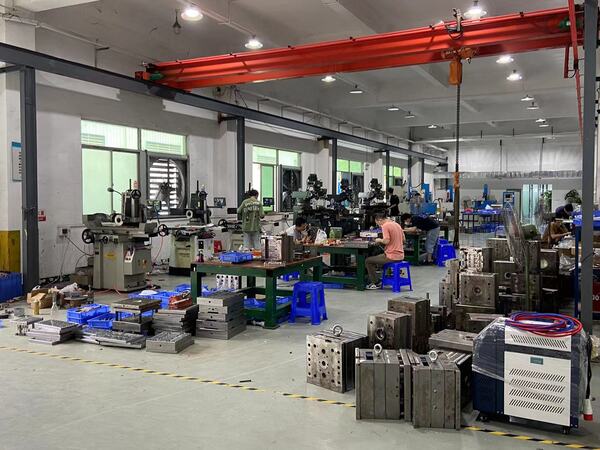
The core issue lies in the cost of developing new molds. For any significant change to the physical shape or internal structure of a Bluetooth earbud or its charging case, a new injection mold is required. These molds are precision-engineered tools, often made from steel, and can cost anywhere from a few thousand to tens of thousands of US dollars9, depending on their complexity, size, and the number of cavities (how many parts they can produce per cycle).
Understanding Mold Cost Amortization:
Imagine a scenario where a new earbud housing mold costs $10,000.
- Scenario A: Order of 500 units. The mold cost per unit is $10,000 / 500 = $20. This $20 is added to the base manufacturing cost of each earbud. If the base cost is $5, your unit price instantly jumps to $25 (excluding other costs like R&D, assembly, profit). This makes the product prohibitively expensive for most wholesale markets.
- Scenario B: Order of 3,000 units. The mold cost per unit is $10,000 / 3,000 = $3.33. Added to the $5 base cost, the unit price is now $8.33. This is a much more manageable and competitive price point for mid-range distribution.
- Scenario C: Order of 10,000 units. The mold cost per unit is $10,000 / 10,000 = $1. Add to the $5 base cost, unit price is $6. This is highly competitive.
This simple calculation illustrates why factories, including our partner resources, have minimum order quantities for ODM projects involving new molds. For Bluetooth earphones, a standard MOQ of 3,000 units is very common for projects requiring new molds. This MOQ ensures that the significant upfront investment in tooling can be spread thin enough across the volume to yield a competitive unit price that makes sense for wholesale distribution.
The "Existing ODM" Solution:
It's also important to note that not all ODM requires brand new molds from scratch. Sometimes, a manufacturer might have a portfolio of existing ODM designs that are slightly different from their standard OEM catalog. These designs might have had their mold costs amortized by previous larger clients, or they might be proprietary designs that the manufacturer is willing to modify slightly without creating a completely new mold. In these cases, you might achieve significant design customization for a lower MOQ than a truly bespoke mold project, but it will still typically be higher than basic OEM. This is where the concept of "leveraging existing ODM designs" becomes more economical than deep OEM customization (e.g., trying to modify a chip function on an OEM product, which could require unexpected R&D).
Impact on Project Feasibility:
For buyers, understanding this relationship between order volume and molding costs is paramount for project feasibility. If your market can only absorb 500-1000 units of a highly customized earbud, then a full ODM project with new molds will likely be too expensive per unit to be profitable. In such cases, a smart buyer would either:
- Re-evaluate their customization needs and opt for an OEM product with logo/packaging changes.
- Explore existing ODM solutions from a supplier that might offer a closer match to their desired design without requiring new mold investment.
- Reassess their sales forecasts and aim for a higher order volume to justify the ODM investment.
We pride ourselves on helping clients understand these economic realities. For serious wholesale buyers, our standard MOQ of 3,000 units for customized projects aligns directly with the cost realities of bringing quality, custom Bluetooth earphones to market competitively. It helps our clients avoid the trap of high unit costs due to insufficient order volume for their desired customization level.
Can Small Batches Really Achieve Deep Customization with Bluetooth Earbuds?
Many buyers dream of highly customized Bluetooth earbuds but are often unsure about the feasibility for smaller order quantities. Is it truly possible to get unique features and designs without committing to massive production runs, or are there hidden complexities that make small-batch deep customization a commercial challenge?
Achieving deep customization for Bluetooth earbuds, such as significant changes to internal components, chipset functions, or complex aesthetic redesigns, is generally not feasible for small order batches. These types of modifications require extensive R&D, engineering, and often new molds, incurring substantial upfront costs. For small batches, these costs cannot be adequately amortized, making the unit price prohibitively high. Minor aesthetic tweaks might even require new molds, further limiting small-batch deep customization.
Dive Deeper: The Unseen Costs of Advanced Customization
When clients inquire about making specific technical adjustments to Bluetooth earbuds – perhaps changing a chip's parameter, modifying the mainboard's functionality, or tweaking the acoustic profile in a unique way – there's often a misconception that these are "small tweaks." I've experienced situations where a buyer thinks, "Just change this one setting on the chip," not realizing that it translates into a complete re-engineering project for the factory.
These requests go far beyond simple assembly line adjustments. They delve into the realm of product development, which carries significant costs independent of production volume.
- Research and Development (R&D) Costs: Modifying chip functions or mainboard designs requires specialized engineers, software developers, and extensive testing. This R&D effort needs to be paid for, whether you order 100 units or 10,000 units. For small batches, this R&D cost gets added almost entirely to each unit, making them incredibly expensive.
- New Mold Development: Even seemingly minor aesthetic changes, such as slightly rounding an edge or repositioning an LED indicator by a few millimeters, can necessitate a completely new injection mold. As discussed earlier, these molds are costly and must be amortized over a large production run. A small batch simply cannot absorb these costs without inflating the unit price to an uncompetitive level.
- Component Sourcing and Minimums: If your deep customization requires a specific, non-standard component (e.g., a unique sensor, a different type of battery, or a specialized driver), suppliers for these components often have their own high MOQs. Factories cannot simply order a handful of custom parts for a small earbud batch; they need to procure in bulk, further complicating small-volume customization.
- Certification Re-testing: Any significant changes to the internal electronics or radio frequency components (which often happens with chip/mainboard modifications) typically require re-certification for standards like CE, FCC, and RoHS. These certifications are expensive and time-consuming, and their costs, like R&D and molds, cannot be effectively spread across small orders10.
I often tell clients that if their customization request requires engineering development, new tooling, or complex component sourcing, they should realistically assess their potential order volume. If it's below 3,000 units (our standard MOQ for such projects, though sometimes even higher for extremely complex designs), the per-unit cost for that level of customization will likely be unfeasible for their target market.
For example, a client once wanted to modify an existing earbud's touch control gesture to be entirely unique, thinking it was a simple software update. We had to explain that this involved firmware modification, potential hardware changes to the touch sensor, and extensive re-testing, making it an ODM project that required a substantial MOQ to justify the development. For small-batch buyers, focusing on high-quality OEM products with custom branding and packaging often yields a better return on investment than attempting deep, costly customizations that only become viable at much higher volumes. Our focus is to provide market-ready solutions that balance quality, cost, and customization realistically.
Frequently Asked Questions
What's the main difference between OEM and ODM in simple terms?
OEM means putting your brand on an existing product design from a factory. ODM means you work with a factory to create a new product based on their existing designs or your specific requirements, which often involves new molds and deeper customization.
Can I get a unique earbud shape with OEM?
No, usually not. OEM typically involves using the factory's existing product molds. To achieve a unique earbud shape, you would need to pursue an ODM approach, which requires new mold development and a higher minimum order quantity to be cost-effective.
What is the typical MOQ for custom Bluetooth earbuds requiring new molds?
For Bluetooth earbuds requiring new molds due to significant design or structural changes, the minimum order quantity (MOQ) typically starts from 3,000 units11. This volume helps to distribute the substantial upfront cost of mold development over a larger production run.
Is ODM always more expensive than OEM?
Per unit, initial ODM costs can be higher due to R&D and mold investments. However, if your order volume is sufficient to amortize these costs (e.g., 3,000+ units), the resulting unit price can be competitive, and the unique product differentiation offers long-term value that OEM cannot.
How do certifications fit into OEM vs. ODM for Bluetooth earbuds?
For OEM Bluetooth earbuds, the base product usually already has certifications (CE, FCC, RoHS). For ODM, especially with significant internal changes, re-certification for your specific customized product will likely be required, adding to the project's cost and timeline.
Conclusion
Choosing between OEM and ODM for your Bluetooth earbud project is a critical decision that hinges on your specific customization needs, desired product uniqueness, and most importantly, your order volume. Misjudging this choice can lead to significant financial setbacks and project delays. Remember that superficial branding is OEM, while fundamental design or functional changes that require new molds push you into the realm of ODM. Understanding the economic realities of mold amortization and R&D costs, particularly the higher MOQs needed for effective OEM vs. ODM Bluetooth earbuds customization, is paramount for success. For wholesale buyers aiming to build stable product lines with competitive pricing, carefully evaluating these factors will lead to a more efficient and profitable procurement process. We are committed to helping our clients make these informed decisions, ensuring a reliable supply chain and marketable products for their specific needs.
"Original equipment manufacturer", https://en.wikipedia.org/wiki/Original_equipment_manufacturer. OEM refers to a company that produces parts or equipment that may be marketed by another manufacturer, a business model common across electronics and consumer goods industries. Evidence role: definition; source type: encyclopedia. Supports: the standard definition of Original Equipment Manufacturing (OEM) in industrial contexts. ↩
"does driver size matter? : r/headphones - Reddit", https://www.reddit.com/r/headphones/comments/vvttlx/does_driver_size_matter/. Speaker driver specifications (size, type, impedance) directly affect audio quality and frequency response, while touch control functionality depends on both capacitive sensor hardware and chipset firmware support for gesture recognition algorithms. Evidence role: mechanism; source type: education. Supports: how hardware components like drivers and sensors determine functional capabilities in audio devices. ↩
"Original design manufacturer", https://en.wikipedia.org/wiki/Original_design_manufacturer. ODM describes manufacturers that design and produce products that are then rebranded by other companies for sale, typically involving more extensive design control than OEM arrangements. Evidence role: definition; source type: encyclopedia. Supports: the definition of Original Design Manufacturing (ODM) as a manufacturing model. ↩
"Active noise control - Wikipedia", https://en.wikipedia.org/wiki/Active_noise_control. Active Noise Cancellation (ANC) uses microphones and inverse sound waves to reduce ambient noise for the listener, while Environmental Noise Cancellation (ENC) typically focuses on reducing background noise during voice transmission for clearer calls. Evidence role: mechanism; source type: encyclopedia. Supports: the technical mechanisms behind active noise cancellation technologies. ↩
"CN202721804U - Bluetooth earphone circuit board", https://patents.google.com/patent/CN202721804U/en. Wireless earbuds integrate printed circuit boards containing the chipset (which handles Bluetooth connectivity, audio processing, and power management), firmware (software controlling device behavior), and various sensors and components that together determine device functionality. Evidence role: mechanism; source type: education. Supports: the functional roles of printed circuit boards, firmware, and chipsets in wireless audio devices. ↩
"Which Sound Signature is right for you?", https://arachne.audio/blogs/in-sono/sound-signature-guide?srsltid=AfmBOoryi4iDN0OvQSPchO6FCLYoNUVR4Jw0-j8BrEcZKQoyujYMH1K4. Sound signature customization in earbuds involves selecting appropriate driver types and sizes, tuning acoustic chambers, adjusting frequency response curves, and optimizing damping materials to emphasize or attenuate specific frequency ranges. Evidence role: mechanism; source type: education. Supports: the technical methods for achieving different sound signatures in audio devices. ↩
"Complete Bluetooth Versions Guide: From 1.0 to 6.3", https://www.mokosmart.com/guide-on-different-bluetooth-versions/. The Bluetooth Special Interest Group defines specifications for each Bluetooth version, with newer versions introducing capabilities such as improved data rates, extended range, multi-stream audio, and lower latency modes designed for specific applications like gaming and audio. Evidence role: general_support; source type: institution. Supports: the technical specifications and feature evolution across Bluetooth versions. Scope note: Specific features depend on implementation and chipset support; version number alone does not guarantee all theoretical capabilities are available in a given device. ↩
"Wireless Devices and Health Concerns", https://www.fcc.gov/consumers/guides/wireless-devices-and-health-concerns. Wireless consumer electronics typically require CE marking for European markets, FCC certification for the United States, and RoHS compliance for restriction of hazardous substances, ensuring product safety and electromagnetic compatibility. Evidence role: general_support; source type: government. Supports: regulatory compliance requirements for wireless consumer electronics in major markets. ↩
"How to Estimate Injection Molding Cost?", https://formlabs.com/blog/injection-molding-cost/. Injection mold costs vary widely based on complexity, material, and size, with simple molds starting around several thousand dollars and complex multi-cavity steel molds reaching into the tens of thousands. Evidence role: statistic; source type: education. Supports: typical cost ranges for injection mold tooling in manufacturing. Scope note: Costs vary significantly by region, complexity, and manufacturer; cited ranges represent general industry estimates rather than fixed pricing. ↩
"Small Batch Manufacturers and Third Party Testing | CPSC.gov", https://www.cpsc.gov/Business--Manufacturing/Small-Business-Resources/Small-Batch-Manufacturers-and-Third-Party-. Regulatory certifications for wireless consumer electronics involve testing fees, documentation, and compliance verification, with costs typically ranging from several thousand to tens of thousands of dollars depending on product complexity and number of markets, and timelines extending from several weeks to several months. Evidence role: general_support; source type: research. Supports: the typical costs and timelines associated with regulatory certifications for consumer electronics. Scope note: Costs vary significantly based on product type, testing lab, number of certifications required, and whether design changes necessitate retesting. ↩
"What is a typical Minimum Order Quantity (MOQ) for low ...", https://orbit.mit.edu/knowledgebase/articles/360039224292-what-is-a-typical-minimum-order-quantity-moq-for-low-volume-manufacturing-in-china. MOQs for products requiring custom tooling are determined by the need to amortize fixed costs like mold development across production volume; typical ranges for consumer electronics with custom molds often start in the thousands of units to achieve economically viable per-unit costs. Evidence role: general_support; source type: research. Supports: the economic rationale for minimum order quantities in custom injection-molded consumer electronics. Scope note: Specific MOQ figures vary by manufacturer, product complexity, and market segment; 3,000 units represents a common threshold rather than a universal standard. ↩