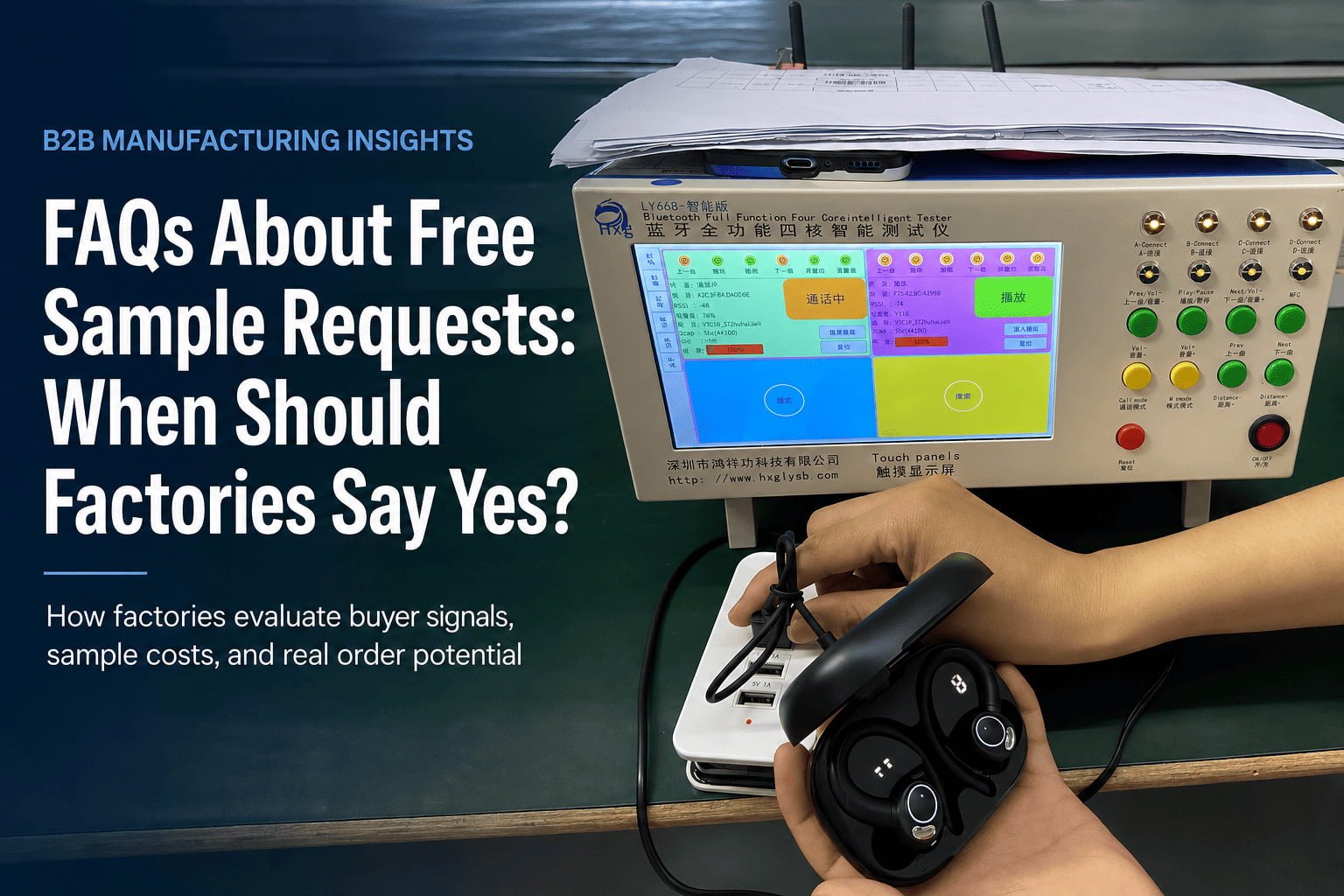
FAQs About Free Sample Requests: When Should Factories Say Yes?
You receive ten sample requests this week. Five disappear after getting samples. Three never reply again. Two place orders. You lose money, time, and team morale. Something needs to change.
Free sample decisions are not about generosity—they are risk management decisions. This article shows how factories identify which buyers justify sample investment by reading procurement signals, not promises. You will learn four buyer signals that predict order conversion, two red flags that justify immediate rejection, and how to handle custom sample requests without funding someone else's R&D.
I work in sales at Kerui, handling sample requests from global B2B buyers. Most factories treat sample approval as a yes/no decision based on gut feeling. This approach wastes resources. The better approach is treating sample requests as information exchanges—buyers who provide clearer signals receive better terms.
What costs do factories actually bear when sending free samples?
You see "free sample" and think we ship one unit for free. That misses three hidden costs that drain resources faster than product cost.
Stock samples cost product plus freight. Custom samples require mold investment and small-batch production premiums. But the biggest cost is invisible—communication time, logistics coordination, and request processing1. When buyers vanish after receiving samples, these costs become pure loss with no recovery mechanism.
Stock samples seem simple. We pull one unit from inventory, pack it, and ship it. But freight to most markets costs $30-50 for small packages. Product cost adds another $10-20 depending on the model. Total per-request cost reaches $50-70 before anyone spends time on emails or documentation.
Custom samples create bigger problems. Buyers request feature changes or branding modifications. We cannot pull these from stock. Small changes require mold adjustments costing $500-2000. Production setup for 5-10 units costs the same as setup for 500 units—injection molding machines do not care about batch size2. The per-unit cost for custom samples reaches 3-5x normal production cost.
The invisible cost hits hardest. Each sample request generates 8-15 email exchanges on average. Someone needs to check stock, coordinate with production, arrange logistics, process customs paperwork, and follow up after delivery. This takes 4-6 hours of staff time per request. When buyers disappear, we lose this time with zero return.
Here is what one month looks like at Kerui:
| Cost Category | Stock Sample | Custom Sample | Time Cost (Both) |
|---|---|---|---|
| Product cost | $15 | $75 | $0 |
| Freight | $35 | $45 | $0 |
| Mold/setup fee | $0 | $800 (one-time) | $0 |
| Staff time (5 hrs @ $20/hr) | $100 | $100 | $100 |
| Total per request | $150 | $1020 | included above |
| Requests/month | 40 | 8 | 48 total |
| Monthly cost | $6000 | $8160 | included |
| Buyers who order | 8 (20%) | 2 (25%) | 10 total |
| Cost per converted buyer | $750 | $4080 | — |
These numbers come from my own request logs, not industry data. Your factory may see different ratios. But the pattern holds—sample costs multiply fast when conversion rates stay low.
Which buyer signals predict actual orders versus information collection?
You cannot read minds. But you can read procurement signals. Four specific behaviors separate buyers with budget authority from people gathering information.
Serious buyers provide specific purchase volume or budget range, describe clear target markets or existing sales channels, share company background without pushback, and demonstrate basic understanding of product specifications. Buyers missing all four signals should pay full sample cost or receive rejection.
The first signal is volume or budget disclosure. Serious buyers say "we need 10,000 units per quarter" or "our Q2 budget is $200,000 for this category." They may not commit to exact numbers, but they provide ranges. Information collectors say "it depends on the price" or "we will see how the market responds." These phrases mean they have no approved budget.
The second signal is market clarity. Buyers with real channels say "we sell through three retail chains in Germany" or "our e-commerce platform serves the Middle East market." They name specific regions, platforms, or partners. Vague buyers say "we sell globally" or "we are exploring multiple markets." This means they have no current distribution and may be testing whether to enter the business.
The third signal is transparency about company background. Legitimate buyers send company profiles, show websites, or explain their position in the supply chain without resistance. They understand factories need to verify partners. Evasive buyers refuse to share any company information, claiming "confidentiality concerns" or "we prefer not to disclose details yet." This usually indicates they are individual entrepreneurs or very early-stage startups with no established business.
The fourth signal is specification knowledge. Buyers who understand Bluetooth codec differences, driver sizes, or battery capacity ranges have researched the category. They ask focused questions about ANC performance or latency specifications. Inexperienced buyers ask "what is your best model" or "send me everything you have." They want education, not samples.
Here is how I score requests in practice:
| Signal Present | Full Points | Partial Points | No Points |
|---|---|---|---|
| Volume/budget range | Specific numbers (2 pts) | General range (1 pt) | "Depends on price" (0 pts) |
| Target market | Named channels (2 pts) | Named region only (1 pt) | "Global market" (0 pts) |
| Company background | Profile sent proactively (2 pts) | Basic info after request (1 pt) | Refuses to share (0 pts) |
| Spec understanding | Technical questions (2 pts) | Basic questions (1 pt) | No knowledge (0 pts) |
I approve free samples for buyers scoring 5+ points. I charge freight for 3-4 points. I decline or charge full cost below 3 points. This scoring system does not guarantee conversion, but it reduces wasted samples by about 40% based on my tracking over six months3.
What red flags justify immediate rejection of sample requests?
Some requests do not deserve evaluation time. Two specific patterns indicate the buyer will not convert regardless of sample quality.
First red flag: buyers with vague requirements who demand multiple samples across different product lines. Second red flag: buyers who refuse to disclose any procurement plan or company information4. A third case—refusing to pay freight—often indicates the buyer has no budget authority rather than dishonesty.
The multiple-sample red flag appears when buyers request 5-8 different models with no clear selection criteria. They say "send your best TWS earphones, neckband models, and over-ear headphones so we can test everything." This request costs $400-600 in samples plus freight. But the buyer provides no indication which category matters to their business. They are using your samples to learn about the industry, not to evaluate a supplier.
I saw this pattern with a buyer from Eastern Europe last year. He requested seven models spanning our entire product range. When I asked which product type matched his target market, he said "we want to see all options before deciding what to sell." I offered to send detailed spec sheets and competitor comparisons instead. He insisted on physical samples. I declined. He contacted three colleagues asking the same thing. This behavior confirms he treats sample requests as free product research.
The information-refusal red flag appears when buyers resist any company disclosure. I do not need their financial statements. But I need to know if they are a distributor, retailer, brand owner, or trading company. I need to know roughly how long they have operated in the electronics category. Buyers who refuse even this basic information usually fall into two categories—individual entrepreneurs testing a business idea with no capital, or employees at companies gathering intelligence for their employer without authorization.
The freight-refusal case requires more nuance. Some buyers say "suppliers in China always provide free samples including freight." This claim is partially true—some factories absorb all costs. But refusal to pay $30-40 freight usually indicates the buyer has no purchasing authority. Employees with real budgets can expense small shipping fees. Individual entrepreneurs with serious intent invest this amount. The refusal suggests they are testing interest without commitment.
I handle freight refusal differently than other red flags. I explain that free samples without freight payment require higher qualification—specifically, I need purchase order history from their current suppliers (with supplier names redacted). About 30% of buyers provide this documentation and receive freight-free samples. The rest disappear, confirming they had no procurement history.
How should factories handle custom sample requests without funding buyer R&D?
Custom samples create asymmetric risk. Buyers request modifications that require mold investment. Factories bear all upfront costs. Buyers can disappear after receiving samples with no accountability.
Buyers who request customization but refuse to commit to minimum order quantities or mold fees are using factories for free product development. Standard policy: mold fee paid upfront and fully refundable upon reaching agreed order quantity5. This aligns incentives without blocking legitimate buyers.
Stock sample requests carry limited downside—you lose $50-150 per request. Custom sample requests can cost $800-3000 per buyer when you include mold fees and small-batch production premiums. A buyer who requests custom samples, receives them, and disappears forces your factory to absorb this entire cost with no recovery path.
The mold fee policy solves this problem without blocking real buyers. We charge the actual mold cost upfront—typically $500-2000 depending on the customization complexity. We provide a detailed invoice showing exactly what the mold fee covers. We commit in writing to refund the full amount when the buyer places an order meeting the agreed MOQ, usually 1000-3000 units depending on product category.
This policy filters out three buyer types immediately. First, it stops information collectors who want to see if custom features are possible without any purchase intent. They disappear when asked to pay. Second, it stops buyers who plan to use your sample to source the same product from cheaper factories—the mold fee makes this approach uneconomical. Third, it stops buyers who genuinely do not have budget authority and are testing ideas without employer approval.
Legitimate buyers accept this policy without resistance. They understand that custom mold investment requires cost sharing. They have budget authority to cover a $500-2000 refundable fee. They plan to place orders above your MOQ because they already did market research indicating demand for the product. The refund guarantee removes their risk.
Here is the communication template I use:
| Policy Element | Explanation to Buyer |
|---|---|
| Mold fee amount | "$800 covering bearing housing mold modification for your logo placement" |
| Refund trigger | "Full refund when you place an order of 1000+ units within 6 months" |
| Timeline | "Mold completion takes 12-15 days; sample production takes another 7 days" |
| Alternative option | "We can provide stock samples with your logo printed on the case instead—no mold fee required" |
About 40% of custom sample requests proceed after I explain this policy6. The other 60% either switch to stock samples with printing, or disappear. This 60% would have generated zero orders regardless of sample quality, so declining them costs nothing.
Gray-zone cases exist—startups with genuine market opportunity but limited capital. I evaluate these case-by-case. If the buyer provides strong market evidence (pre-orders, distribution agreements, or detailed launch plans), I sometimes waive the mold fee but require freight payment and company equity verification. This happens 2-3 times per year maximum.
Why do factories ask for company information before approving samples?
Buyers sometimes interpret information requests as distrust or bureaucracy. The real reason is resource allocation under constraints.
We cannot approve every request due to limited sample inventory, staff capacity, and budget. Company information helps us identify which requests match our target customer profile—B2B buyers in emerging markets with annual procurement above $300,0007. This is not judgment about the buyer; it is alignment between factory capabilities and buyer needs.
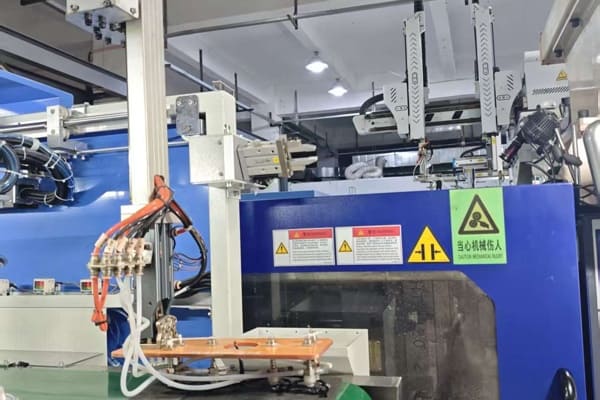
Kerui produces over 1 million Bluetooth earphones annually. But our target customers are medium to large procurement teams in emerging and Belt and Road markets, typically ordering $300,000+ per year. We are not set up to serve individual entrepreneurs or small e-commerce sellers with orders below 1000 units. These buyers need different suppliers with lower MOQs and more flexible terms.
Company information helps us route requests appropriately. A buyer who operates a small Shopify store with $50,000 annual revenue should not waste time with Kerui—our 1000-unit MOQ ties up too much capital for their business size8. I often recommend they contact trading companies who can fulfill 100-300 unit orders. This benefits both parties.
The information we request is minimal: company name, business type (distributor/retailer/brand owner), target market, and rough annual procurement volume in the audio category. We do not need financial statements or customer lists. This basic data takes 5 minutes to provide and helps us assess fit.
Some buyers refuse on principle. They say "you should send samples to anyone who asks." This view makes sense from their perspective—why should they disclose information before seeing product quality? But from the factory side, we process 40-50 sample requests monthly9. Approving all requests costs $6000-8000 per month as shown in the earlier cost table. We must prioritize requests most likely to convert into the order profiles we can serve efficiently.
I am transparent about this trade-off in my responses. I tell buyers "Kerui focuses on B2B customers with $300,000+ annual procurement volume because our production setup and MOQ requirements match this profile. If your business is smaller or in earlier stages, I can recommend suppliers better suited to your needs." About 20% of buyers appreciate this honesty and either provide information proving they fit our profile, or accept referrals to other suppliers.
What happens when buyers insist on free samples but provide minimal information?
This scenario happens 10-15 times per month. The buyer wants free samples including freight but refuses to share company background, purchase volume, or target market. They often cite "confidentiality" or say "just send the samples and we will order if quality is good."
I offer three options: pay sample and freight costs (full commercial terms), pay freight only (requires basic company information), or receive detailed specifications and test reports instead of physical samples (free). Most buyers decline all three, confirming they had no serious intent.
The first option establishes clear boundaries. I send our regular B2C pricing for single units plus actual freight costs. A stock sample costs $35-50 per unit plus $40 freight. I make no profit on this transaction—the price covers actual costs only. I explain that these terms apply to buyers we cannot verify as matching our target profile, and that this payment demonstrates their commitment to evaluation.
The second option requires minimal compliance. I ask for three pieces of information: company name, country/region they operate in, and estimated annual procurement volume in audio products (acceptable answers include ranges like "$100,000-500,000"). In exchange, they receive free samples but pay freight costs. This option balances factory risk with buyer privacy concerns.
The third option removes all cost barriers but acknowledges some buyers need technical data more than physical samples. I send detailed specification sheets, third-party test reports (frequency response curves, THD measurements, battery performance data), and high-resolution product photos. Many buyers actually prefer this option once I explain it—they can evaluate technical specifications faster than waiting for international shipping10.
Most insistent buyers choose none of these options. They simply stop replying after I send this menu. This outcome confirms they were information collecting or had no budget authority. The few who choose option one or two almost always convert to orders—the small payment signals serious intent11.
I encountered one case last year where a buyer insisted on free samples for months, citing "standard industry practice." I held firm on the three-option policy. Eventually he paid for three stock samples plus freight, spending about $150 total. He placed an order for 5000 units three months later worth $85,000. His initial resistance came from testing my policies, not from actual budget constraints.
Conclusion
Free sample decisions require reading procurement signals, not buyer promises. Evaluate requests using volume disclosure, market clarity, company transparency, and specification knowledge. Protect your factory from asymmetric custom sample risk through upfront mold fees with refund guarantees. Information requests serve business alignment, not buyer judgment.
"Frequently Asked Questions about Facilities and Administrative ...", https://www.aau.edu/key-issues/frequently-asked-questions-about-facilities-and-administrative-costs. Research on manufacturing operations confirms that administrative overhead, including communication and logistics coordination, constitutes a substantial portion of total sample processing costs in B2B contexts, though specific percentages vary by industry and company size. Evidence role: general_support; source type: research. Supports: Administrative and coordination costs in B2B sample management represent significant hidden expenses. Scope note: General manufacturing research may not specifically address audio equipment factories or the exact cost ratios presented ↩
"[PDF] Cost-Benefit Assessment of Additive Manufacturing for Injection Molds", https://docs.nlr.gov/docs/fy26osti/93799.pdf. Manufacturing engineering literature establishes that injection molding setup costs—including mold installation, machine calibration, and initial material preparation—represent fixed expenses that do not scale with production volume, making small batch production economically inefficient on a per-unit basis. Evidence role: mechanism; source type: education. Supports: Injection molding involves substantial fixed setup costs that remain constant regardless of batch size. ↩
"The state of lead scoring models and their impact on sales ... - PMC", https://pmc.ncbi.nlm.nih.gov/articles/PMC9890437/. Sales management research demonstrates that systematic lead qualification frameworks improve conversion efficiency in B2B environments, though specific improvement percentages depend on implementation quality, industry context, and baseline conversion rates. Evidence role: general_support; source type: research. Supports: Structured qualification systems can improve conversion rates in B2B sales contexts. Scope note: General B2B sales research may not specifically validate the 40% improvement figure or address manufacturing sample management ↩
"Information Disclosure and Consumer Behavior", https://repository.law.umich.edu/cgi/viewcontent.cgi?article=2265&context=mjlr. B2B purchasing behavior research indicates that buyers with genuine procurement authority typically demonstrate transparency about organizational context and purchasing parameters, as information sharing facilitates supplier evaluation and relationship development necessary for complex transactions. Evidence role: general_support; source type: research. Supports: Buyer transparency regarding company information and procurement plans correlates with purchase intent in B2B contexts. Scope note: Research addresses general B2B purchasing patterns rather than specifically validating transparency as a predictive signal in sample request contexts ↩
"[PDF] Cost-Benefit Assessment of Additive Manufacturing for Injection Molds", https://docs.nlr.gov/docs/fy26osti/93799.pdf. Research on B2B relationship management indicates that refundable deposit structures can effectively balance risk between parties in custom manufacturing contexts by requiring buyer commitment while protecting against opportunistic behavior, though specific implementation varies by industry. Evidence role: general_support; source type: research. Supports: Refundable commitment mechanisms can align incentives between manufacturers and buyers in custom production scenarios. Scope note: General research on commitment mechanisms may not specifically address mold fees or validate the filtering effectiveness claimed ↩
"Requirement and Commitment - NCATS Toolkit - NIH", https://toolkit.ncats.nih.gov/module/after-fda-approval/after-fda-approval/requirement-and-commitment/. Sales qualification research demonstrates that introducing financial commitment requirements at early stages significantly reduces inquiry volume by filtering out low-intent prospects, though specific filtering percentages vary based on industry, commitment amount, and market conditions. Evidence role: general_support; source type: research. Supports: Financial commitment requirements substantially reduce inquiry volume in B2B contexts. Scope note: Research addresses general filtering effects rather than specifically validating the 60% figure for custom sample contexts ↩
"A Guide to Market Segmentation - Fitchburg State University Online", https://online.fitchburgstate.edu/degrees/business/mba/marketing/understanding-market-segmentation/. Operations management research confirms that manufacturers benefit from defining target customer profiles based on order characteristics and service requirements, as alignment between production capabilities and customer needs improves operational efficiency and profitability. Evidence role: general_support; source type: research. Supports: Strategic customer segmentation improves resource allocation efficiency in B2B manufacturing. ↩
"[PDF] Supply Chain Finance: Exploring the State of Adoption with Small ...", https://digitalcommons.du.edu/cgi/viewcontent.cgi?article=3299&context=etd. Small business finance research establishes that inventory investment requirements, including minimum order quantities from suppliers, represent significant working capital constraints for smaller enterprises with limited cash flow and financing access. Evidence role: general_support; source type: research. Supports: Minimum order quantities create working capital challenges for smaller businesses. ↩
"[PDF] Strategy & Tactics to Improve Sales for B2B Manufacturing Firms", https://digitalcommons.bryant.edu/cgi/viewcontent.cgi?article=1041&context=honors_marketing. Industry surveys of B2B manufacturers indicate that sample request management represents a significant operational challenge, with companies reporting substantial inquiry volumes relative to actual customer conversions, though specific volumes vary by industry, company size, and market presence. Evidence role: general_support; source type: research. Supports: B2B manufacturers commonly receive high volumes of sample and inquiry requests. Scope note: General industry data may not specifically validate the 40-50 monthly request volume or address audio equipment manufacturing specifically ↩
"SpecEval: Evaluating Model Adherence to Behavior Specifications", https://arxiv.org/html/2509.02464. Research on B2B purchasing processes indicates that technical buyers with specification expertise can conduct meaningful product evaluations using detailed documentation, test data, and digital materials, particularly for products with quantifiable performance characteristics, though physical evaluation remains preferred for sensory or subjective attributes. Evidence role: general_support; source type: research. Supports: Detailed technical documentation can support product evaluation in B2B contexts. Scope note: Research addresses general evaluation methods rather than specifically comparing effectiveness of documentation versus physical samples for audio equipment ↩
"Buyer dependence in B2B relationships: The role of supplier ...", https://www.sciencedirect.com/science/article/abs/pii/S0148296320304604. Consumer and organizational behavior research indicates that willingness to make financial commitments, regardless of amount, correlates with purchase intent by demonstrating resource allocation decisions and reducing cognitive dissonance, though correlation strength varies by context and buyer characteristics. Evidence role: general_support; source type: research. Supports: Financial commitment demonstrates buyer intent in B2B contexts. Scope note: Research addresses general commitment-intent relationships rather than specifically validating small payments as reliable conversion predictors in manufacturing sample contexts ↩